English (GB)
5
4. Applications
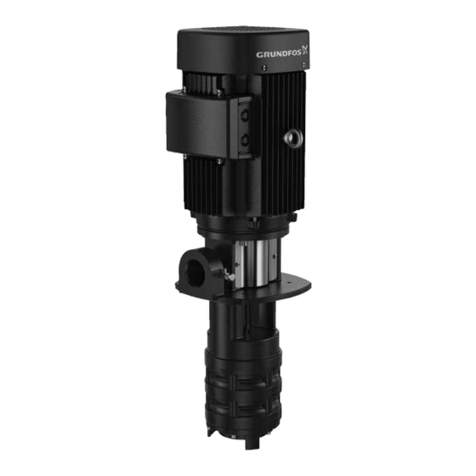
Grundfos multistage in-line centrifugal pumps, type CRT, are
designed for a wide range of applications. Reliable and cost-
efficient, CRT pumps handle a variety of liquids from seawater to
sodium hypochlorite.
Pumped liquids
Thin, clean, non-flammable, non-combustible or non-explosive
liquids, not containing solid particles or fibres. The liquid must not
attack the pump materials chemically.
When pumping liquids with a density and/or viscosity higher than
that of water, use motors with correspondingly higher outputs, if
required.
5. Technical data
5.1 Ambient temperature and altitude
If the ambient temperature exceeds the above temperature
values or the pump is installed at an altitude exceeding the above
altitude values, the motor must not be fully loaded due to the risk
of overheating. Overheating may result from excessive ambient
temperatures or the low density and consequently low cooling
effect of the air.
In such cases, it may be necessary to use a motor with a higher
rated output.
Fig. 2 Motor output depends on temperature/altitude
Example
Figure 2shows that the load of an IE3 motor at an ambient
temperature of 70 °C must not be loaded more than 89 % of the
rated output. If the pump is installed 4,750 metres above sea
level, the motor must not be loaded more than 89 % of the rated
output.
In cases where both the maximum temperature and the maximum
altitude are exceeded, the derating factors must be multiplied
(0.89 x 0.89 = 0.79).
5.2 Maximum operating pressure and temperature
limits
Maximum operating pressure: 25 bar.
Temperature range: -20 °C to +120 °C.
See also Appendix on page 136, which shows the relationship
between liquid temperature and maximum operating pressure.
CRT pumps are not suitable for the pumping of liquids hotter than
+120 °C for long periods.
5.3 Minimum inlet pressure
Fig. 3 Schematic view of open system with a CRT pump
The maximum suction lift "H" in metres head can be calculated as
follows:
H = pbx 10.2 - NPSH - Hf- Hv- Hs
pb= Barometric pressure in bar.
(Barometric pressure can be set to 1 bar.)
In closed systems, pbindicates the system pressure in
bar.
NPSH = Net Positive Suction Head in metres head (to be read
from the NPSH curve on page 139 at the highest flow the
pump will be delivering).
Hf= Friction loss in suction pipe in metres head at the
highest flow the pump will be delivering.
Hv= Vapour pressure in metres head.
See Fig. E on page 138.
tm= Liquid temperature.
Hs= Safety margin = minimum 0.5 metres head.
If the calculated "H" is positive, the pump can operate at a suction
lift of maximum "H" metres head.
If the calculated "H" is negative, an inlet pressure of minimum "H"
metres head is required. There must be a pressure equal to the
calculated "H" during operation.
Example
pb= 1 bar.
Pump type: CRT 16, 50 Hz.
Flow rate: 16 m3/h.
NPSH (from page 139): 1.5 metres head.
Hf= 3.0 metres head.
Liquid temperature: +60 °C.
Hv (from Fig. E on page 138): 2.1 metres head.
H = pbx 10.2 - NPSH - Hf- Hv- Hs [metres head].
H = 1 x 10.2 - 1.5 - 3.0 - 2.1 - 0.5 = 3.1 metres head.
This means that the pump can operate at a suction lift of
maximum 3.1 metres head.
Pressure calculated in bar: 3.1 x 0.0981 = 0.304 bar.
Pressure calculated in kPa: 3.1 x 9.81 = 30.4 kPa.
Motor
power
[kW]
Motor
make
Motor
efficiency
class
Maximum
ambient
temperature
[°C]
Maximum
altitude
above sea
level
[m]
0.37 - 0.55 Grundfos
MG - +40 1000
0.75 - 18.5 Grundfos
MG IE3 +60 3500
TM05 2003 4213
Pos. Motor power
[kW] Motor make
1 0.37 - 0.55 MG
20.75-22 MG
For motor bearing maintenance at ambient
temperatures above 40 °C, see section
9. Maintenance.
20 25 30 35 40 45 50 55 60 65 70 75 80
50
60
70
80
90
100
[%]
P2
2
1
t [°C]
1000 2250 3500 4750 m
The maximum operating pressure and liquid
temperature ranges apply to the pump only.
Liquid temperatures above +120 °C may involve the
risk of periodic noise from the shaft seal and reduce
shaft seal life.
TM02 0118 3800