1/2" Connector
Junction
Box
2 Wire
Connectors
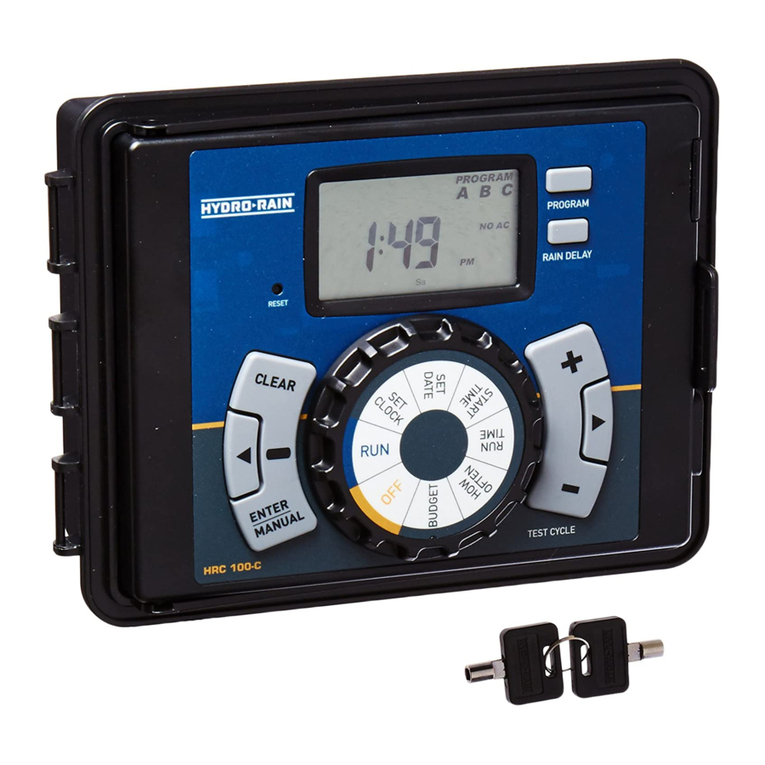
RUN
OFF
SET
CLOCK
SET
DATE
BUDGET
HOW
OFTEN
RUN
TIME
START
TIME
TEST CYCLE
5. Activate Battery
One Lithium CR2032 battery (included) is required to retain the
program in memory during power loss. Annual replacement is
recommended.
Remove the plastic strip to activate the pre-installed battery.
(See page 12 for battery replacement)
Note: The battery alone will not operate the valves in your
sprinkler system. The sprinkler controller has a built-in
transformer that must be connected to an AC voltage source.
Section 3: Programming with
Easy-Set Logic™
A note about multiple programs
The HRC 100 C provides the flexibility of using 3 independent
programs (A,B,C). A program is where you store all of your
sprinkler settings. It consists of a group of stations set to
specific start times and run times. Multiple programs allow
you to run different valves on different days with different run
times. While many applications only require one program (A),
using multiple programs can be useful for drip areas, newly
planted lawn, or rotary sprinkler stations. Using programs
to group stations with similar water needs will maximize
irrigation efficiency.
Primary programming can be accomplished in just a few basic
steps.
Primary Programming
Press the [RESET] to clear any previous factory programming
1. Set Clock
• Turn dial to [SET CLOCK]
8
4. Connect Electrical Power
Indoor Locations – Insert the power cord into an 110V electrical
outlet.
Outdoor Locations – If a covered Ground Fault Interrupter (GFI)
outlet is available, insert the power cord into the 110 volt outlet.
If no outlet is available, the controller must have the wiring
permanently installed (*see figure 5)
•Turn off the AC power at the AC circuit breaker and
apply an appropriate safety lockout. Verify that the power
has been turned off to the installation site using an AC
voltmeter set for the correct measurement range.
•Use power feed wire of 14 gauge (AWG) minimum with
a temperature rating of 155 degrees Fahrenheit (68
degrees Celsius) or higher.
•Install the conduit and associated fittings. Connect the
AC electrical power wiring to the source by following all
the right codes and local standards.
•Connect the junction box to the controller using a ½”
nipple (Junction box and nipple not included). [See Figure
5] Connect the source power conduit to the entrance of
the junction box, following all the appropriate codes.
•Take the cord (running from the controller to the junction
box) from the junction box and cut it to length. Remove the
outer insulation (from cord) to expose the three wires.
•Connect the source wires to the wires extending from the
sprinkler controller.
•For USA: Take care to follow the correct color code.
Connect the, Black for Live, and White for Neutral, there
is no ground connection required.
•Make sure all connections are made with code-approved
insulated connectors.
•Be sure to place a weatherproof gasket and lid on the
junction box.
•Turn AC power on at the AC circuit breaker.
Important: Installation Using Permanant Wiring
The sprinkler controller has a built-in transformer that must be
connected to an AC line voltage source. Check the back of the
sprinkler controller box for power requirements. Local building
and electrical codes usually require that an approved electrical
conduit and electrical fittings be used to connect exterior wall-
mounted equipment to AC power. Please check local codes. Any
permanent connection should be made by a licensed electrical
contractor in accordance with the requirements of the National
Electrical Code and other state and local codes.
This sprinkler controller has two holes at the bottom for wire
access. Use a 1/2” Nipple to connect the sprinkler controller to
a standard electrical junction box. Both connector and junction
box must be UL Listed or equivalent or comply with IEC or EN
standards or equivalent.
The wire can be buried in the ground; however, for more
protection wires should be pulled through electrical conduit and
buried underground. Be careful to avoid burying the wires in
locations where they could be damaged by digging or trenching in
the future.
Caution: Do not connect the sprinkler controller to one phase of
a three phase power system used by a pump or other electrical
equipment.
Note: For outdoor applications it is recommended that a qualified
electrician complete the installation in accordance with electrical
codes and regulations. When used outdoors this sprinkler
controller is intended for use with a Ground Fault Interrupter
(GFI) protected circuit.
Figure 5: Using a Junction Box