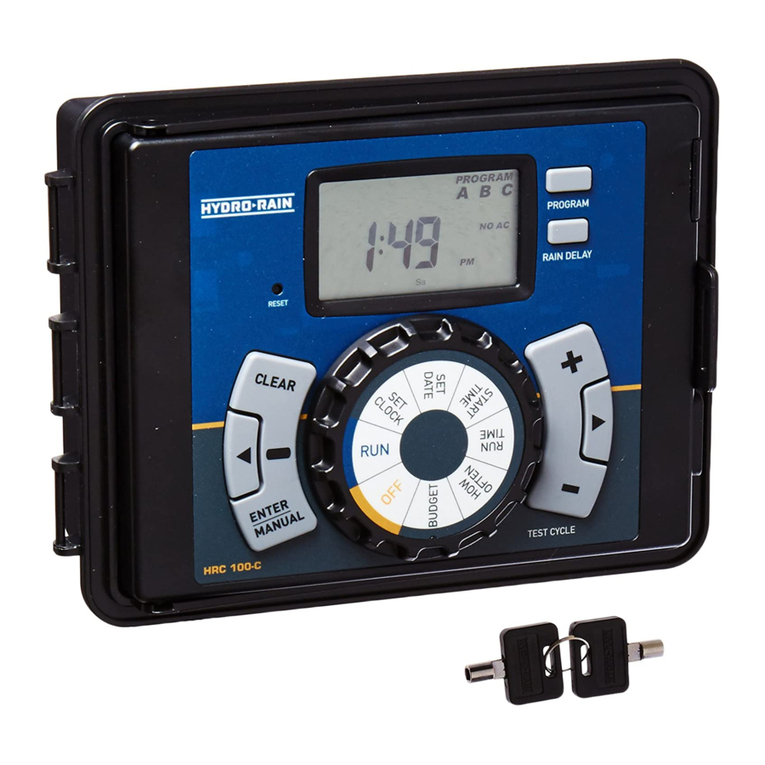
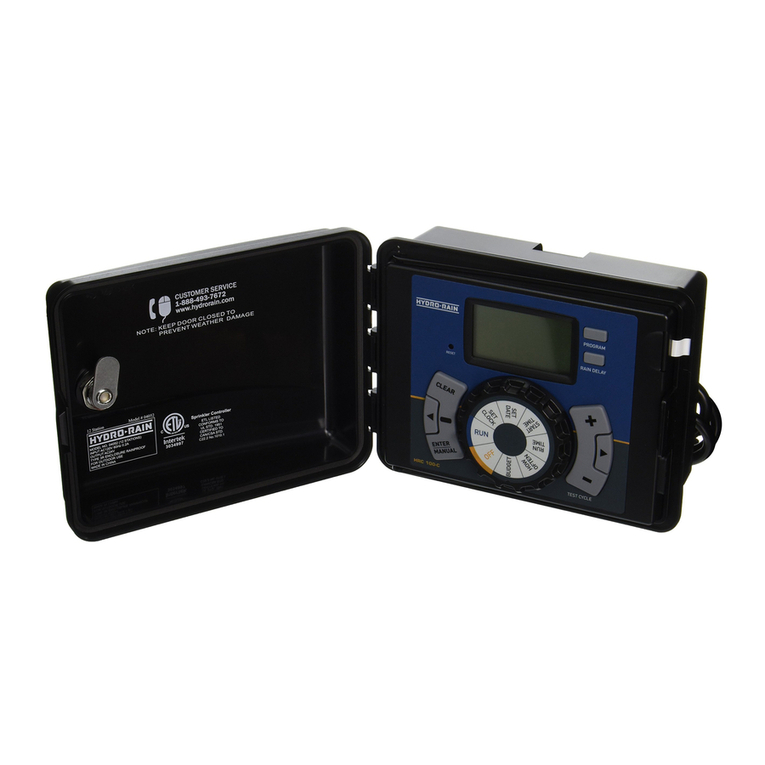
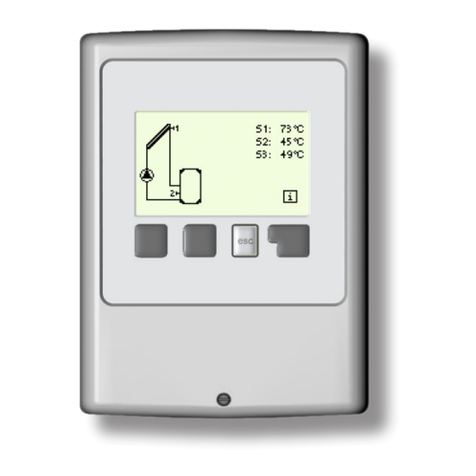
The HRM-12 is a 12 station controller that can be set to water from twenty-four
times a day to once every two weeks. The watering time can be adjusted from
approximately 5 to 60 minutes for each circuit. The controller is in a weather
resistant case that can be mounted on a two
inch
pipe pedestal or against a wall
with wood screws. The controller has a lockable cover, with two keys, to
discourage unauthorized adjustment.
STEP 1: WALL MOUNTING
Open the cover of the controller and open the panel by unscrewing the latch
screw. (See Figure 3). Disconnect the wiring connector and rotate the panel until
it can be lifted up off the hinges. Punch through the three mounting holes so No.
8
wood screws can pass through the back of the case. Place the empty controller
box against the wall and screw three No. 8 wood screws through the back and
into the wall.NOTE: To install the timer on a plaster or masonry wall, use plastic or
lead shields to secure screws.
STEP 2: CONNECT THE TRANSFORMER
This connection should be made by a licensed electrical contractor in
accordance with all requirements of the National Electrical Code and
applicable state and local codes.
Using the
7/8
inch conduit hole in the bottom of the cabinet, run the 120V AC
power wires into the wiring cavity. Remove the Caution High Voltage plate and
use wire nuts to connect the white wire as the common, the black wire as the
power, and the green wire as earth ground.
CAUTION: Make sure the 120V circuit breaker is turned to the off
position prior to wiring the controller.
After the electrical wires are attached, replace the caution plate before turning
the circuit breaker on.
STEP 3: CONNECT THE VALVE WIRES
Run the valve wires through the 2 inch hole and connect them to the terminal
strip inside the controller. Connect the wire from valve No. 1 to the terminal
marked No.
1,
valve No. 2 to terminal 2, etc. (See Figure 2). Connect the valve
common wires to any terminal marked C. If the valve wires are to be run through
conduit, a conduit junction box can be used by placing a reducer from 2 inch on
one end and screw the 2 inch reducer into the hole.
STEP 1: PEDESTAL MOUNTING
The pedestal should be mounted on a level concrete base about lOxlOx8
inches with the top of the concrete base at least two inches above ground
level. Position a 2 inch elbow and a
1/2
inch conduit in the concrete form as
shown. The elbow and conduit must be in position before the concrete is
poured. Four hold down bolts must be positioned in the concrete before it
sets. Feed the
12OV
AC power wires through the conduit. Screw the 2 inch
pedestal pipe into the controller and run the ring nut up tight against the
controller to lock its position on the pedestal. Do not use pipe dope as a
sealing compound.
Lower the controller, with pedestal attached down upon the concrete
base, at the same time feeding the conduit with power wires inside into the
controller’s conduit opening. Secure the conduit to the controller and
tighten pedestal base nuts.
STEP2: CONNECT THE TRANSFORMER
Open the cover of the controller and
loosen the latch screw (See Figure 3) to
swing out the control panel. Remove the
Caution High Voltage plate and use wire
nuts to connect the white wire as the
common, the black wire as the power, and
the green wire as earth ground.
CAUTION: Make sure the
120V circuit
breaker is turned to the off position prior
to wiring the controller.
FIGURE 1
After the electrical wires are attached,
replace the caution plate before turning the
circuit breaker on.
STEP 3: CONNECT THE VALVE WIRES
Run the valve wires through the 2 inch
pedestal pipe and connect them to the
terminal strip inside the controller. Connect
the wire from valve No. 1 to the terminal
marked No.
1,
valve No. 2 to terminal No. 2,
etc. Connect the valve common wires to any
terminal marked C. (See Figure 2).
2
3