installation and operation (continued)
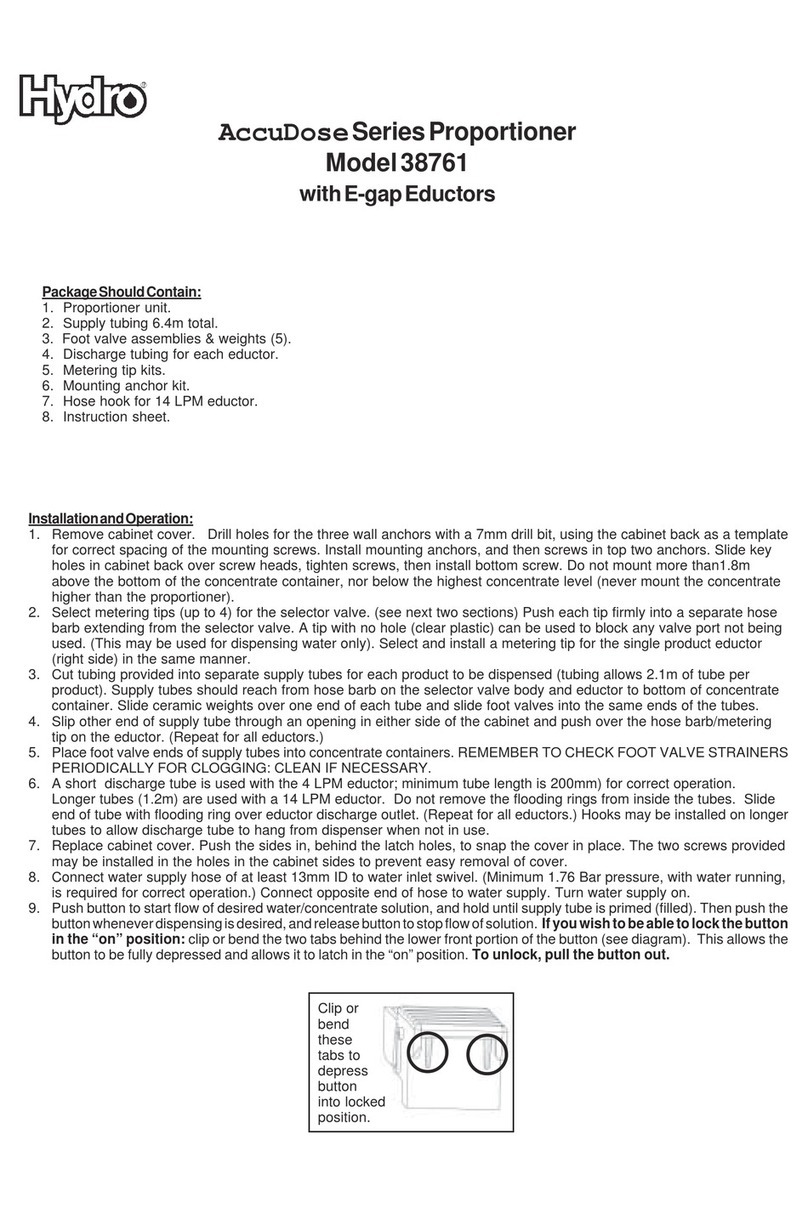
5. A long (4ft.) discharge tube is used with 4 GPM (yellow) eductors. Do not remove flooding rings from insidethe tubes. Slide
end of tube with flooding ring over discharge outlet.
6. Install discharge tubes over inner discharge tubes. Put the ends of the tubes into the appropriate sink compartments.
7. Place foot valve ends of supply tubes into concentrate containers. REMEMBER TO CHECK FOOT VALVE STRAINER
PERIODICALLY FOR CLOGGING: CLEAN IF NECESSARY.
Operation
1. Connect water supply hose of at least ½” ID to water inlet swivel. (Minimum 25 psi pressure, with water running, is required for
proper operation.) Connect other end of hose to water supply. Turn water supply on.
2. Purge air from the system by opening the ball valves briefly. (Ball valves will be in vertical position -- pointing up and
down -- when open.) There may be some water discharge from the eductor vents until the air is purged.
3. Open one ball valve to start flow of desired water/concentrate solution, and run unit until supply tube is primed (filled). Repeat
priming operation for other ball valve. Then, open ball valves when dispensing is desired. Close ball valves to stop flow of
solution.
4. It is essential that the discharge hose not be obstructed. If discharge is restricted, water will fl ow out the eductor
vents.
The final concentration of the dispensed solution is related to both the
size of the metering tip opening and the viscosity of the liquid being
siphoned. For water-thin products, the chart at right can be used as
a guideline. If product is noticeably thicker than water, consult the
Measurement of Concentration procedure to achieve your desired
water-to-product ratio. Because dilution can vary with water tempera-
ture and pressure, actual dilution achieved can only be ascertained
by using the Measurement of Concentration procedure. The clear,
undrilled tip is provided to permit drilling to size not listed should you
need a dilution ratio that falls between standard tip sizes.
NOTE: A 1.0 GPM eductor is grey; a 3.5 GPM eductor is yellow. Refer
to parts diagram if unfamiliar with names of system components.
Measurement of Concentration:
You can determine the dispensed water-to-product ratio for any
metering tip size and product viscosity. All that is required is to
operate the primed dispenser for a minute or so and note two things:
the amount of dispensed solution, and the amount of concentrate
used in preparation of the solution dispensed. The water-to-product
ratio is then calculated as follows:
Dilution Ratio (X:1) where X = Amount of Mixed Solution — Amount of Concentrate Drawn
Amount of Concentrate Drawn
Dilution Ratio, then, equals X parts water to one part concentrate (X:1). If the test does not yield the desired ratio, choose a
different tip and repeat the test. Alternative methods to this test are 1) pH (using litmus paper), and 2) titration. Contact your
concentrate supplier for further information on these alternative methods and the materials required to perform them.
APPROXIMATE DILUTIONS
AT 40 psi FOR WATER-THIN PRODUCTS (1.0 CP)
Tip
Color
Orifice
Size
Std. Drill
Number
Ratio
No Tip .187
3/16 6:1
Gray .128
30 6:1
Black .098
40
7:1
Beige .070
50 12:1
Red .052
55 20:1
White .043
57 28:1
Blue .040
60 32:1
Tan .035
65 45:1
Green .028
70 80:1
Orange .025
72 95:1
Brown .023
74 120:1
Yellow .020
76 150:1
Aqua .018
77 190:1
Purple .014
79 300:1
Pink .010
87 750:1
Lt. Purple .009 89 875:1
metering tip selection
2