- 5 -
the line is via compression fittings, hose with clamp, threaded fittings or flanges,
whichever is appropriate. Care must be taken not to transmit a twisting force through the
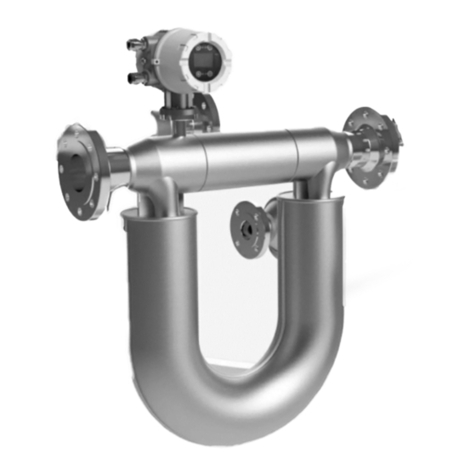
sensor’s midsection. The TU and TUL sensors, whether flanged or not, must not be used
to pull other piping together or to make up angular mismatch of fittings. The sensor
mounted enclosure should never be rotated for any reason.
TU and TUL sensors 1
'16 or smaller may be sleeved with a c" tube for added support.
Connection should always be made to the flow tube, as there is no assured seal between
the flow tube and the sleeve.
Fluid temperatures other than ambient require special attention. Thermal gradients from
one end of the sensor to the other, as well as along the radius of the connection pipe, are
undesirable. Therefore, effective insulation should be installed around the inlet and outlet
straight line runs. Gradients which may exist in the line further up stream can be removed
if an insulated elbow is installed in the line prior to entering the straight line portion of the
plumbing. Metallic support braces for the sensor or adjoining plumbing can act as a heat
sink and cause indication errors in high temperature applications. The support braces
should be thermally isolated from the line to avoid heat loss effects.
If the sensor is for use above 212°F, it will have a stainless steel side arm to get the
electronics box away from the heat. Free air should be allowed to flow around the side
arm and electronics enclosure to keep the electronics cool. The side arm can be insulated
up to one third of its length from the sensor body.
In these applications, proper thermal control is vital to accurate meter performance. Non-
uniformheat tracing, relay on/off temperature controllers and oscillating proportional type
control should always be avoided. Steam trace lines with good pressure regulation or
properly tuned proportional temperature control systems are effective in maintaining
uniform fluid temperature. A box around the sensor and inlet tubing is highly
recommended for operating temperatures higher than room ambient. Allow enough
inlet tubing inside the box to allow the fluid temperature to become the same
temperature as the surrounding air. Separately control the box air temperature at the
same temperature as the incoming fluid temperature to minimize thermally induced
indication errors.
Flow stream conditioning must also be considered to maximize meter performance. Avoid
upstream protrusions and short distance straight runs, particularly for insertion probes and
TU/TUL sensors ¼" and larger. Flow pulsations, such as those created by metering
pumps, may cause the instrument to differ from the factory calibration. Furthermore, if the
flow is varied by stroke and by pump speed adjustment, the indication will most likely be
non-repeatable. If you are using a pump of this type, it is recommended that a pulsation
dampening device be used to provide smooth continuous flow. Otherwise a readjustment
of the instrument calibration after installation would be required (See SECTION 4.2).
For liquid measurement systems using high pressure gas to force flow, the effects of the
absorbed gas must be considered. In these cases, sudden pressure drops up stream of the
sensor such as line size expansions, control valves, and pressure dropping regulators must