manuals.online logo
Brands
  1. Home
  2. •
  3. Brands
  4. •
  5. JBL
  6. •
  7. Subwoofer
  8. •
  9. JBL GT1041 User manual

JBL GT1041 User manual

This manual suits for next models

5

Other JBL Subwoofer manuals

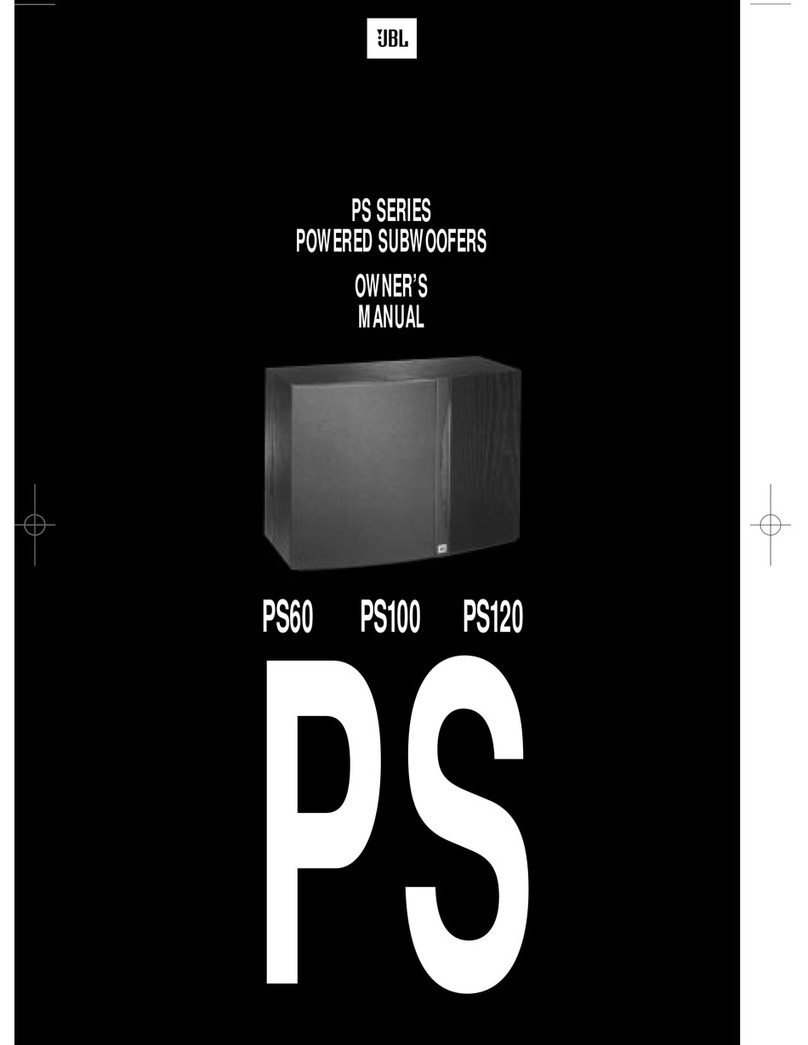
JBL PowerBass PB10 User manual

JBL

JBL PowerBass PB10 User manual

JBL P-1500 Instruction manual

JBL

JBL P-1500 Instruction manual

JBL GT4 User manual

JBL

JBL GT4 User manual

JBL GT-X1250T User manual

JBL

JBL GT-X1250T User manual

JBL 600GTI User manual

JBL

JBL 600GTI User manual

JBL Grand Touring GTO1014 User manual

JBL

JBL Grand Touring GTO1014 User manual

JBL Grand Touring GTO1014 User manual

JBL

JBL Grand Touring GTO1014 User manual

JBL HLS 820 User manual

JBL

JBL HLS 820 User manual

JBL CS1215B User manual

JBL

JBL CS1215B User manual

JBL SP-150 User manual

JBL

JBL SP-150 User manual

JBL GT152 User manual

JBL

JBL GT152 User manual

JBL Studio S120PII User manual

JBL

JBL Studio S120PII User manual

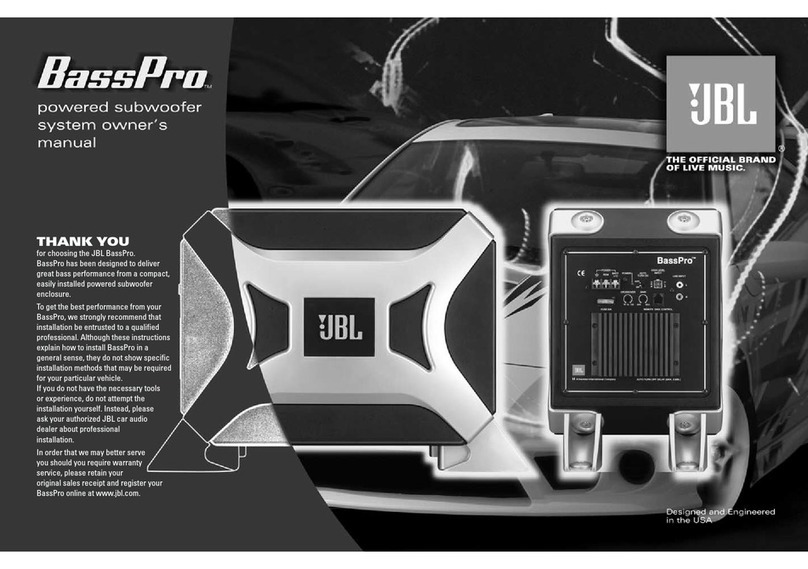
JBL BASSPRO User manual

JBL

JBL BASSPRO User manual

JBL GTO1004D Instruction manual

JBL

JBL GTO1004D Instruction manual

JBL PERFORMANCE P10SW User manual

JBL

JBL PERFORMANCE P10SW User manual

JBL GTO1220D Instruction manual

JBL

JBL GTO1220D Instruction manual

JBL SF22SP/230 User manual

JBL

JBL SF22SP/230 User manual

JBL WS1000 User manual

JBL

JBL WS1000 User manual

JBL Loud+Clear LC-S1050W User manual

JBL

JBL Loud+Clear LC-S1050W User manual

JBL PSW-D112 User manual

JBL

JBL PSW-D112 User manual

JBL P1022 Instruction manual

JBL

JBL P1022 Instruction manual

JBL Studio S120PII User manual

JBL

JBL Studio S120PII User manual

JBL P1222 User manual

JBL

JBL P1222 User manual

JBL S2-1024 User manual

JBL

JBL S2-1024 User manual

Popular Subwoofer manuals by other brands

Sony XS-AW8 operating instructions

Sony

Sony XS-AW8 operating instructions

Sony XS-L836 Specifications

Sony

Sony XS-L836 Specifications

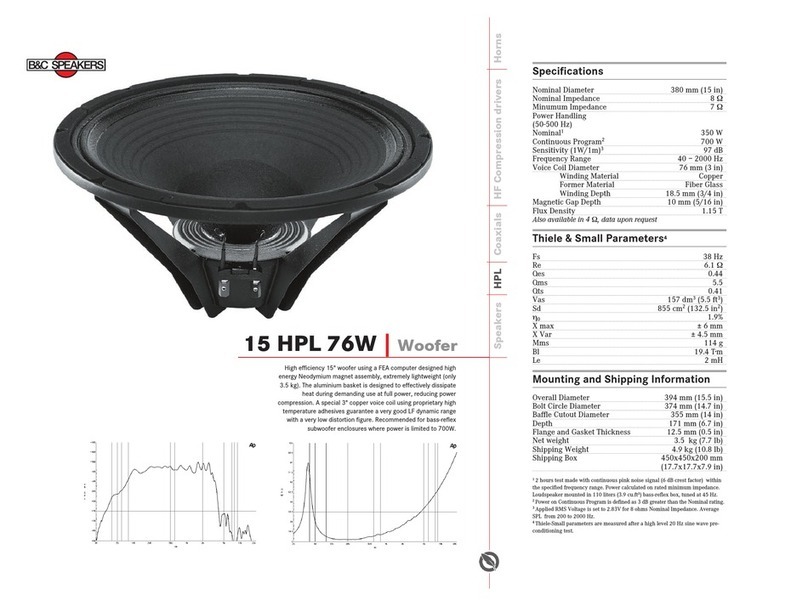
B&C Speakers 15 HPL 76W Specifications

B&C Speakers

B&C Speakers 15 HPL 76W Specifications

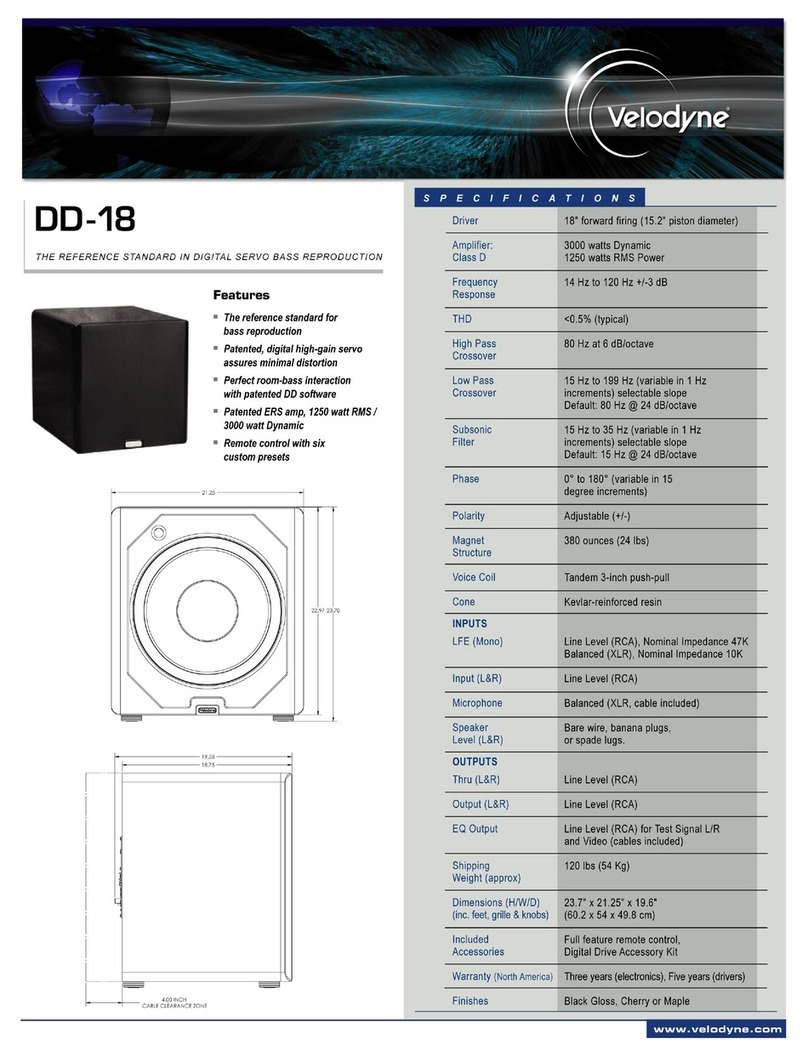
Velodyne DD-18+ Specifications

Velodyne

Velodyne DD-18+ Specifications

Sonance Cinema Series SUB 10-150 Specifications

Sonance

Sonance Cinema Series SUB 10-150 Specifications

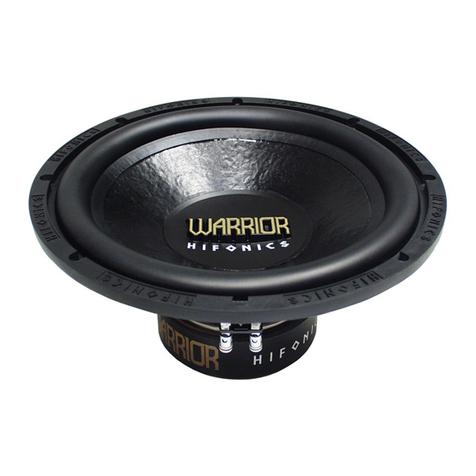
Hifonics HW-12 Owners & installation manual

Hifonics

Hifonics HW-12 Owners & installation manual

Magnat Audio ADR 130 BP user manual

Magnat Audio

Magnat Audio ADR 130 BP user manual

Blitz BZP106 Specifications

Blitz

Blitz BZP106 Specifications

Technics SB-AS500 Operaing instructions

Technics

Technics SB-AS500 Operaing instructions

Lyngdorf BW-2 owner's manual

Lyngdorf

Lyngdorf BW-2 owner's manual

Lyngdorf BW-3 owner's manual

Lyngdorf

Lyngdorf BW-3 owner's manual

Pyle Pro PYLE PRO PDW15125 owner's manual

Pyle Pro

Pyle Pro PYLE PRO PDW15125 owner's manual

REL Acoustics Q Series operating instructions

REL Acoustics

REL Acoustics Q Series operating instructions

L-Acoustics KIVA SB15M Rigging manual

L-Acoustics

L-Acoustics KIVA SB15M Rigging manual

Pioneer Elite S-W1EX Service manual

Pioneer

Pioneer Elite S-W1EX Service manual

B&C Speakers Woofer 12 HPL 76 specification

B&C Speakers

B&C Speakers Woofer 12 HPL 76 specification

KEF KUBE 200 installation manual

KEF

KEF KUBE 200 installation manual

Yamaha SW500 owner's manual

Yamaha

Yamaha SW500 owner's manual

manuals.online logo
manuals.online logoBrands
  • About & Mission
  • Contact us
  • Privacy Policy
  • Terms and Conditions

Copyright 2025 Manuals.Online. All Rights Reserved.

GrandTouring®Series
GT1041, GT1041D, GT1081, GT1241, GT1241D, GT1281
Owner’s Manual
AUTOMOTIVE SUBWOOFERS
SERIES
GT Series Owners Manual 5/14/99 9:49 AM Page 1
Thank you for purchasing a new
JBL GT Series subwoofer. Subwoofer
installation often requires woodworking
skills and some experience disassem-
bling and reassembling automotive inte-
riors. If you lack the tools or necessary
skills, have your subwoofer installed by
an authorized JBL dealer.
Warning: Playing loud music in an auto-
mobile can permanently damage your
hearing as well as hinder your ability to
hear traffic. We recommend listening at
low levels while driving. JBL accepts no
liability for hearing loss, bodily injury or
property damage resulting from use or
misuse of this product.
construction is straightforward and there
are many prefabricated sealed enclo-
sures available. An optimum sealed
enclosure is always smaller than other
types of enclosures optimized for a par-
ticular speaker, so they require the small-
est amount of space inside the vehicle.
Vented enclosures provide better effi-
ciency in the 40Hz – 50Hz range, but this
efficiency comes at the expense of sound
in the lowest octave (below 40Hz), and at
the expense of some control and power
handling. If you are using a small
amplifier, a vented box will provide more
bass output from less power. Vented
enclosures are also well suited to a
variety of music types. Because vented
enclosures require the volume of the
enclosure and the size of the port to have
a specific relationship with the character-
istics of the woofer, the enclosure must
be built exactly to the specifications
provided. While there are some prefabri-
cated vented boxes available, matching a
prefabricated box to a particular woofer
is difficult. If you wish to use a vented
enclosure, we strongly recommend
having your authorized JBL dealer build
02
Choosing an Enclosure
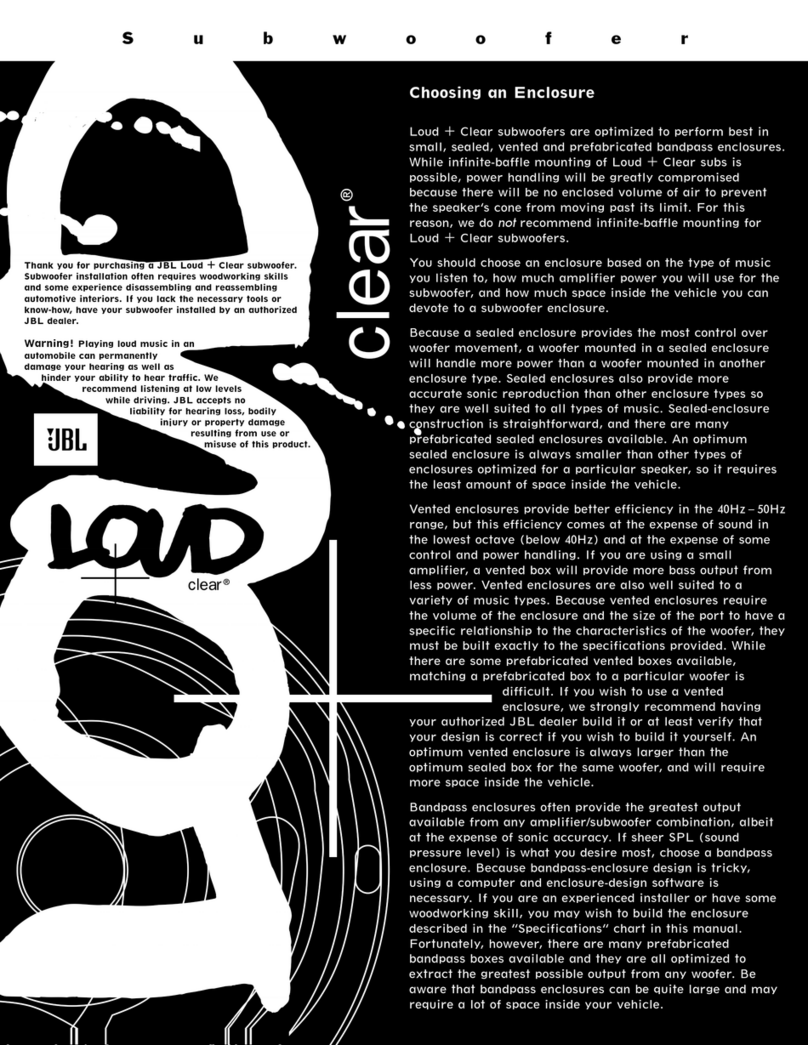
GT Series subwoofers are optimized to
perform best in small sealed, vented
and prefabricated bandpass enclosures.
While infinite-baffle mounting of
GT Series subs is possible, power
handling is greatly compromised
because there’s no enclosed volume of
air to prevent the speaker’s cone from
moving past its limit. For this reason,
we do not recommend infinite-baffle
mounting for GT Series subwoofers.
You should choose the enclosure you
will use based on the type of music you
listen to, how much amplifier power you
will use for the subwoofer and how
much space inside the vehicle you can
devote to a subwoofer enclosure.
Because a sealed enclosure provides the
most control over the woofer’s move-
ment, a woofer mounted in a sealed
enclosure can handle more power than a
woofer mounted in another enclosure
type. Sealed enclosures provide more
accurate sonic reproduction than other
enclosure types, so they are well suited
to all types of music. Sealed-enclosure
it, or verify that your design is correct
if you wish to build it yourself. An
optimum vented enclosure is always
larger than the optimum sealed box for
the same woofer, and will require more
space inside the vehicle.
Bandpass enclosures often provide
the most output available from any
amplifier-and-subwoofer combination at
the expense of sonic accuracy. If sheer
SPL (sound-pressure level) is what you
desire most, choose a bandpass
enclosure. Bandpass-enclosure design
is very tricky; using a computer and
enclosure-design software is necessary.
If you are an experienced installer or
have some woodworking experience,
you may wish to build the enclosure
described in the
Specifications
chart in
this manual. Fortunately, there are many
prefabricated bandpass boxes available,
and they are all optimized to extract the
most output possible from any woofer.
Bandpass enclosures can be quite large
and may require a lot of space inside
your vehicle.

GT Series Owners Manual 5/14/99 9:49 AM Page 2
03
Connecting Your Subwoofer to Your
Amplifier
JBL GT Series subwoofers are available
in three different configurations: single
4-ohm voice coil, single 8-ohm voice coil
and dual 4-ohm voice coils. Depending
on the amplifier you are using, you may
use either single- or dual-voice-coil
subwoofers in singles or multiples to
maximize the power available from your
amplifier. To achieve the maximum
amplifier output possible, you should
design a speaker system that provides
the lowest impedance that your amplifier
is rated to drive safely. When designing
a subwoofer system, abide by the
following rules:
1. Don’t mix different subwoofer or enclo-
sure types in the same system (use all
single-coil 4-ohm woofers, all single-
coil 8-ohm woofers, or all dual-coil
woofers).
2. You may connect the coils of a dual-
voice-coil woofer in series, but NEVER
connect separate woofers in series.
Because the amplifier-damping factor
(the amplifier’s ability to control the
motion of the woofer) is expressed as
a ratio of terminal impedance (the sum
of speaker impedance, wire resistance
and the D.C. resistance of any
crossover coil connected to the
woofer) to amplifier-output imped-
ance, connecting woofers in series
reduces the damping factor of the
amplifier to a value less than 1. This
will result in poor transient response.
3. You must use both coils of a dual-
voice-coil woofer either in series or in
parallel.
4. Most amplifiers deliver exactly the
same amount of power bridged into
a 4-ohm load as they do running a
2-ohm stereo load.
To design a subwoofer system that
maximizes available amplifier power,
keep the following rules in mind:
1. The total system impedance of
woofers in parallel = 1/(1/w1 + 1/w2 +
1/w3...) where w is the nominal imped-
ance of the woofer.
2. The total system impedance of voice
coils (or woofers) in series = w1 +
w2 + w3...
The diagrams below and at right show
parallel and series speaker connections.
Figure 1. Parallel connection
Figure 2. Series connection
GT Series Owners Manual 5/14/99 9:49 AM Page 3
Declaration of Conformity
We, JBL Europe A/S
Kongevejen 194B
DK-3460 Birkerod
DENMARK
declare in own responsibility, that the products
described in this owner’s manual are in compliance
with technical standards:
EN 50081-1:1992
EN 50082-1:1992
Steen Michaelsen
JBL Europe A/S
Birkerod. DENMARK. 5/99
JBL Consumer Products, 250 Crossways Park Drive, Woodbury, NY 11797
800-336-4JBL (4525) www.jbl.com Part No. GTSUBOM Made in USA
Specifications
GT1041 GT1041DGT1081 GT1241 GT1241DGT1281
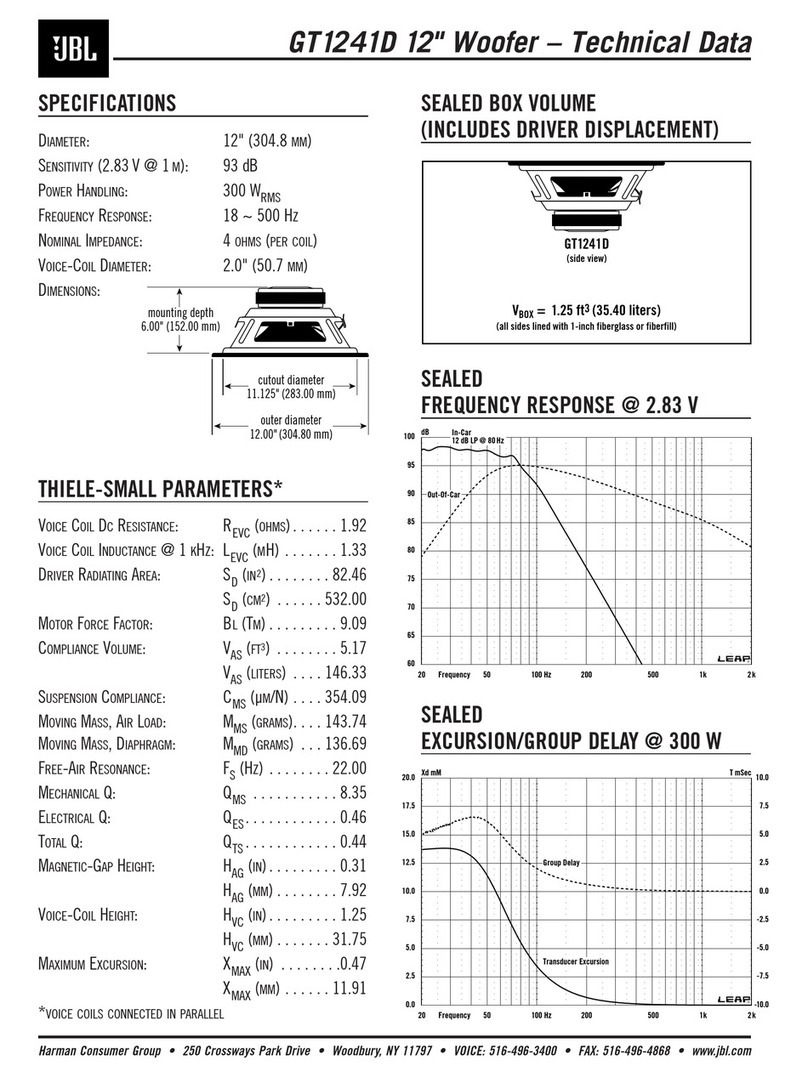
Configuration 10" subwoofer 10" subwoofer 10" subwoofer 12" subwoofer 12" subwoofer 12" subwoofer
Recommended Amplifier
Power Range 18W – 275W 18W – 275W 18W – 275W 18W – 300W 18W – 300W 18W – 300W
Impedance 4 ohms dual 4 ohms 8 ohms 4 ohms dual 4 ohms 8 ohms
Sensitivity 90dB 90dB 90dB 93dB 93dB 93dB
Frequency Response 20Hz – 500Hz 20Hz – 500Hz 20Hz – 500Hz 18Hz – 500Hz 18Hz – 500Hz 18Hz – 500Hz
Mounting Depth 5-3/8" (137mm) 5-3/8" (137mm) 5-3/8" (137mm) 6" (153mm) 6" (153mm) 6" (153mm)
Cut-Out Diameter 9-1/4" (235mm) 9-1/4" (235mm) 9-1/4" (235mm) 11-1/8" (283mm) 11-1/8" (283mm) 11-1/8" (283mm)
GT Series Owners Manual 5/14/99 9:49 AM Page 4