.........................................................................................................................................................................................................................................................................................................................................................................................................................................................
H- Using Lanyard
H-1- The minimization of impact forces - absorbtion of the energy of a fall
(Figure -1)
H.1.1 - Fall Factor
I- Using Energy Absorber With Lanyard
I-1- Fall Factor
J-Fall Clearance Distance (Figure-2)
K- Choosing Harness Anchor Point (Figure - 3)
K-1- Use of Sternal A Attachment Point (Figure - 3.1)
K-2- Use of Dorsal A Attachment Point (Figure - 3.2)
1. General Specification
Personal Protective Equipment (PPE)
Engery Absorber Lanyard is a part of the fall arrest system. Engery Absorber
Lanyard should be used with a safety harness during work and lanyard should
be connected to a safe anchorage point. Engery Absorber Lanyard is designed
for works at 2 m height maximum and limit the impact force on the user at
6 kN (600 kg) in case of a fall. During working at height with energy absorber,
special textile of the energy absorber starts tearing when the force on the
energy absorber approaches to 6 kN and limits the impact transmitted to the
user in case of a fall. This lanyard with energy absorber, is manufactured in
complience with standard of EN 355:2002 and EN 354:2010 specified in the
directive 89/686/EEC.
2. Responsibility
* Before using this equipment you must read and understand this instruction.
* Working at height is one of the most dangerous activities that can lead to
serious injuries and death.
It is under the responsibility of the user to learn and apply appropriate techniques
and safety methods. This Lanyard with energy absorber should be used by only a
trained personnel or under the supervision of suchpersonnel. Improper use can
cause serious injuries and fatal accidents.
* This lanyard is for personal use only.
* This lanyard is a component of a fall arrest system and is aimed to prevent
user from falling. This equipment itself is not suitable for working at height,
it must also be used together with CE certificated harnesses (EN 361), hooks
(EN362), absorbers(EN 355) and fall arresters(EN 360).
* This product must be used between - 30 °C and + 70 °C air conditions.
3. Raw Material
This Lanyard is made of;
Textile Materials: % 100 Polyester
Connectors: 304 or 316 Stainless Steel or aluminium material
Accessories: Polyester or Polyamide or PVC
4. Instructions For Use
Caution
* Harness should be adjusted according to your body in order to prevent the
possible injuries in case of a fall.
* Carabiners should be locked and carabiners with automatic lock should
be preferred. Carabiner always must used in strongest axis.
* Avoid contact with sharp and abrasive surfaces while working.
4.1 Using Lanyard- EN 354:2010 (Figure-1)
* Lanyards that are part of fall arrest systems, shouldn’t be used without an
energy absorber. Usage of lanyard with energy absorber is always advised.
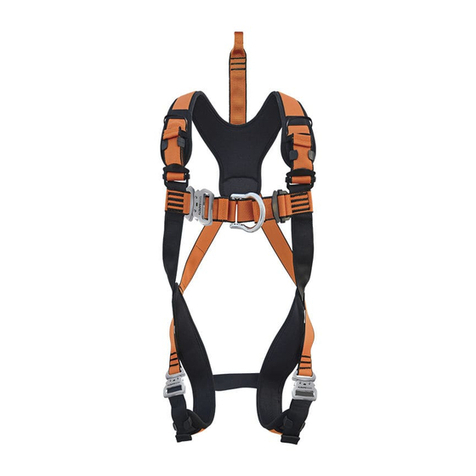
4.1.1 Choosing Harness A Attachment Point
* Connect your lanyard with energy absorber only to the anchorage point
located on your chest or, if not present, to the anchorage point (EN 361)
located at the back.
As shown on figure-3.1, connect your lanyard to the sternal A anchorage
point if there is a chance of hitting obstacles in front in the case of a fall.
As shown on figure-3.2, connect your lanyard to the dorsal A anchorage
point if there is a chance of hitting obstacles at the back in the case of a fall.
4.2 Using Lanyard
• It must be ensured that the impact force is less than 6 kN in the event
of a fall.
• Fall arrest systems are generally used with an shock absorber. Energy
absorbers absorb the energy of fall by tearing of sewing of specific webbing.
• Using lanyards without energy absorber may result in serious injury or
dead
* The anchor point must always be used above the user’s head.
*Only shock absorbing lanyards must be used where fall factor is higher
than 0,5. ıf the fall factor is less or equal to 0,5 then a lanyard without
shock absober can be used.
* Double safe carabiners with wide gate opening located on the tips of lanyard
provide ease at work.
* Lanyard with energy absorber should be preferred for work if the work at
height is not at a fixed point but includes moving left – right and up - down.
4.3 Lanyard with Energy Absorber Usage
* Advised length of the lanyard with energy absorber should be 1.2 meters
maximum including the carabiners. Legally maximum length of the lanyard
is stated as 2 meters.
* Fall distance should not be more than 2.4 meters.
* While working with the lanyard with energy absorber, slope of the working
surface which is used as an anchorage point should not exceed 15°. Surfaces
exceeding 15° of slope might cause falls more than 2.4 meters.
4.4 Fall Clearance Distance - Height of Fall (Figure-2);
Fall Clearance is defined as necessary distance between the anchorage
point and the ground (or first obstacle) to avoid crashing into the ground
in case of a fall.
Fall length in between the anchorage point and the ground should be
minimum 6,25 meters.
Elements needed to calculate fall clearance are;
A - Length of the Lanyard
B - Energy Absorber Extension
C - Height of User
D - Safety Margin
5 Control of Product and Validation
5.1 Before Every Use
Working at height equipment must be personalized. These products must
be controlled on a regular basis before and after each use. Findings must
be recorded into product record book. On an adequate lighted environment,
by lying the product on a flat surface, apply the following controls;
• Webbings or ropes should be checked for cuts, abrasions, color change,
broken stitches and undue stretching
• Metal parts should be checked for signs of wear, cracks, deformation,
corrosion or other damage.
• Connectors should be checked for sign of wear, cracks, deformation, corrosion,
dirt. The gate and the locking mechanism should work without any problem.
The gate should open and close completely.
• Labels should be secure and legible.
During the controls if at least one of these deviations is found, usage of the
equipment should be suspended or retired and immediately send back to
producer for detailed inspection. No repair is allowed by unauthorised person.
Only producer’s directions should be applied.
5.2 During Each Use
During the working at height if you need to use this product connected with
other systems, make sure that all pieces of equipment in the system are
correctly positioned and compatible with each other.
6. Supplementary Information Regarding Standard; EN 365
6.1 Rescue Plan
A worker who has been incapacitated by an injury or medical condition and
who is suspended by the full body harness must be rescued immediately.
So you must always have a rescue plan for such emergencies. Adequately
trained personnel and rescue equipment must be present for rescue.
6.2 Anchor Point
The anchor point of the system comprises this product should preferably
be located above the user or should. At least located at the waist level of
the user. An attachment point below this level will cause a serious injury or
death. The anchor point must conform to the requirements of the EN 795
standard and the minimum strength of it must be 12 kN.
6.3 Various Situations
* A lanyard is the only device allowed for supporting the body in a fall
arrest system.
*In a fall-arrest system, it is essential to check the required clearance
under the user before each use, to avoid any impact with the ground or an
obstacle in case of a fall.
* Make sure that the anchor point is correctly positioned, in order to limit
the risk and the height of a fall.
* When using multiple pieces of equipment together, a dangerous situation
can result if the safety function of one piece of equipment is affected by the
safety function of another piece of equipment.
* Users must be medically fit for activities at height. Warning, inert suspension
in a harness can result in serious injury or death.
* The instructions for each item of equipment used in conjunction with this
product must be respected.
* The instructions must be provided to users of this equipment in the language
of the country in which the product is to be used.
7. General Information
7.1 Life Span
This product’s maximum lifespan is 10 years. (10 years is the time of storage
without being used, the product should be destroyed even if it has never been
used during this time).
• It has suffered a high shock load or has had a load dropped on to it.
• There are discoloration, stiffness, cuts and tears, glazed or fused areas on
the webbing or ropes.