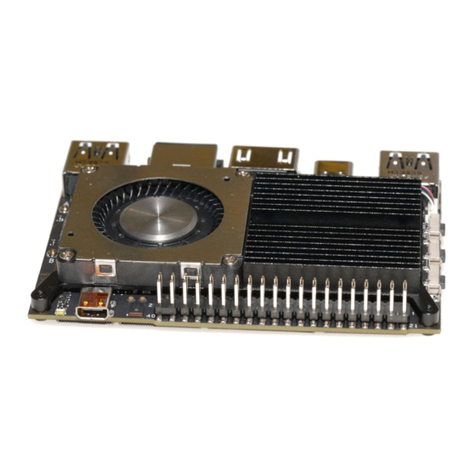
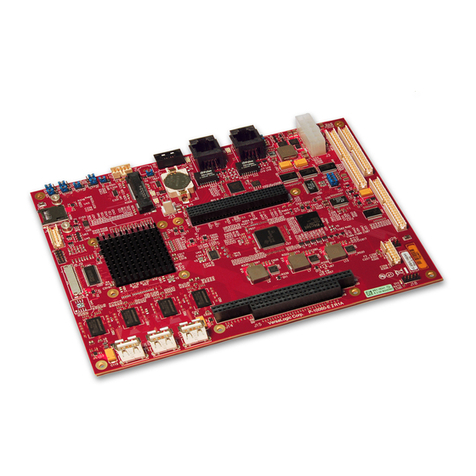
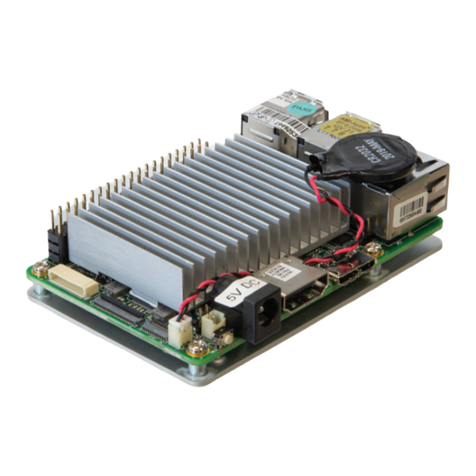
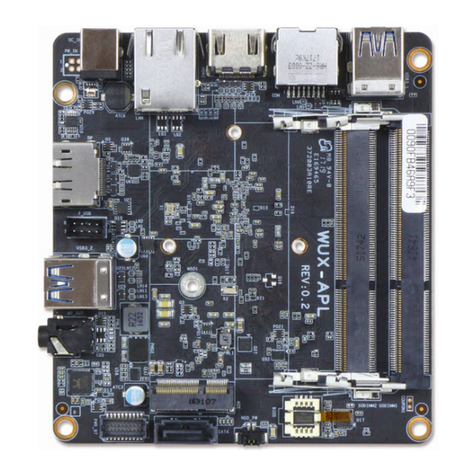
KHADAS SBC2.0a User manual

2
2. Product Specification
2.1 Function Block diagram
2.2 Function Specification
Item
Description
Model
SBC2.0a
Major Chipset
RK3399
Emmc Storage
16GB
RAM
4GB
Ethernet
Gigabit LAN
WiFi/BT
AP6398S 2T2R 802.11 a/b/g/n/ac + Bluetooth5.0
DC input
DC Jack, 2.1x5.5mm Standard
Spearker
2P/2.0MM JST Jack
LCD Connector
1) MIPI-DSI Interface
2) Touch with I2C interface
USB Ports
1) USB-C 3.0 OTG *1
2) USB-A 3.0 HOST*1
3) Micro USB2.0 HOST*2
RF Power(Typical)
BLE: -2.0dBm(Max)
2.4GWiFi:16.0dBm(Max)for ant 0
2.4GWiFi:17.0dBm(Max) for ant 1
5.2GWiFi:11.0dBm(Max) for ant 0
5.2GWiFi:14.0dBm(Max) for ant 1
5.8GWiFi:12.0dBm(Max) for ant 0
5.8GWiFi:12.0dBm(Max) for ant 1
Frequency Range
2402MHz - 2480MHz, 2412 –2462 MHz, 5180MHz-5240MHz,5745MHz-5825MHz

3
Modulation Type
GFSK for Bluetooth
IEEE 802.11b: DSSS (CCK, DQPSK, DBPSK)
IEEE 802.11g: OFDM (64QAM, 16QAM, QPSK, BPSK) IEEE 802.11n: OFDM
(64QAM, 16QAM,QPSK,BPSK)
IEEE 802.11a/n/ac: OFDM (64QAM, 16QAM, QPSK, BPSK)
2.3 Interface Instructions
1) Ethernet
Connect the ethernet cable from the SBC2.0a to your network.
Make sure both ends of the network cable are plugged in, and that the corresponding network
port is patched at the switch.
2) Display
Connect the FPC port on SBC2.0a with your LCD Display device. The LCD
display device must be MIPI interface.
3) AC Power
Once the Box is plugged in, it will boot up. Make sure all of the other connections are in place
first.
Power can be provided by the AC power adapter (12V 2A DC).
2.4 Product Pin Definition

4

5
Placement
Pin No.
Function
Description
CON31
1
ED35 AZ5725-01F ESD0402
2
ED36 AZ5725-01F ESD0402
3
GND
Ground
4
GND
Ground
5
NC
NC
6
NC
NC
CON23
1
UART_TX
UART_TX
2
UART_RX
UART_RX
3
GND
Ground
J13
1
VCC_TP
VCC_TP
2
VCC_TP
VCC_TP
3
I2C2_SDA_3V3
I2C2_SDA_3V3
4
I2C2_SDA_3V3
I2C2_SDA_3V3
5
GND
Ground
6
GND
Ground
7
TP_INT
TP_INT
8
TP_RST
TP_RST
9
MCU_TX
MCU_TX
10
VCC1V8_S3
VCC1V8_S3
G1
GND
Ground
G2
GND
Ground
J11
1
GND
Ground
2
MIPI_TX0_D3N
MIPI_TX0_D3N
3
MIPI_TX0_D3P
MIPI_TX0_D3P
4
GND
Ground
5
MIPI_TX0_D2N
MIPI_TX0_D2N
6
MIPI_TX0_D2P
MIPI_TX0_D2P
7
GND
Ground
8
MIPI_TX0_CLKN
MIPI_TX0_CLKN
9
MIPI_TX0_CLKP
MIPI_TX0_CLKP
10
GND
Ground
11
MIPI_TX0_D1N
MIPI_TX0_D1N
12
MIPI_TX0_D1P
MIPI_TX0_D1P
13
GND
Ground
14
MIPI_TX0_D0N
MIPI_TX0_D0N
15
MIPI_TX0_D0P
MIPI_TX0_D0P
16
GND
Ground
17
VCC3V3_S0
VCC3V3_S0
18
VCC3V3_S0
VCC3V3_S0
19
LCD_EN
LCD_EN
20
LCD_RST
LCD_RST
21
LCD_BL_PWM
LCD_BL_PWM
22
GND
Ground
23
GND
Ground
24
GND
Ground

6
25
GND
Ground
26
DC12V
Power
27
DC12V
Power
28
DC12V
Power
29
DC12V
Power
30
DC12V
Power
G1
GND
Ground
G2
GND
Ground
J47
Power
Power in
J5
TYPE-C
CN2
USB Port
J49
RJ50
Connect LAN

7
FCC Statement
This device complies with part 15 of the FCC rules. Operation is subject to the
following two conditions: (1) this device may not cause harmful interference,
and (2) this device must accept any interference received, including interference
that may cause undesired operation.
Changes or modifications not expressly approved by the party responsible for
compliance could void the user’ s authority to operate the equipment.
NOTE: This equipment has been tested and found to comply with the limits for a
Class B digital device, pursuant to part 15 of the FCC Rules. These limits are
designed to provide reasonable protection against harmful interference in a
residential installation. This equipment generates uses and can radiate radio
frequency energy and, if not installed and used in accordance with the
instructions, may cause harmful interference to radio com munications.
However, there is no guarantee that interference will not occur in a particular
installation. If this equipment does cause harmful interference to radio or
television reception, which can be determined by turning the equipment off and
on, the user is encouraged to try to correct the interference by one or more of
the following measures:
‐Reorient or relocate the receiving antenna.
‐Increase the separation between the equipment and receiver.
‐Connect the equipment into an outlet on a circuit different from that to which
the receiver is connected. ‐Consult the dealer or an experienced radio/TV
technician for help.

8
important announcement Important Note:
Radiation Exposure Statement
This equipment complies with FCC radiation exposure limits set forth for an
uncontrolled environment. This equipment should be installed and operated
with minimum distance 20cm between the radiator and your body.
This transmitter must not be co-located or operating in conjunction with any
other antenna or transmitter. Country Code selection feature to be disabled for
products marketed to the US/Canada.
This device is intended only for OEM integrators under the following conditions:
1. The antenna must be installed such that 20 cm is maintained between
the antenna and users, and
2. The transmitter module may not be co-located with any other
transmitter or antenna,
3. For all products market in US, OEM has to limit the operation channels
in CH1 to CH11 for 2.4G band by supplied firmware programming tool. OEM
shall not supply any tool or info to the end-user regarding to Regulatory Domain
change. (if modular only test Channel 1-11)
As long as the three conditions above are met, further transmitter testing will
not be required. However, the OEM integrator is still responsible for testing their
end-product for any additional compliance requirements required with this
module installed.

9
Important Note:
In the event that these conditions cannot be met (for example certain laptop
configurations or co-location with another transmitter), then the FCC
authorization is no longer considered valid and the FCC ID cannot be used on the
final product. In these circumstances, the OEM integrator will be responsible for
re-evaluating the end product (including the transmitter) and obtaining a
separate FCC authorization.
End Product Labeling
The final end product must be labeled in a visible area with the following"
Contains FCC ID: 2A2OC-PEGV14
Manual Information to the End User
The OEM integrator has to be aware not to provide information to the end user
regarding how to install or remove this RF module in the user’s manual of the
end product which integrates this module.
The end user manual shall include all required regulatory information/warning
as show in this manual.

10
Integration instructions for host product manufacturers according to KDB
996369 D03 OEM Manual v01
2.2 List of applicable FCC rules
CFR 47 FCC PART 15 SUBPART C has been investigated. It is applicable to the
modular transmitter
2.3 Specific operational use conditions
This module is stand-alone modular. If the end product will involve the
Multiple simultaneously transmitting condition or different operational
conditions for a stand-alone modular transmitter in a host, host
manufacturer have to consult with module manufacturer for the
installation method in end system.
2.4 Limited module procedures
Not applicable
2.5 Trace antenna designs
Not applicable
2.6 RF exposure considerations
This equipment complies with FCC radiation exposure limits set forth for an
uncontrolled environment. This equipment should be installed and operated
with minimum distance 20cm between the radiator & your body.
2.7 Antennas
This radio transmitter 2A2OC-PEGV14 has been approved by Federal
Communications Commission to operate with the antenna types listed below,
with the maximum permissible gain indicated.Antenna types not included in this
list that have a gain greater than the maximum gain indicated for any type listed
are strictly prohibited for use with this device.
Table of contents
Other KHADAS Single Board Computer manuals