KIMBALL MIDWEST PROPRIETARY - ALL RIGHTS RESERVED
MAINTENANCE INSTRUCTIONS
OPERATING INSTRUCTIONS
1. LUBRICATION:
Lubricate the tool daily with a high-quality air tool oil. If no inline oiler is used, run a teaspoon of oil through the tool.
The oil can be added into the tool air inlet or into the hose at the nearest connection to the air supply, then run the tool.
2. TIGHTNESS OF PARTS:
Regularly check whether all connecting parts are fastened securely. Follow this procedure daily before beginning work.
3. STORAGE:
Avoid storing the tool in a location subject to high humidity. If the tool is left unused, the residual moisture inside the
tool can cause rust. Before storing and after operation, oil the tool at the air inlet with a good quality air tool oil and
run it for a short period.
4. REPAIR & SERVICING:
For further operational and handling information or for replacement of parts and components, contact your
Kimball Midwest Sales Representative or Power Tool Repair (371 West Ave. Tallmadge, OH 44278, 330-630-0022).
Users of this tool should review the chemical composition of the work surface and any products used in conjunction
with this tool for any hazardous chemicals prior to engaging in any activity that creates dust and/or microscopic particles.
Users should obtain the Safety Data Sheets for all identified chemicals, either from the manufacturer or their employer,
and proceed to study, understand, and follow all instructions and warnings for exposure to such chemicals.
Some examples of these chemicals are: lead from lead based paints; crystalline silica from bricks, cement and other
masonry products; and arsenic and chromium from chemically treated lumber. A listing of the chemicals can be
obtained at www.oehha.ca.gov under Proposition 65.
In order to reduce their exposure to such chemicals, users should always:
- work in well-ventilated areas.
- wear appropriate safety equipment and PPE that are specifically designed to filter out microscopic particles.
PRODUCT INFORMATION
When unpacking, check the parts diagram and part number listing on page 3 to make sure all parts are included.
BEFORE USE
INTENDED USE OF THE TOOL
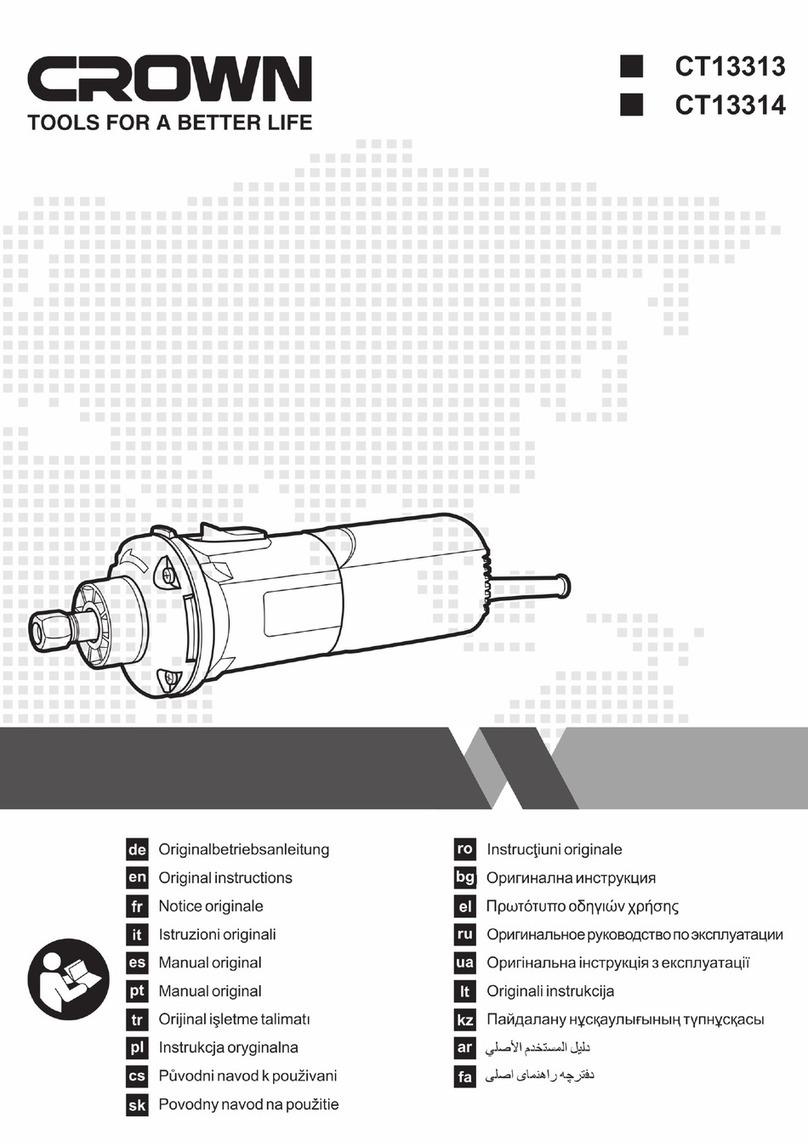
This 1/4" Die Grinder is designed as a handheld pneumatic tool used to grind, sand, hone, polish or machine
materials such as metal or plastic. Do not use this tool outside of the designed intent. Never modify the tool
for any other purpose or use.
SPECIFICATIONS
• Extended shaft provides access for hard to reach places
• High speed
• Positive grip body for easy control
• All ball-bearing construction for long tool life
• Lever throttle for positive speed control
• Rear exhaust air flow system
Collet Size: 1/4"
Free Speed: 20,000 RPM
Overall Length: 13" (340mm)
Net Weight: 2.8 Lbs
Motor: 0.42 HP
Air Inlet: 1/4" NPT
Air Hose I.D. Size: 3/8"
Avg. Air Consumption: 4 CFM
Air Pressure: 90 PSI
To Operate The Die Grinder:
1. Use the two wrenches provided to loosen the Collet Nut.
2. Insert the 1/4" diameter shank of a cutting/grinding tool (not included) fully into the collet.
Then, firmly re-tighten the collet nut to lock both the collet and shank in place.
3. Connect the air supply hose to the Die Grinder. Turn on the air compressor, and set its regulator to the
recommended 90 PSI for the Die Grinder.
4. In order to keep the air supply hose out of the way, hang it over your shoulder.
5. IMPORTANT! Grip the Die Grinder firmly with both hands.
6. Trip the safety lever assembly (23) with your finger. Then slowly apply hand pressure to the trigger until the desired
speed is obtained. NOTE: The Die Grinder always turns the tool shank clockwise.
7. With a firm grip on the Die Grinder, lightly apply the cutting/grinding tool to the workpiece, slowly and steadily moving
the cutting/grinding tool to the right and left until you have achieved the desired appearance (finish) on the workpiece.
8. Once the work is completed, release hand pressure on the trigger (23). The safety will automatically
return to its locked position to prevent the trigger from accidentally being activated.
9. Turn off the air compressor. Trip the safety with your finger, and slowly squeeze the trigger to release any
remaining air pressure from the Die Grinder. Then, disconnect the air hose from the tool.
10.Remove the cutting/grinding tool from the Die Grinder. Then, store the tool in a clean,
dry location out of reach of children.