5
• Set the generator level at zero, connect the Multimeter across the R50 and R53 resistors,
then adjust VR1 trimmer to read 5±0.1mVdc.
BANDWIDTH CHECK:
• Switch alternatively the generator frequency to 100Hz and 10kHz, no level changes must
be detectable respect 1kHz.
• Switch the generator frequency to 30Hz and verify the output level decreases abruptly
respect to 1 KHz level.
OFFSET SENSOR CHECK:
• Set the Variac to zero voltage output, disconnect resistive load from the amplifier output,
connect temporarily (by means of a suitable conductor wire) CN4 pin 4 (+15Vdc) to R72
side RL1, the protection circuitry (Q14,15,16) detect the DC voltage and open the output
relay (RL1) within 3 seconds approx.
• Remove the connection, wait until the relay switch on and after some seconds repeat
the check with -15Vdc (available on CN4 pin 5), the protection circuitry must open the relay
again.
SIGNAL TO NOISE RATIO CHECK:
• Disconnect the audio generator and short the input (pin 1,2,3 of XLR socket shorted) the
output signal (noise) must be less than 1mV.
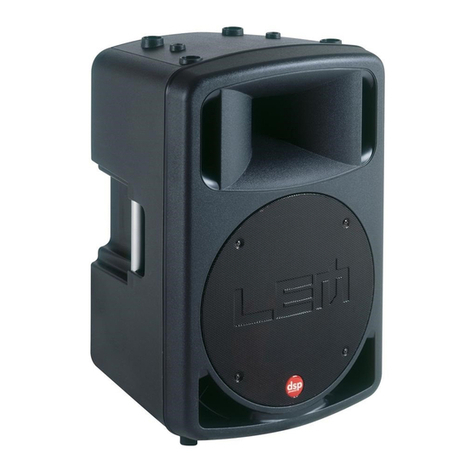
H300A H300MA CHECKING & ADJUSTMENTS
The following adjustment and notes are relative to these models only.
Technical Specifications
Dimensions: .....................H300A (WxHxD)................................... 455x580x405mm
.......................................H300MA (WxHxD) ................................ 455x580x405mm
Weight:............................H300A ................................................ 27.5Kg
.......................................H300MA .............................................. 27Kg
Power Requirements: .........(230Vac±10% 50Hz) ............................ 310VA
.......................................(115Vac±10% 50/60Hz) ....................... 310VA
Output Power*:.................(4Ω/8Ω).............................................. 230W/80W
Max.Undistorted Out*: .......(4Ω/8Ω).............................................. 85Vpp/71Vpp
Active crossover:...............(frequency Hz @ slope dB/oct.).............. 3.5K@12/18
Sensitivity: .......................H300A H300MA (1W/1m) ...................... 97.3dBSPL
Max SPL:..........................H300A H300MA (continuous) ................. 121dBSPL
.......................................H300A H300MA (peak).......................... 124dBSPL
Frequency Response ..........(amplifier+speaker).............................. 48Hz÷20KHz
.......................................(only amplifier -3dB)............................. 10Hz÷60KHz
Input Sensitivity:...............(0dB).................................................. 0.775VRMS
Input Impedance:..............(balanced)........................................... 30KΩ
.......................................(unbalanced) ....................................... 15KΩ
Voltage Gain: .............................................................................. 32±1dB
IMD:................................(SMPTE 60Hz/7KHz 4:1)........................ <0.1%
THD: ...............................(THD+N)............................................. <0.1%
S/N Ratio: ........................(unweighted) ....................................... >100dB
*Note: measured with the limiter enabled.
Remarks
• This is a bi-amplified speaker, the more powerful amplifier is for the low frequency
range (woofer), the less powerful amplifier is for the high frequency range (compression HF
driver).
• The power supply of the first amplifier utilizes a dual bipolar DC rail configuration with
low and high voltages; one positive and one negative low rail (+/-Vcc1) and one positive
and one negative high rail (+/-Vcc2). The second amplifier is supplied by means the onlylow
rail (+/-Vcc1).
Setup
• Verify, with the Multimeter, the insulation between the heatsink and the transistors col-
lectors. Also see Advices section.
• Verify, with the Multimeter, the PTC resistor value (TH1), it must be between 50Ωand
200Ω.
• Connect the Variac between the mains and the amplifier and set it at zero voltage.
• Connect the audio generator to the channel input and set it to 2kHz 775mVRMS (0dB)
sinusoidal signal.
• Place the temperature sensor between heatsink and the PTC (TH1).
• Connect the CH1 scope GND clip to CN1 pin 1 (SGND terminal) and the probe tip to R60
side RL1 (LF PWR out), set it to 20V/div. 1mS/div.
• Connect the CH2 probe tip to R260 side IC202 (HF PWR out) and set its sensitivity at
20V/div.
• Set the LEVEL potentiometer full clockwise.
• The load resistor is disconnected.
• The procedures that follow must be executed subsequently in the order specified.
Supply Check
• Remove the transformer secondary fuses (located on SUPPLY board), set the Variac to
the nominal mains voltage, check with the Multimeter the AC supply voltages:
F1-F2=86±2Vac
F4-F5=62±1.5Vac.
• Re-set the Variac at zero voltage, turn off the amplifier and put the fuses back on its
holders.
• Set up the Variac slowly monitoring the Outputs with the oscilloscope CH1 and CH2
connected, starts from 2/3 of nominal mains voltage it should display the sinusoidal input
signal amplified with no distortions, if a distortion occur or the protection trips check the
AMPLIFIER board as suggested in the ADVICES section.
• Finally verify the DC supplies on SUPPLY board:
CN1 pin 2 (+Vcc2) =+60±2Vdc
CN2 pin 3 (+Vcc1) =+43±1.5Vdc
CN2 pin 1 (-Vcc1) =-43±1.5Vdc
CN2 pin 2 (-Vcc2) =-60±2Vdc
CN1 pin 4 =+15±1Vdc
CN1 pin 5 =-15±1Vdc
• If one or more voltages don’t correspond, check the rectifiers, capacitors and transformers
disconnecting them from circuitry, refer to schematics.
Low Frequency Channel Check
• Set the audio generator to 500Hz 775mVRMS (0dB) sinusoidal signal.
• Connect the CH2 probe tip to D22 cathode and set its sensitivity at 20V/div.
LOW RAIL VOLTAGE AMPLIFICATION TEST:
• Increase slowly the Variac. The channel output signals must be symmetrical respect the
GND without visible distortion and oscillation as shown in Fig.1 Trace A (Trace B shown the
amplifier 2nd stage input R58 side C28). If there is a distortion read the section ADVICES.
HIGH RAIL VOLTAGE AMPLIFICATION TEST:
• When the output signal (Positive half-wave) is less than 34Vp the voltage on D22 cathode
must remain constant at 40V, when the output signal exceeds 34Vp the voltage must follow
the output signal with 6V offset (see Fig.2 Trace B), to check the negative high rail connect
the probe to D26 anode (see Fig.2 Trace C).
LOAD CURRENT TEST:
• Connect the 4Ω 500W load on the output and repeat the LOW RAIL and HIGH RAIL te-
sts.
LIMITER CHECK:
• Increase the input signal of 10 dB and verify the output voltage and wave shape remain
constant.
BIAS ADJUSTMENT:
• With resistive load connected wait until the temperature reach 50°c.
• Set the level at zero, connect the Multimeter across the resistors R60, then adjust VR1
trimmer to read 6±0.1mVdc.
BANDWIDTH CHECK:
• Disconnect the load. Set the generator at -10dB, sweeping the generator frequency from
10Hz to 10kHz the level changes accordingly Figure 4 (1a).
OFFSET SENSOR CHECK:
• Set the Variac to zero voltage output, disconnect resistive load from the amplifier output,
connect temporarily (by means of a suitable conductor wire) CN1 pin 4 (+15Vdc) to R72
side RL1, the protection circuitry (Q14,15,16) detect the DC voltage and open the output
relay (RL1) within 3 seconds approx.
• Remove the connection, wait until the relay switch on and after some seconds repeat
the check with -15Vdc (available on CN1 pin 5), the protection circuitry must open the relay
again.
SIGNAL TO NOISE RATIO CHECK:
• Disconnect the audio generator and short the input (pin 1,2,3 of XLR socket shorted) the
output signal (noise) must be less than 1mV.
High Frequency Channel Check
• Verify, with the Multimeter, the insulation between the heatsink and the TDA7294 case.
• Set the audio generator to 5KHz 775mVRMS (0dB) sinusoidal signal.
• Connect the CH2 probe tip to R260 side IC202 (HF PWR out) and set its sensitivity at
20V/div. 200µS/div.
VOLTAGE AMPLIFICATION TEST:
• Increase slowly the Variac. The channel output signals must be symmetrical respect the
GND without visible distortion and oscillation. If there is a distortion replace the TDA7294.
LOAD CURRENT TEST:
• Connect the 8Ω 500W load on the output and repeat the test.
LIMITER CHECK:
• Increase the input signal of 10 dB and verify the output voltage and wave shape remain
constant.
BANDWIDTH CHECK:
• Disconnect the load. Set the generator at -10dB, sweeping the generator frequency from
10Hz to 10kHz the level changes accordingly Figure 4 (1b).
SIGNAL TO NOISE RATIO CHECK:
• Disconnect the audio generator and short the input (pin 1,2,3 of XLR socket shorted) the
output signal (noise) must be less than 1mV.
H350A CHECKING & ADJUSTMENTS
The following adjustment and notes are relative to these models only.
Technical Specifications
Dimensions: .....................H350A (WxHxD)................................... 455x790x405mm
Weight:............................H350A ................................................ 33.5Kg
Power Requirements: .........(230Vac±10% 50Hz) ............................ 310VA
.......................................(115Vac±10% 50/60Hz) ....................... 310VA
Output Power*:.................(4Ω/8Ω).............................................. 230W/80W
Max.Undistorted Out*: .......(4Ω/8Ω).............................................. 85Vpp/71Vpp
Active crossover:...............(frequency Hz @ slope dB/oct.).............. 600@18/18
Sensitivity: .......................H350A (1W/1m)................................... 96.7dBSPL
Max SPL:..........................H350A (continuous).............................. 121dBSPL
.......................................H350A (peak) ...................................... 124dBSPL
Frequency Response ..........(amplifier+speaker).............................. 38Hz÷20KHz
.......................................(only amplifier -3dB)............................. 10Hz÷60KHz
Input Sensitivity:...............(0dB).................................................. 0.775VRMS
Input Impedance:..............(balanced)........................................... 30KΩ
.......................................(unbalanced) ....................................... 15KΩ
Voltage Gain: .............................................................................. 32±1dB
IMD:................................(SMPTE 60Hz/7KHz 4:1)........................ <0.1%
THD: ...............................(THD+N)............................................. <0.1%
S/N Ratio: ........................(unweighted) ....................................... >100dB
*Note: measured with the limiter enabled.
Remarks
• This is a bi-amplified speaker, the more powerful amplifier is for the low frequency range
(woofer), the less powerful amplifier is for the high frequency range (midrange and twee-
ter).
• The power supply of the first amplifier utilizes a dual bipolar DC rail configuration with
low and high voltages; one positive and one negative low rail (+/-Vcc1) and one positive
and one negative high rail (+/-Vcc2). The second amplifier is supplied by means the onlylow
rail (+/-Vcc1).
Setup
• Verify, with the Multimeter, the insulation between the heatsink and the transistors col-
lectors. Also see Advices section.
• Verify, with the Multimeter, the PTC resistor value (TH1), it must be between 50Ωand
200Ω.
• Connect the Variac between the mains and the amplifier and set it at zero voltage.
• Connect the audio generator to the channel input and set it to 2kHz 775mVRMS (0dB)
sinusoidal signal.
• Place the temperature sensor between heatsink and the PTC (TH1).
• Connect the CH1 scope GND clip to CN1 pin 1 (SGND terminal) and the probe tip to R60
side RL1 (LF PWR out), set it to 20V/div. 1mS/div.
• Connect the CH2 probe tip to R260 side IC202 (HF PWR out) and set its sensitivity at
20V/div.
• Set the LEVEL potentiometer full clockwise.
• The load resistor is disconnected.
• The procedures that follow must be executed subsequently in the order specified.
Supply Check
• Remove the transformer secondary fuses (located on SUPPLY board), set the Variac to
the nominal mains voltage, check with the Multimeter the AC supply voltages:
F1-F2=86±2Vac
F4-F5=62±1.5Vac.
• Re-set the Variac at zero voltage, turn off the amplifier and put the fuses back on its
holders.
• Set up the Variac slowly monitoring the Outputs with the oscilloscope CH1 and CH2
connected, starts from 2/3 of nominal mains voltage it should display the sinusoidal input
signal amplified with no distortions, if a distortion occur or the protection trips check the
AMPLIFIER board as suggested in the ADVICES section.
• Finally verify the DC supplies on SUPPLY board:
CN1 pin 2 (+Vcc2) =+60±2Vdc
CN2 pin 3 (+Vcc1) =+43±1.5Vdc
CN2 pin 1 (-Vcc1) =-43±1.5Vdc
CN2 pin 2 (-Vcc2) =-60±2Vdc
CN1 pin 4 =+15±1Vdc
CN1 pin 5 =-15±1Vdc
• If one or more voltages don’t correspond, check the rectifiers, capacitors and transformers
disconnecting them from circuitry, refer to schematics.