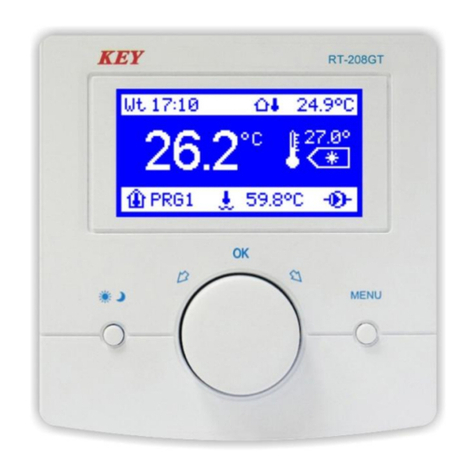
Lennox V0STAT54P-3 Installation instructions

1
Electrostatic discharge can aect
electronic components. Take precau-
tions to neutralize electrostatic charge
by touching your hand and tools to
metal prior to handling the control.
Frequent changes to operating mode
may cause system malfunction.
Allow at least one minute between
mode changes to allow the system to
stabilize.
INSTALLATION/
OPERATION
INSTRUCTIONS
CONTROLS
507898-01
01/2019
THIS MANUAL MUST BE LEFT WITH
THE OWNER FOR FUTURE REFER-
ENCE
WARNING
Improper installation, adjustment,
alteration, service or maintenance
can cause property damage,
personal injury or loss of life.
Installation and service must be
performed by a licensed professional
HVAC installer (or equivalent) or
service agency.
!
V0STAT54P-3 Indoor Unit
Non-programmable
Controller
IMPORTANT
!
IMPORTANT
!
©2018 Lennox Industries Inc. Dallas, Texas, USA
VRF

2
Shipping and Packing List
Package 1 of 1 contains;
1 – Wired Controller
2 – Plastic spacers
3 – Screws
1 – Installation and operation manual
General
The V0STAT54P-3 is a wired non-pro-
grammable local controller that controls
up to 16 VRF indoor units. These instruc-
tions are intended as a general guide and
do not supersede local codes in any way.
Consult authorities having jurisdiction be-
fore installation.
Requirements
• Four-conductor, 18-gauge, stranded,
shielded, polarity-sensitive cable is re-
quired for installation.
• Be sure that the indoor unit power sup-
ply has been turned o before begin-
ning installation.
• This controller should be used only as
described in this manual.
• Do not install the controller on outside
walls (where there is unconditioned
space on opposite side of wall) or in
locations where direct sunlight may be
present.
Installation
Clean controller using a clean,
damp cloth. Do not spray cleanser
on or around controller.
Do not install controller in areas
where harmful gases containing
sulfur or other damaging agents
may exist or the controller may be
damaged.
CAUTION
!
Power wiring between controller and
rst indoor unit:
• Minimum 18 AWG stranded shielded
cable up to 164 feet (50 m).
• Ensure there are no gaps between
the controller back cover and the
mounting surface.
• Fill any holes in the wall behind the
controller to avoid false readings from
inltration.
• Ground the shielded control wiring at
the indoor unit.
• Do not use a megger to test insulation.
Communication wiring between indoor
units:
• Minimum 18 AWG stranded shielded
cable.
CAUTION
!

3
Read all of the information in this manu-
al before using this controller. All wiring
must conform to local and national build-
ing and electrical codes and ordinances.
This is a 12 VDC controller. Do not in-
stall on voltages higher than 12 VDC.
Do not operate controller with wet
hands.
• This manual provides the installation
instructions for this controller. Refer to
the included wiring diagrams to con-
nect the controller to the indoor unit.
• The controller uses low voltage. Keep
a minimum distance of 12” (305 mm)
between low voltage control wire and
high voltage power wires.
Figure 1. Remove Controller from Back Cover
CAUTION
!
IMPORTANT
!
1 2
3

4
1. Remove the back cover by inserting a
at head screw driver into the slots until
the clips release then lifting up the bot-
tom of the controller and sliding it toward
the top of the back cover. See Figure 1.
Do not lift the bottom of the controller
straight up as that will damage the
clips. See Figure 1.
Figure 2. Do Not Damage Casing
Return air (T1) sensor.
Do not insert screw
driver.
Use these slots
to remove the
back cover.
Do not twist screw driver or use the
screw driver to pry up the cover plate.
Use caution to prevent damage to
casing.
2. Do not twist the screw driver or use the
screw driver to pry up the face plate or
the casing could be damaged. Use cau-
tion to avoid damaging the controller.
Do not insert the screw driver in the T1
Return Air sensor hole. See Figure 2.
3. Adjust the length of the two plastic spacers as needed to allow the controller to be
mounted ush with the wall. NOTE – Be sure to provide for future maintenance by
allowing enough slack in the wiring to allow the controller to be removed from the wall
if needed. See Figure 3.

5
Figure 3. Installation
Figure 4. Connection at Controller
4-conductor wiring
4. Attach the back cover using factory-provided screws or other xing method as appro-
priate for the application. See Figure 3.
5. At the controller, wire the eld-provided 4-conductor shielded cable to +12V/COM/HB/
HA terminals of the controller. See Figure 4.
6. Reattach the controller to the back cover.

6
Figure 5. Wire to One Indoor Unit
CAUTION
Connect “+12V” on the controller to
terminal “+12V” on the rst indoor unit
only. 12V connection provides power
to controller; connection to multiple
indoor units will damage controller and
indoor unit boards.
7. Connect the controller to one or more indoor units, up to 16. Use 4-conductor shield-
ed cable to connect to the rst indoor unit. NOTE - Wiring is polarity sensitive. See
Figure 5.
COM +12V
HB
HA
NOTE - 1. Connect up to 16 indoor units
2. Ground cable shielding at indoor unit
3. All wiring is polarity sensitive
COM +12V
HB
HA

7
Specications
Input voltage 12 VDC
Ambient temperature 23~110°F (-5~43°C)
Ambient humidity RH40%~RH90%
Table 1. Specications
Figure 6. Wire Multiple Indoor Units
NOTES - 1. Connect “+12V” on the controller to terminal “+12V” on the first indoor
unit only. 12V connection provides power to controller; connection to
multiple indoor units will damage controller and indoor unit boards.
2. Ground cable shielding at each indoor unit.
4. Use stranded, shielded, 18 GA cable.
5. Connect up to 16 indoor units.
COM +12V
HB
HA
COM +12V
HB
HA
COM +12V
HB
HA COM +12V
HB
HA
8. Daisy chain 2-conductor control wiring to each additional indoor unit using the
HB/HA terminals in the electrical control box of the indoor unit. Do not daisy chain
the +12V power cable or the COM wire. See Figure 6. NOTE - Wiring is polarity sen-
sitive.

8
Description of Buttons & Display
Power
Button
Fan
Speed
Button
Up-Arrow
Button
Mode
Button
Cooling
Mode
Heating
Mode
Auto
Mode
Dry
Mode
Fan
Mode
Locked
Function
Centralized
Controller
Locked
Cooling
Setpoint
Heating
Setpoint
Down-Arrow
Button
Room
Temperature
Swing
Fan Speed
Sub

9
Operation
After powering on the controller, wait 30 seconds for initialization The indoor unit cannot
be controlled by the controller until initialization is complete.
Start/Stop Operation
Press the power button.
• Controller ON: LED display lit.
• Controller OFF: LED display not lit.
Set Operation Mode
Press the Mode button to scroll through the mode selections.
• Cool – System operates in cooling mode.
• Heat – System operates in heating mode.
• Auto -- System operates in auto mode.
• Dry -- System operates in dehumidication mode. NOTE - fan speed cannot be ad-
justed during dry mode.
• Fan – Fan only, no heating or cooling.
To set (or change) the room temperature setting (setpoint)
Press the up-arrow & down-arrow buttons to adjust the setpoint.
When in Auto mode, separate heating and cooling setpoints can be set. Press the Mode
button to switch between heating and cooling setpoints.
NOTE - Indoor units connected to a local controller may also be controlled by a centralized
controller. Indoor units respond to the last command sent. It is recommended that indoor
units be controlled from a single source of control, either local controller or centralized
controller but not both, to avoid conicts in commands.

10
Figure 8. Function Lock Indicator
Louver Swing Operation
Press both the up-arrow button and the down-arrow button simultaneously to change lou-
ver auto swing operation, specied position and stop as shown in Figure 7. Do not move
louvers manually; only move louvers using the louver swing function on the controller.
NOTE - Not available on all indoor unit types.
Lock Operation
Some operational functions can be locked. Use Settings No. 29~33 to lock the functions
of the controller. See Table 2.
Figure 7. Louver Swing Operation
AUTO
AUTO
Locked Function
Centralized
Controller
Locked
Table of contents
Other Lennox Temperature Controllers manuals
Lennox
Lennox COMFAIR HH Series Installation guide
Lennox
Lennox RDF300.02 ARG71 User manual

Lennox
Lennox A122C User manual

Lennox
Lennox CL50-RoofTop User manual

Lennox
Lennox Basic Climatic Controller Ecologic User manual
Lennox
Lennox Zoning System LZP-4 User manual
Lennox
Lennox A111C User manual

Lennox
Lennox Climatic 10 User manual
Popular Temperature Controllers manuals by other brands
SMC Networks
SMC Networks Thermo-con INR-244-639 Operation manual
eltherm
eltherm Ex-TC It Series operating instructions

Omron
Omron C200H-TV Series Operation manual

industrie technik
industrie technik CA1 instructions
KRAL
KRAL EET 32 operating instructions
dixell
dixell XR420C Installing and operating instructions