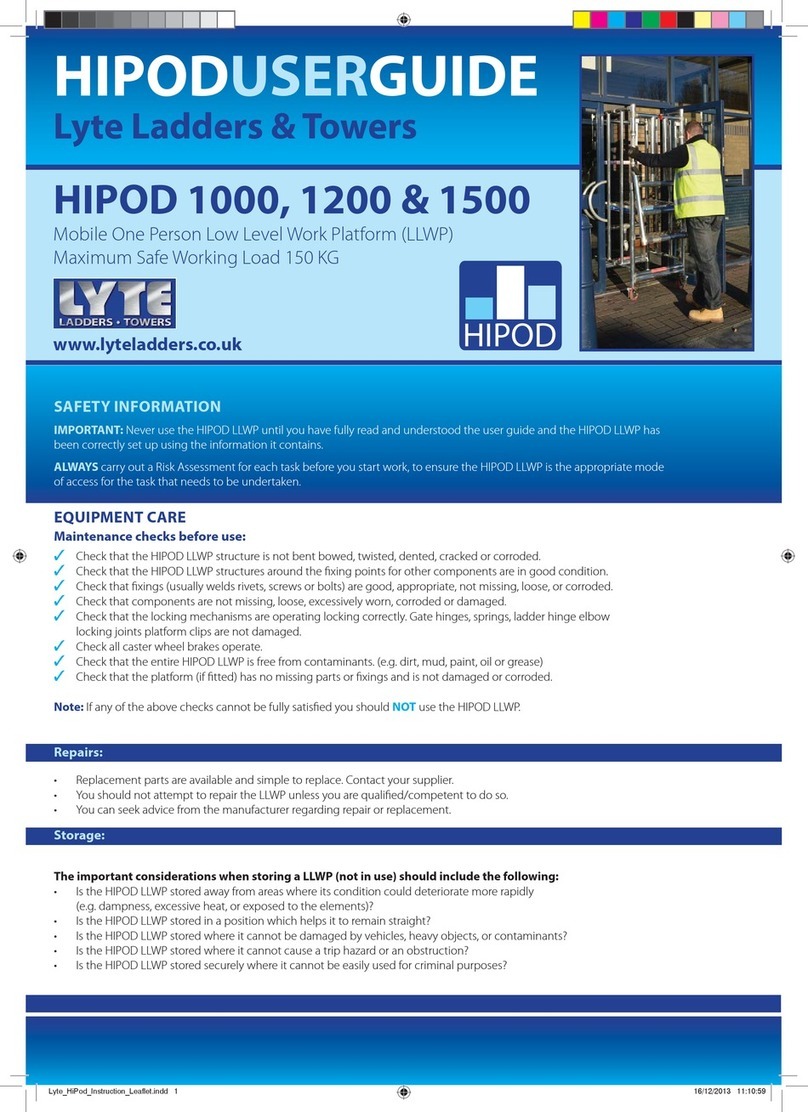
HIPODUSERGUIDE
SAFETY INFORMATION
IMPORTANT: Never use the HIPOD LLWP until you have
fully read and understood the user guide and the HIPOD
LLWP has been correctly set up using the information
it contains.
ALWAYS carry out a Risk Assessment for each task before
you start work, to ensure the HIPOD LLWP is the appropriate
mode of access for the task that needs to be undertaken.
Maintenance checks before use:
HIPOD 1000, 1200 & 1500
Lyte Ladders & Towers
www.lyteladders.co.uk
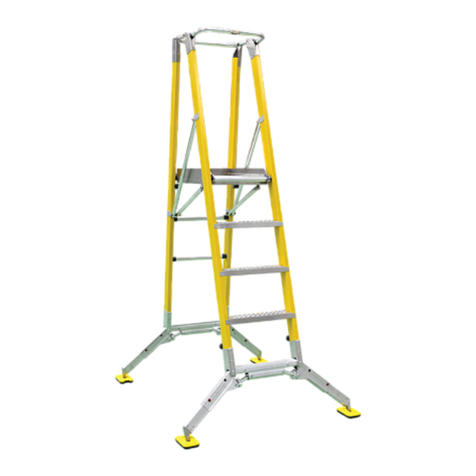
Mobile One Person LOW LEVEL WORKING PLATFORM (LLWP)
Maximum Safe Working Load 150 KG
Repairs:
EQUIPMENT CARE
3Check that the HIPOD LLWP structure is not bent, bowed, twisted, dented, cracked or corroded.
3Check that xings (usually welds, rivets, screws or bolts) are good, appropriate, not missing, loose, or corroded.
3Check that components are not missing, loose, excessively worn, corroded or damaged.
3Check that the locking mechanisms are operating and locking correctly. Gate hinges, springs, ladder hinge,
elbow locking joints and platform clips are not damaged.
3Check the side arm and rubber feet are not worn.
3Check all caster wheel brakes operate.
3Check that the entire HIPOD LLWP is free from contaminants. (e.g. dirt, mud, paint, oil or grease)
3Check that the platform has no missing parts or xings and is not damaged or corroded.
Note: If any of the above checks cannot be fully satised you should NOT use the HIPOD LLWP.
• Replacement parts are available and simple to replace. Contact your supplier.
• You should not attempt to repair the LLWP unless you are qualied/competent to do so.
• You can seek advice from the manufacturer regarding repair or replacement.
The important considerations when storing a LLWP (not in use) should include the following:
• Is the HIPOD LLWP stored away from areas where its condition could deteriorate more rapidly
(e.g. dampness, excessive heat, or exposed to the elements)?
• Is the HIPOD LLWP stored in a position which helps it to prevent damage?
• Is the HIPOD LLWP stored where it cannot be damaged by vehicles, heavy objects, or contaminants?
• Is the HIPOD LLWP stored where it cannot cause a trip hazard or an obstruction?
• Is the HIPOD LLWP stored securely where it cannot be easily used for criminal purposes?
Storage:
SAFETY CHECKLIST
Is the HIPOD in good condition
(see equipment care &
inspection information).
The total load (person plus
equipment) should not
be more than 150kg.
Ensure castors are rmly
braked o and in contact
with the oor.
The access ladder
is correctly located.
Ensure side arm is
correctly positioned.
The HIPOD is in the correct
position for work and over
reaching is avoided.
Ensure the height of the
HIPOD is also conducive
to the instructions and work
being carried out.
All safety gates and locks are
engaged when in use.
3
•
•
•
•
•
•
•
•
DO NOT TRANSPORT OR MANOEUVRE THE HIPOD
BY THE ACCESS LADDER, THIS WILL CAUSE DAMAGE
PAS2503HIPOD
PAS250
Lyte_HiPod_Instruction_Leaflet_2015.indd 1Lyte_HiPod_Instruction_Leaflet_2015.indd 1 23/04/2015 14:24:5623/04/2015 14:24:56