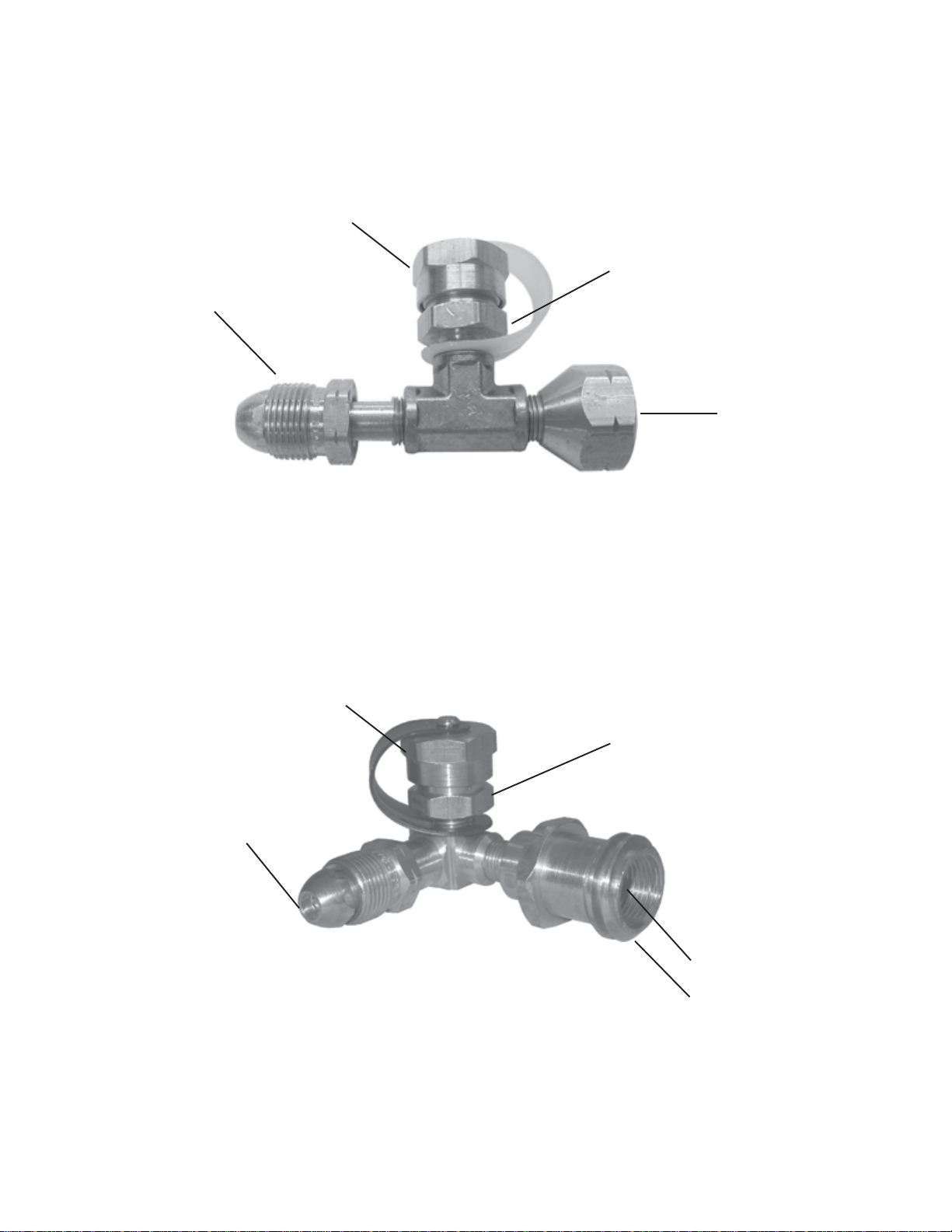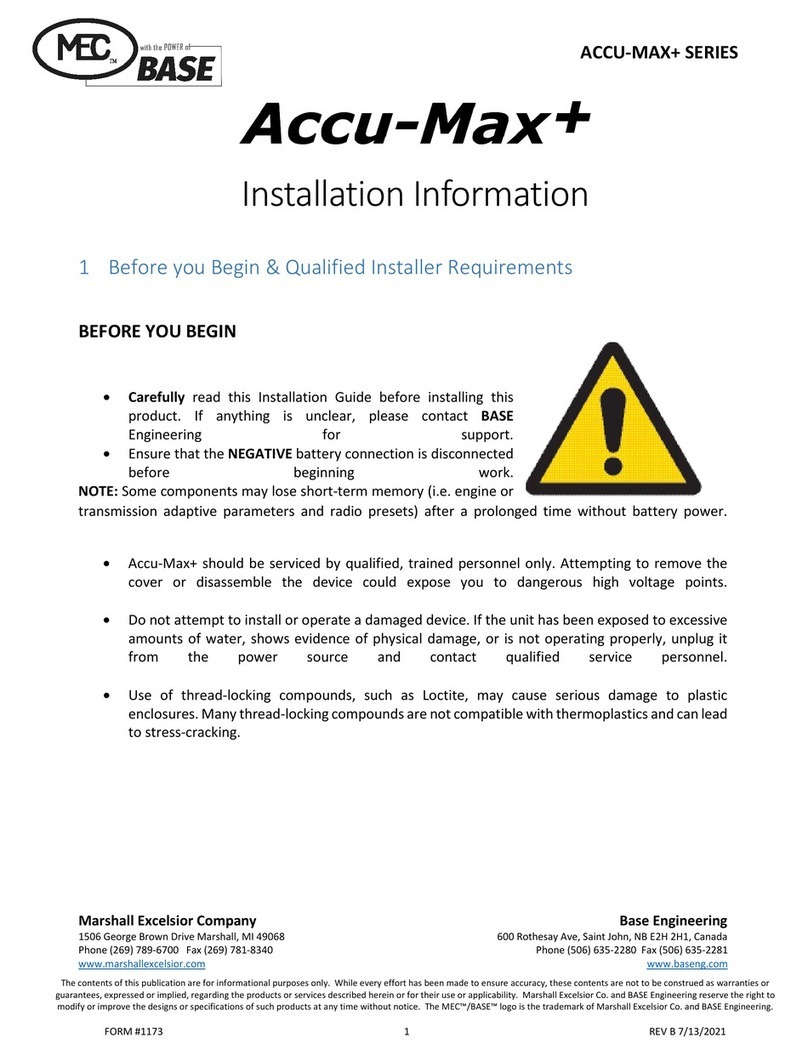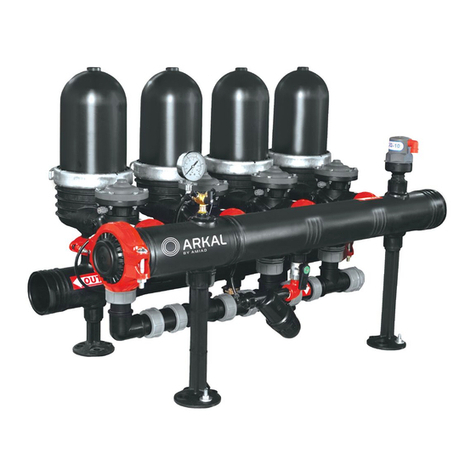
It will be necessary to move the existing POL fitting on your regulator away from the vapor withdrawal
valve far enough to place the Flow-Longer tee between them. If the Flow-Longer is being installed on
an RV’s ASME tank, this may also require moving the regulator cover.
Thread the male POL fitting on the Flow-Longer tee, into the vapor withdrawal valve. Turn this left-
hand nut counter-clockwise to tighten, but before tightening, position the fitting’s top outlet port for best
access. Use a 7/8 inch wrench to tighten the POL nut into the vapor withdrawal valve.
Flow Longer Tee- Thread the male POL fitting attached to the pressure regulator or pigtail hose, into the
female POL fitting on the Flow-Longer tee.Again, turn the left-hand POL nut counter-clockwise. Two
(2) wrenches are required to tighten this connection properly, but before tightening, besure to orient your
pressure regulator in its original position. It is important not to break the factory seal on the threaded inlet
and outlet connections on the Flow-Longer tee. Use one wrench to securely hold the Flow-Longer
female fitting while tightening the male POL nut with a second wrench. Prevent rotating the Flow-
Longer tee while tightening this connection.
Flow Longer Plus Tee–Can follow same installation instructions as above orcan be used with a standard
Type I connection, by turning the plastic nut onto the male threads clockwise until hand tight. Do not use
tools to make this connection.
If you installed the Flow-Longer tee on an RV’s ASME tank, securely fasten the pressure regulator and
its accompanying low-pressure outlet hose to the vehicle, to avoid possible damage or loosening due to
“over the road” vibration. Depending upon the particular layout of your vehicle’s LP-Gas container
compartment, it may be necessary to have an LP-Gas dealer or RV service technician fabricatebrackets
or supporting hardware.
LEAKAGE CHECKS for the Flow-Longer tee:
After allconnections are tightened securely,the installation must bechecked for leaks.Make sure all gas appliances
are off, and then turn the LP-Gas vapor withdrawal valve counter-clockwise to its full open position. Using an
ammonia-free soap, prepare a soapy water solution and check for leakage at all the connections from the valve up
to and including the low-pressure outlet of the regulator. If a leak is found at one of the POL connections, tighten
it until the bubbles stop. If however, leakage is found at a pipe thread connection at the Flow-Longer tee, or at the
pressure regulator, close the cylinder valve immediately and contact your LP-Gas dealer.
WARNING: An LP-Gas leak, if ignited, could result in fire, explosion, severe personal injury, property damage,
or death. Matches, candles, or other sources of open flame must NEVER be used to test for leaks.
DOUBLE CYLINDER INSTALLATIONS:
If your double cylinder installation has an automatic changeover regulator, the indicator arrow of the
changeover must point at the cylinder to which the tee is connected to assure an uninterrupted supply of gas
to the tee.As long as there is gas in the cylinder to which the tee is connected, the tee will function regardless
of which cylinder the arrow points to. However, if the cylinder to which the tee is connected is emptied, the
automatic regulator will not allow gas to flow to the tee if the arrow points to the opposite cylinder. If the
cylinder to which the tee is connected is empty and the arrow is pointed to the empty cylinder, the gas
pressure to the tee will be reduced to approximately 10 to 15 psi. While this pressure is sufficient for most
portable appliances, it may not be suitable for appliances having larger BTU requirements. Also, some
regulatorsonportableappliancesfunctiondifferentlywithlessthanfullcylinderpressure.Anemptycylinder