4
ul 325 compliant
installation requirements
AInstall the gate operator only when:
1The operator is appropriate for the construction of the gate and the usage Class of the gate,
2All openings of a horizontal slide gate are guarded or screened from the bottom of the gate to a minimum of 6 feet (1.83 m) above the
ground to prevent a 2-1/4 inch (57.2 mm) diameter sphere from passing through the openings anywhere in the gate, and in that
portion of the adjacent fence that the gate covers in the open position,
3All exposed pinch points are eliminated or guarded, and
4Guarding is supplied for exposed rollers.
BThe operator is intended for installation only on gates used for vehicles. Pedestrians must be supplied with a separate access opening. The
pedestrian access opening shall be designed to promote pedestrian usage. Locate the gate such that persons will not come in contact with
the vehicular gate during the entire path of travel of the vehicular gate.
CThe gate must be installed in a location so that enough clearance is supplied between the gate and adjacent structures when opening and
closing to reduce the risk of entrapment. Swinging gates shall not open into public access areas.
DThe gate must be properly installed and work freely in both directions prior to the installation of the gate operator. Do not over-tighten the
operator clutch or pressure relief valve to compensate for a damaged gate.
EFor gate operators utilizing Type D protection:
1The gate operator controls must be placed so that the user has full view of the gate area when the gate is moving,
2 A gate operator shall additionally be provided with a placard that is marked in letters at least 1/4-in (6.4-mm) high with the word
“WARNING” and the following statement or the equivalent: “Moving Gate Has Potential of Inflicting Injury or Death - Do Not Start
Gate Unless Path is Clear”.
3An automatic closing device (such as a timer, loop sensor, or similar device) shall not be employed, and
4No other activation device shall be connected.
FControls intended for user activation must be located at least six feet (6’) away from any moving part of the gate and where the user is
prevented from reaching over, under, around or through the gate to operate the controls. Outdoor or easily accessible controls shall have a
security feature to prevent unauthorized use.
G
The Stop and/or Reset button must be located in the line-of-sight of the gate. Activation of the reset control shall not cause the operator to start.
HA minimum of two (2) WARNING SIGNS shall be installed, one on each side of the gate where easily visible.
IFor gate operators utilizing a non-contact sensor:
1See instructions on the placement of non-contact sensors for each Type of application,
2
Care shall be exercised to reduce the risk of nuisance tripping, such as when a vehicle, trips the sensor while the gate is still moving, and
3One or more non-contact sensors shall be located where the risk of entrapment or obstruction exists, such as the perimeter reachable
by a moving gate or barrier.
JFor a gate operator utilizing a contact sensor:
1One or more contact sensors shall be located where the risk of entrapment or obstruction exists, such as at the leading edge, trailing
edge, and post mounted both inside and outside of a vehicular horizontal slide gate.
2One or more contact sensors shall be located at the bottom edge of a vehicular vertical lift gate.
3One or more contact sensors shall be located at the pinch point of a vehicular vertical pivot gate.
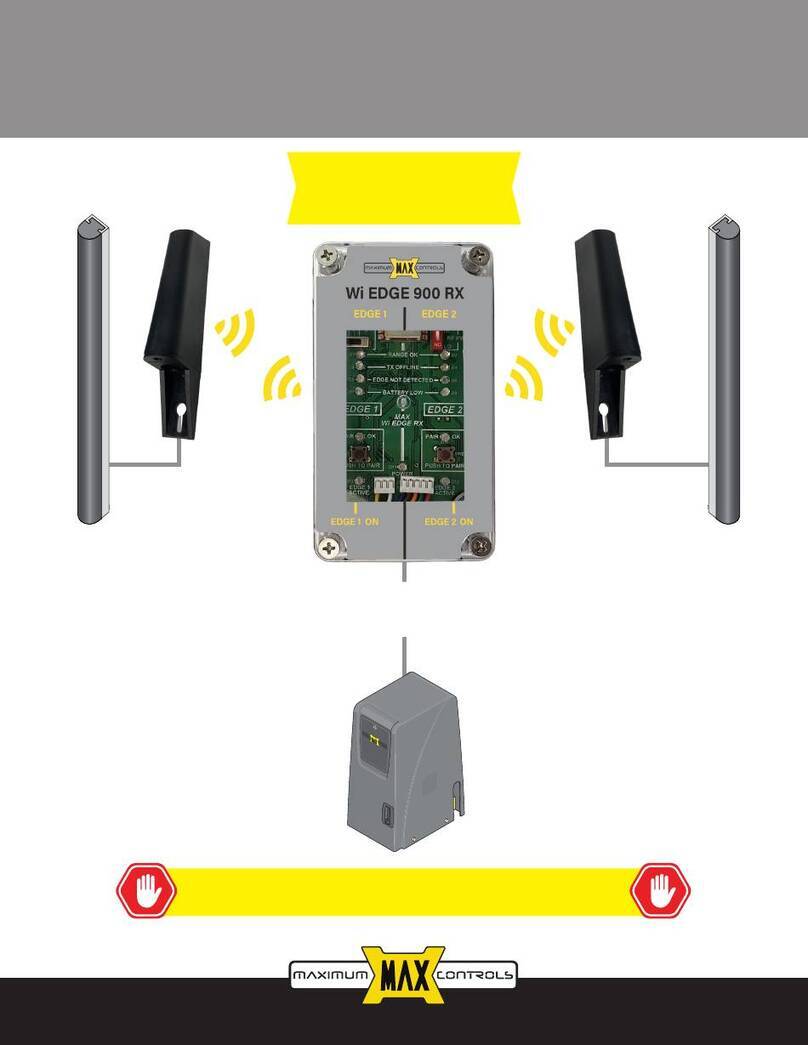
4A hardwired contact sensor shall be located and its wiring arranged so that the communication between the sensor and the gate
operator is not subjected to mechanical damage.
5A wireless device such as one that transmits radio frequency (RF) signals to the gate operator for entrapment protection functions
shall be located where the transmission of the signals are not obstructed or impeded by building structures natural landscaping or
similar obstruction. A wireless device shall function under the intended end-use conditions.
6One or more contact sensors shall be located on the inside and outside leading edge of a swing gate. Additionally, if the bottom edge
of a swing gate is greater than 6 inches (152 mm) above the ground at any point in its arc of travel, one or more contact sensors shall
be located on the bottom edge.
7One or more contact sensors shall be located at the bottom edge of a vertical barrier (arm).