MxL7213 13A Dual Phase EVB User Manual Introduction
10/15/20 000UMR05 1
Introduction
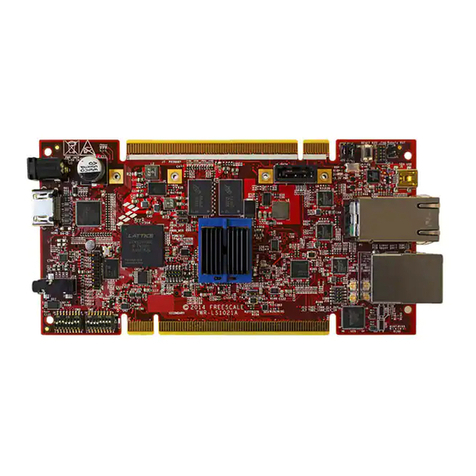
The MxL7213 evaluation board provides a platform to evaluate the features and performance of the MxL7213. The
MxL7213 is a dual 13A Power Module optimized for powering Telecom, Networking and Industrial equipment. This manual
covers the 13A Dual Phase BGA and LGA Evaluation Boards.
Quick EVB Set Up and Start Up
Factory Settings
In addition to utilizing the 4.5V to 16V input voltage range and dual 13A maximum load current rating capabilities of the
MxL7213 Power Module, the Evaluation Board has been set up with the factory default configurations shown below for
quick set up and operation. Do not exceed the EVB maximum load current rating.
The factory default configuration (Table 2) for the MxL7213 Evaluation Board is:
■VOUT1 = 3.3V ±1.5%
■VOUT2 = 5.0V ±1.5%
■750kHz Switching Frequency
■CCM mode. For other modes, see Jumper J44 MODE.
■Run is enabled for both channels. See Jumpers J30
RUN1 and J29 RUN2.
■Soft-start is selected for both channels. See Jumper
J26 TRACK1 SEL and Jumper J25 TRACK2 SEL.
■CLKOUT phase is 90 degrees, see Jumper J45
PHASMD.
■Differential remote sense amplifier monitoring VOUT1
Quick Start Up
To quickly see the regulator in operation:
1. Use the factory settings and default configuration. If
other settings or components are desired, apply them
before the next steps and see Set-Up Options for more.
2. Connect a turned-off power supply that is within a VIN
specification of 4.5V to 16V, (12V typical) to VIN and
GND with short, thick leads. Use test pins VIN+ and
VIN- to monitor VIN and GND respectively. See
locations in Figure 1.
3. For the channel 1 output, connect an electronic load
initially set to 0A, that will be no more than the above
maximum IOUT (13A ), to VOUT1 and GND with short /
thick leads. Use test pins VOUT1 (J52) and
VOUT_GND (J60) to monitor VOUT1 and GND
respectively. See locations in Figure 1.
4. For the channel 2 output, connect an electronic load
initially set to 0A, that will be no more than the above
maximum IOUT (13A ), to VOUT2 and GND with short,
thick leads. Use test pins VOUT2 (J53) and
VOUT2_GND (J61) to monitor VOUT2 and GND
respectively. See locations in Figure 1.
5. Turn on the power supply and check VOUT of both
channels. The EVB will power up and (factory default)
regulate the channel 1 output at 3.3V ±1.5% (3.251V to
3.349V) and channel 2 output at 5.0V ±1.5% (4.925V
to 5.075V). Output ripple should be measured across
the output capacitors for each channel: C8 for VOUT1
and C22 for VOUT2. Test points J52 and J53 can be
used to monitor the ripple for VOUT1 and VOUT2,
respectively.
6. Set or vary the load (do not exceed the maximum IOUT)
and check VOUT and other desired performance levels
such as regulation and efficiency.
See Configuration and I/O Interfaces and Load Transient
Circuit for more on testing and monitoring. For Single Rail
Dual Phase 26A Operation and to vary VOUT see MxL7213
EVB Mode Selection.