MFJ-962D Instruction Manual
3
Introduction
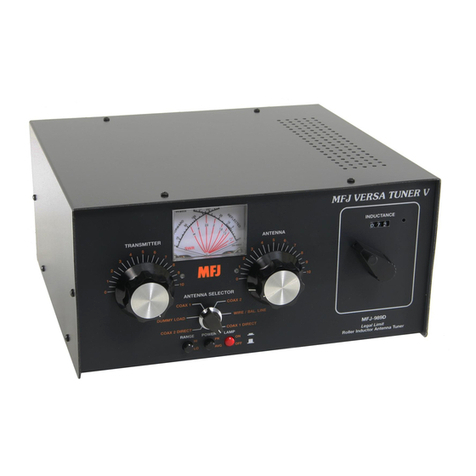
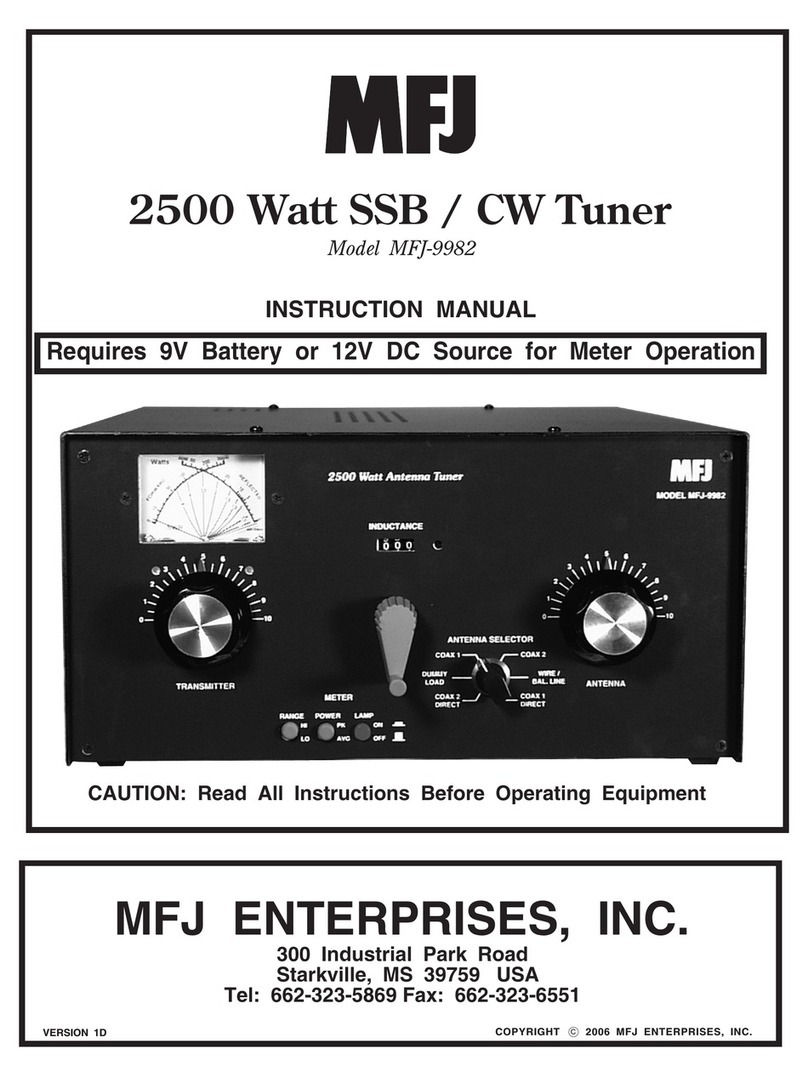
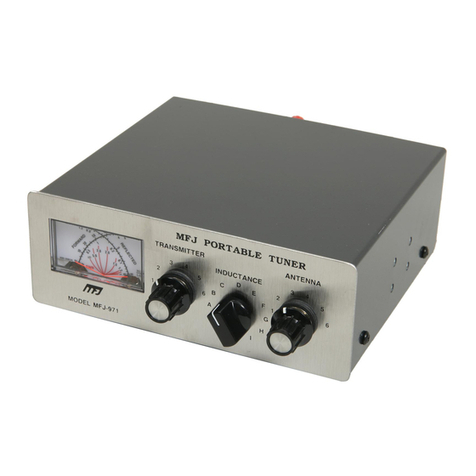
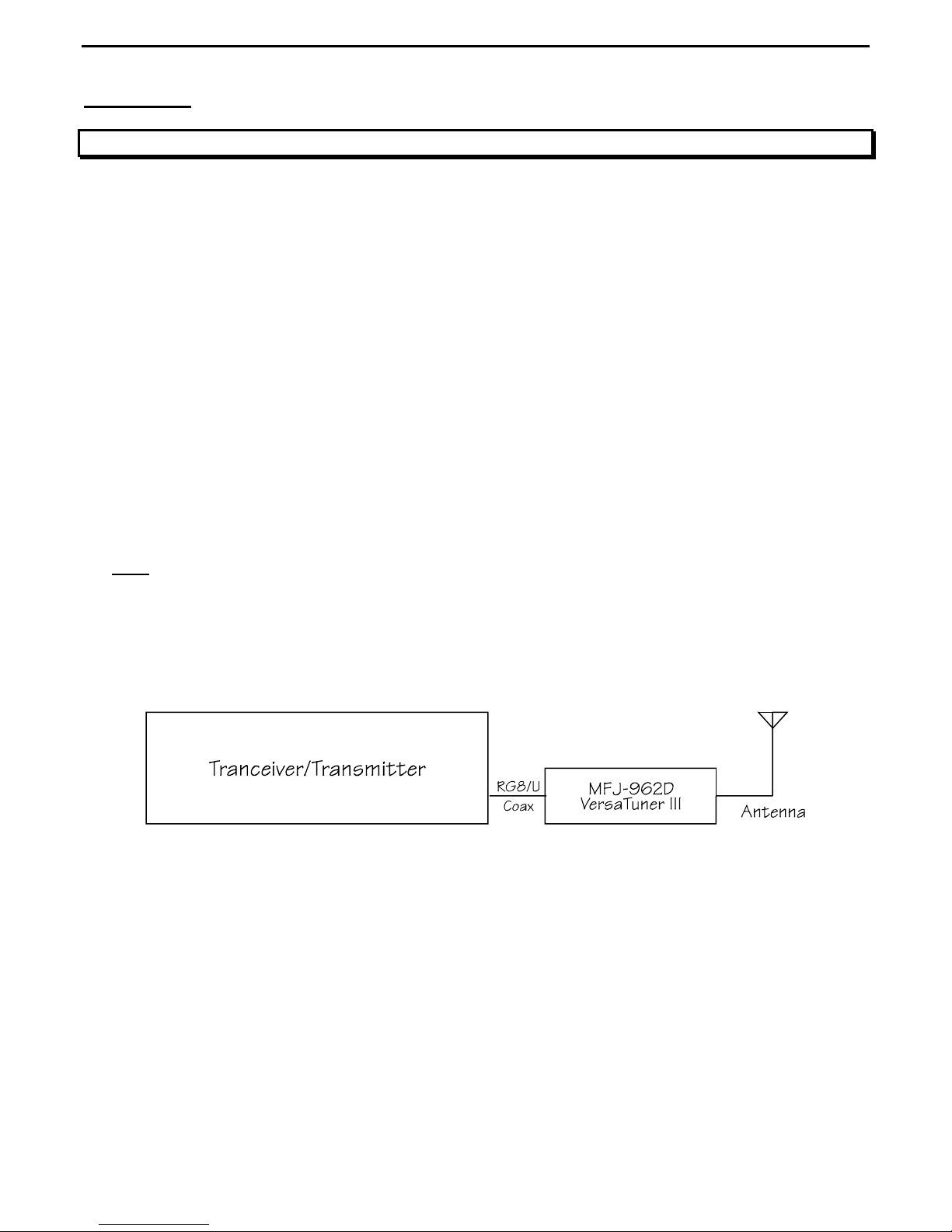
The MFJ-962D is a "T" network roller inductor tuner with built-in antenna switching, RF power and
SWR metering and a 1:1 balun. The largest amplifiers that can safely be used include the Heathkit SB-
200 and 201, Collins 30L1, and Ameritron's AL-600 and AL-811 series of amplifiers. This tuner is
designed for maximum RF output power levels of 800 watts carrier or PEP on 80-10 meters, and 500
watts carrier or PEP on 160 meters. It is designed to match 50 ohm output amplifiers, transmitters or
transceivers to virtually any antenna. Peak and average forward power, reflected power, and SWR are
displayed on the wattmeter's illuminated cross-needle meter.
The MFJ-962D uses a roller inductor "T" matching network. It continuously tunes all frequencies from
1.8 through 30 MHz. It will match dipoles, inverted-vee's, verticals, mobile whips, beams, random
wires, and many other antennas. The built-in balun will work with balanced open wire, twinlead, or
twin-axial feedlines.
An internal six position antenna-selector switch selects two separate coaxial line outputs either in tuned
(with tuner's matching network in line) or direct (no matching circuit) configurations, a balanced line
output, and a coax bypass position for accessories such as an external dummy load. Long wire antennas
can be connected to the center connector of the coax connector.
Understanding Power Ratings
There are no standardized power rating systems for tuners. The names used (i.e. 3 kW Tuner) carry over
from the time when amplifiers were rated by peak power input, and not the true RF power output. For
example, the one thousand watt Johnson Matchbox was rated to handle a 1000 watt plate modulated AM
transmitter (four kilowatts PEP transmitter input and 3000 watts PEP RF output). The Heathkit SB-220
was called a two kilowatt amplifier, and the rated CW output was approximately 600 watts. Matching
tuners were called 2 kilowatt tuners, and these tuners safely handled 600 watts of CW power and 1200
watts PEP SSB.
The FCC has changed the power rating system of amplifiers, and tuners no longer follow amplifier
power ratings. Most typical 1500 watt tuners remain able to safely handle 400-600 watts CW, and 600-
900 watts PEP SSB.
Load conditions and control settings also greatly affect the power handling capability of the tuner. T-
networks typically handle more power on higher frequency bands into higher load impedances. The
worst operating condition for T-network tuners are low impedance capacitive reactance loads. T-
network tuners always handle the least power when operated on 160 meters into low impedance
capacitive reactive loads.
Power Requirement
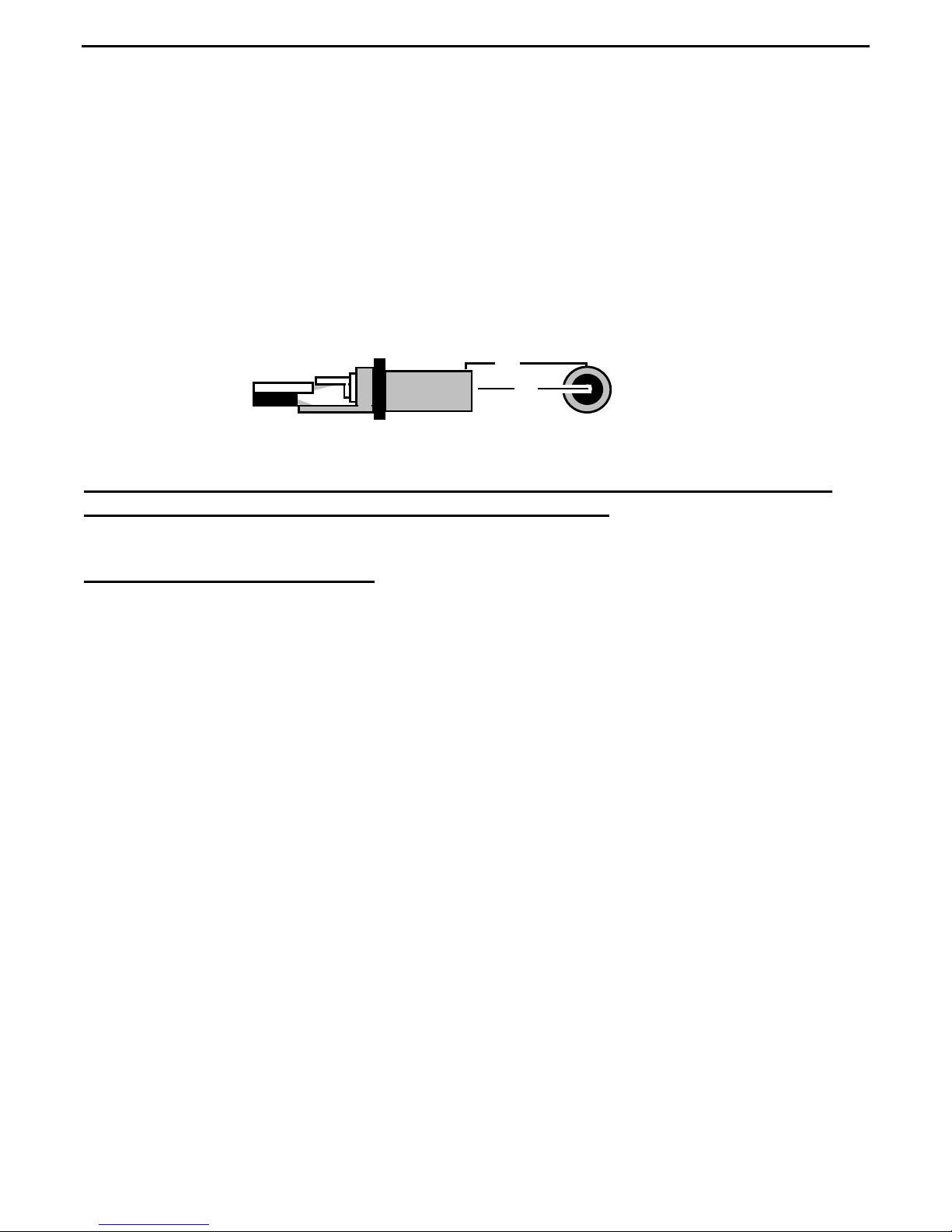
The upgraded MFJ-962D requires a power source to run its SWR/Wattmeter circuitry. Power may come
from one of two sources:
1.) 9-Volt Battery:To install a 9-volt battery, access the internal holder and snap clip by removing the
12 cabinet screws and lifting off the tuner cover. The holder is mounted on the upper right corner of the
front panel. We strongly recommend installing a battery, even if you intend to use an external power
source. Doing so provides backup voltage to operate the meter and also prevents the battery snap clip
from floating loose inside the cabinet where it could contact high RF potentials. If you elect to omit the