- 4 -
Most road bikes usually use tubeless tires which are fixed
by rubber glue, so it requires flat sectional shape.
However most MTB usually require the rim with ordi-
nary tube which has shoulders inside to hold the tire
bead.
Wrong sized rim, too narrow or too wide, can cause the
tire to come off or be punctured easily. So you should
ask to your local shop about the combination of the rim
and the tire, and choose the correct size.
MATERIAL
Check the material of the rims.
There are many kinds of material for the rims in the
market; light alloy, stainless steel, chrome plated steel
or carbon. They have their own benefits, but they also
have their own problems.
If you will use the wheel only for race, you can choose
a light weight one. But if you will use the wheel every-
day, you should take strength rather than weight.
In this instructions, we choose a light alloy rim, because
it is light weight enough and durable and has a reason-
able price.
DISTORTION
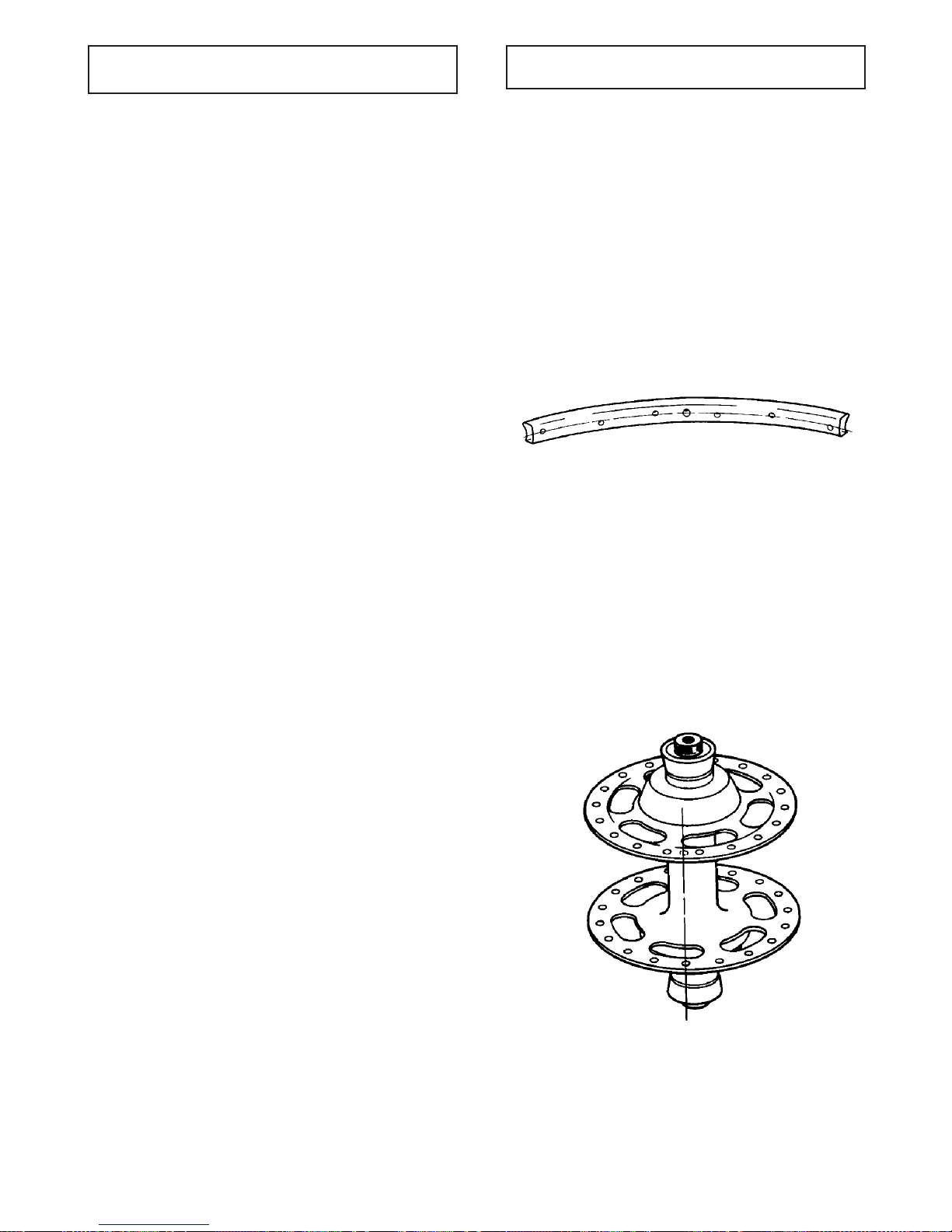
Check the distortion of the rim.
At first, place the rim on a flat table, and next, push
down the edge with your fingers. If the other side has
raised up more than 5mm, the rim is bad. You should
exchange it for a better one. It is the most important
thing when you buy a rim at a shop. Because it is diffi-
cult to fix the distortion of the rim will keep its own
shape.
§SPOKE
In this instructions, we use 36 pieces of 14-gauge non-
butted 265mm stainless steel spokes. Please check the
following things.
MATERIAL
Check the material of the spokes.
There are various kinds of materials for spokes in the
market; stainless steel, chrome plated steel or titanium.
They have their own benefits, and also they have their
own problems.
Titanium spokes are very light weight, but they can be
broken easily by sudden force. Chrome plated steel
spokes are cheap, but they will rust easily.
You should choose the material with your own pur-
pose.
We use stainless steel spokes because it is cheaper than
titanium, and its has enough strength.
SHAPE
Check the shape of the spokes.
There are two kinds of its style; straight and swaged.
We usually use swaged spokes. However some choose
straight spokes with a special hub for the front wheel
of road bikes.
There are other kind of shapes; butted and non-butted.
Butted spokes have flat shafts on its center part for
aerodynamics. But you should understand that butted
spokes are weaker than non-butted spokes.
SIZE
Check the length and diameter of the spokes.
Mostly there are two different diameters of the spokes;
14-gauge (2.0mm) and 15-gauge (1.8mm).
We usually use 15-gauge spokes for bicycles. Although
some heavy weight riders should choose 14-gauge
spokes.
All spokes must be the correct size for the nipples, it is
the most important thing.
And there are many length of the spokes available.
Length is decided by two factors; radial or tangential
wheel style, and front or rear. Rear wheel requires a
special style to construct, it is “offset”.
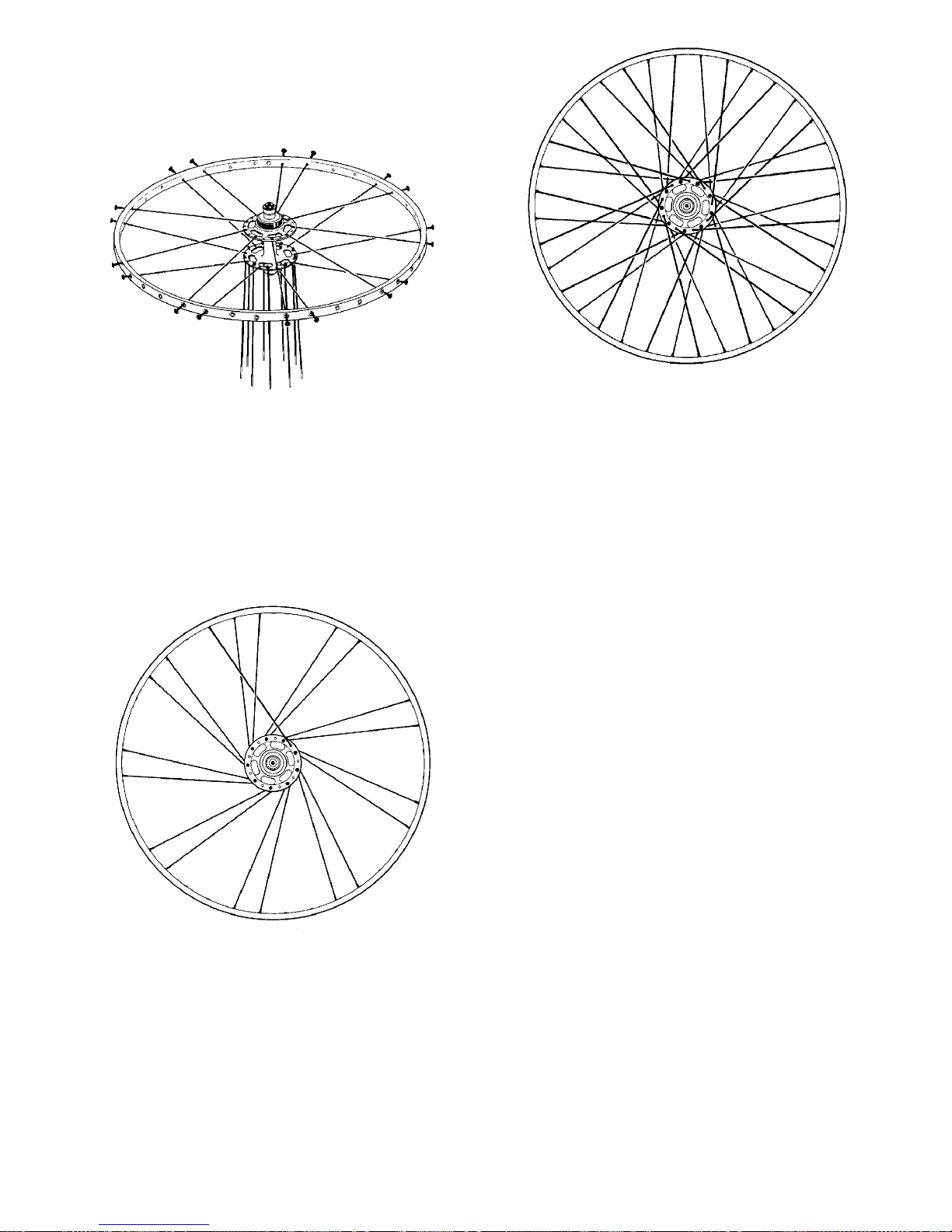
We can see the different spoke angles on the rear wheel
between right side and left side. Right side (rear cog
side) spokes are more near by hub center than the left
side. Because rear wheel must have 8 to 10 transmis-
sion gears on its right side, so the spokes must walk
away to the center.
We recommend the best spoke length combination for
best fitting, right side spokes should be 1mm shorter
and left side spokes should be 1mm longer. You may
ask to your local shop what the length of the spokes
that you need.