Function Idle/Moving
F1 Bell on/off
F2 Horn
F3 Accessory light on/off, air release
F4 Coupling 1
F5 Brake release (idle) / brake squeal (moving)
F6 Dynamic brake on/off
F7 Air hose firing/uncoupling lever
F8 3 times will shut down when in idle / Manual notch down
F9 Engine cooling fan / Manual notch up
F10 Rail wheel clack (only moving)
F11 Tractionair compressor
F12 Sound on / off
F13 Master volume reduce by 1 / air release when reach minimal
F14 Master volume increase by 1/ air release when reach maximum
F15 Air compressor
F16 Flange squeal
F17 Air release
F18 Change bell type
F19 Horn type select
F20 Associated loco sound
F21 Change bell volume and turn on the bell
F22 Change horn volume
F23 Change diesel rumble volume
F24 Safety valve pop
F25 Air release
F26 Flange noise
F27 Sand drop
F28 Air release
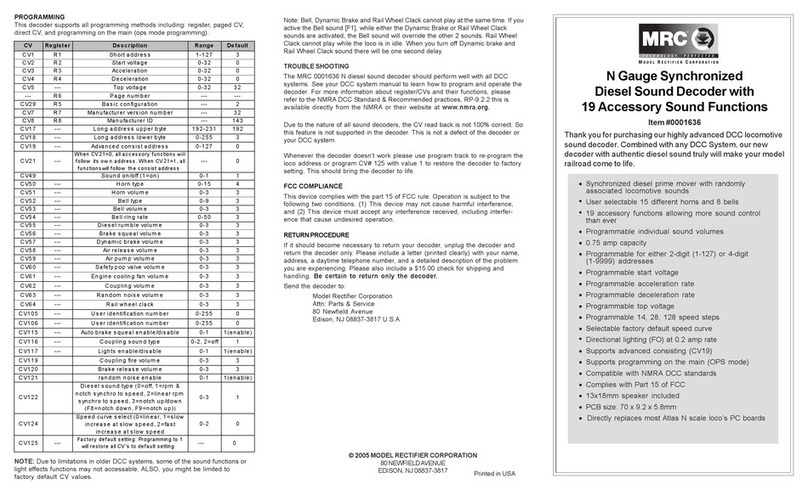
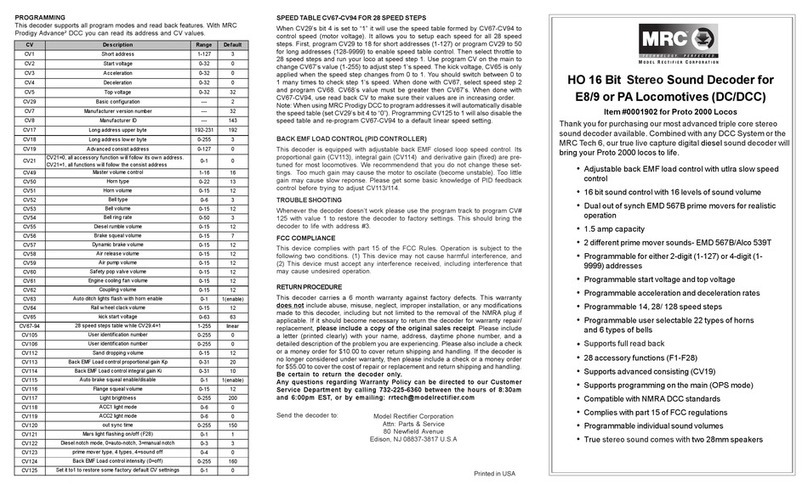
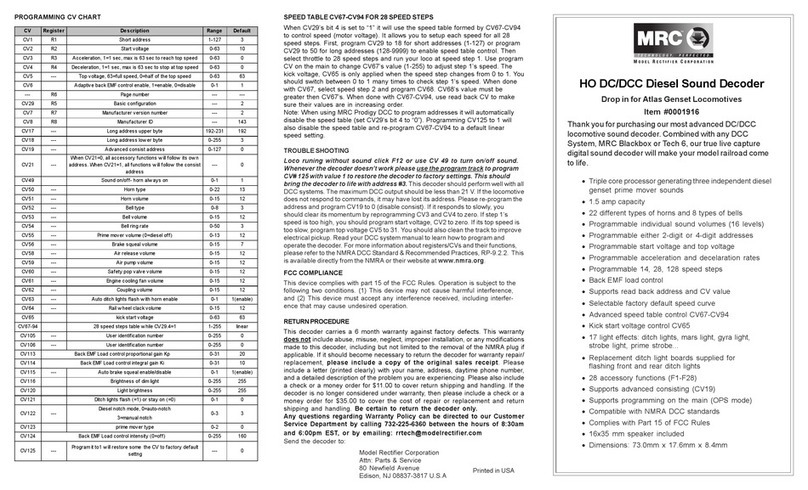
CV118 for ACC1 and CV119 for ACC2
CV118/119 value ACC#1/ACC#2 Light effect
0 Ditch light
1 Gyra light
2Marslight
3 Prime strato light
4 Single strobe light
5 Double strobe light
6 on/off
Decoder Prime mover
SD39, SD40, SD40A, SD40-2, SD40T-2, SD45. SDP45, SD45X, SD45-2,
SD45T-2, F45, FP45, DDA40X, GP15T, GP39, GP39-2, GP40, GP40-2
SW1000, SW1001, SW1500, SW1504, MP15DC, MP15AC, MP15T,
GP38, GP38-2, SD38, SD38-2, GP15AC, GP15-1
0001613 EMD710 SD70AC, SD70M-2
0001614 ALCO 244
0001615 ALCO 539T
F2A/B, F3A/B, F7A/B, F9A/B, BL1, BL2, FP7, FL9, FT, GP7, GP9,
GP18, GP28, E6, E7, E8, E9, NW2, NW3, NW4, SW1, SW7, SW8,
SW9, SW600, SW900, SW1200
0001616 EMD567
S-2, S-4, RS-1, RSC-1, RSD-1, DL-105, DL107, DL-108, DL-109, DL-110
0001611 EMD645E
0001612 EMD645
Prime movers and their application
Suitable for the locomotive
RS-3, PA1, PB1
INSTALLATION
If your loco has an NMRA DCC 8 pin or 9 pin JST socket, all you need to
do is remove the dummy plug and plug in the decoder. If the loco travels
in wrong direction you should change the 8 pin plug orientation. If your
locomotive is not DCC ready and does not have a decoder plug, use the
following directions:
The decoder will be inserted between the wheel pickups and the motor
as shown in Figure1. Cut off the 8 pin plug on the decoder. After discon-
necting the motor terminals from the pickups, connect the right side
pickup wires to the red decoder wire, and connect the left side pickup
wires to the black wire. Connect the right motor terminal to the orange
wire, then connect the left motor terminal to the grey wire. Always use
good soldering techniques, and use shrink wrap to isolate the connec-
tions. The white wire is for the front headlight and the yellow wire is for
the rear light. The brown and green wires are for your accessory lights.
The blue wire is the common wire for all four lights.
DCCOPERATIONONLY
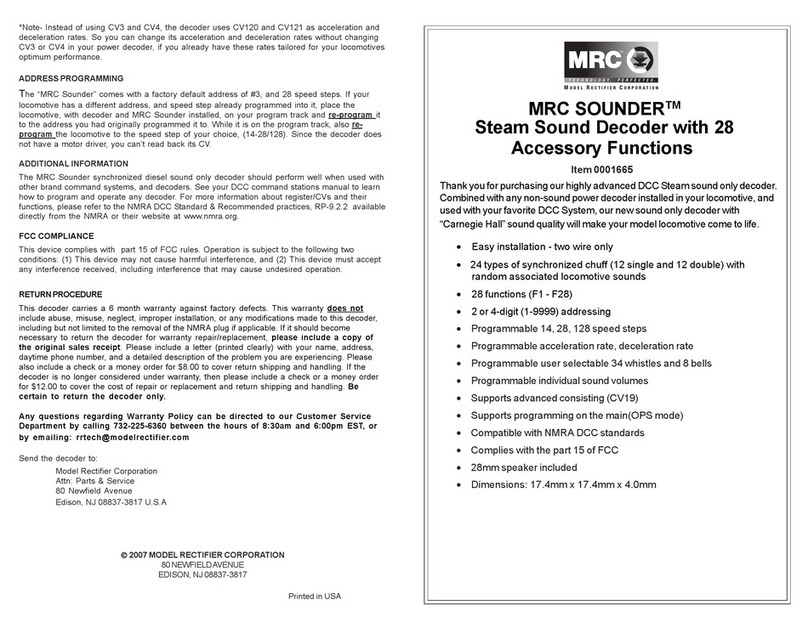
The decoder has been factory programmed with address #3, 28/128
speed steps and maximum top voltage. Select the “Run” mode of your
DCC system and select or acquire address #3. Move up the throttle and
the loco should move.
The decoder has a start up and shut down feature. If the loco has been
previously shut down, you have to start up the engine by simply pressing
any numbered function button. To shut down the engine you must bring
the loco to idle and then press F8 three times.
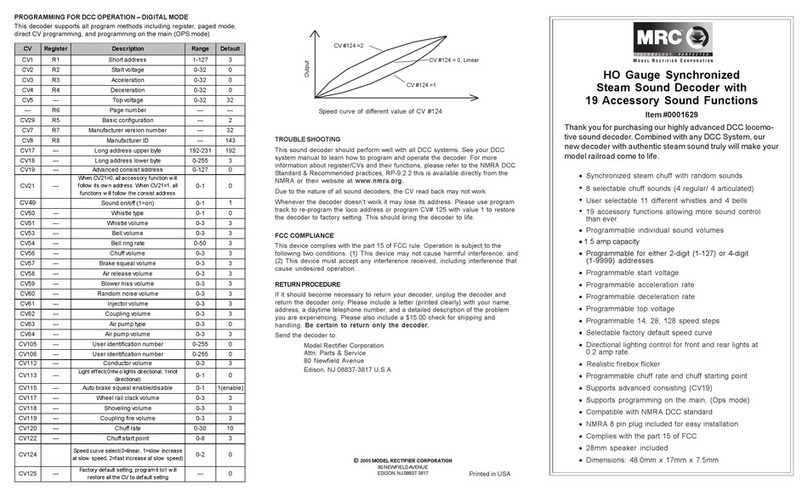
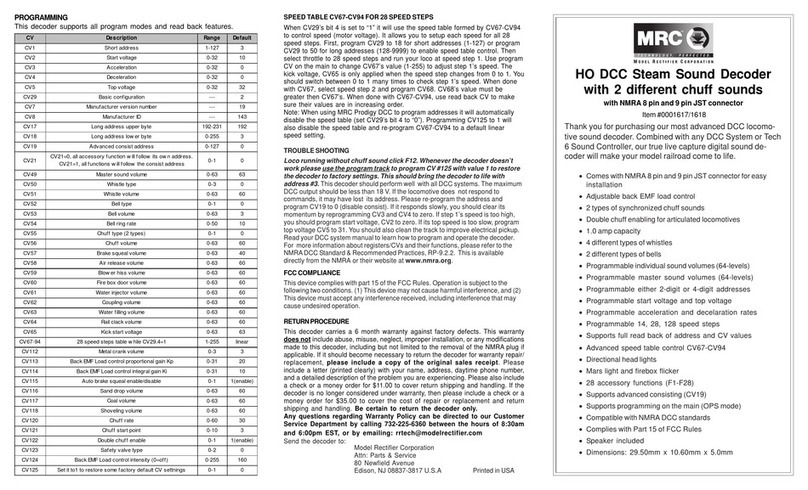
This decoder has 4 different horns. You can use F19 or program CV50 to
select these 4 horns. You can also use F18 or program CV52 to select
different 2 bell sounds.
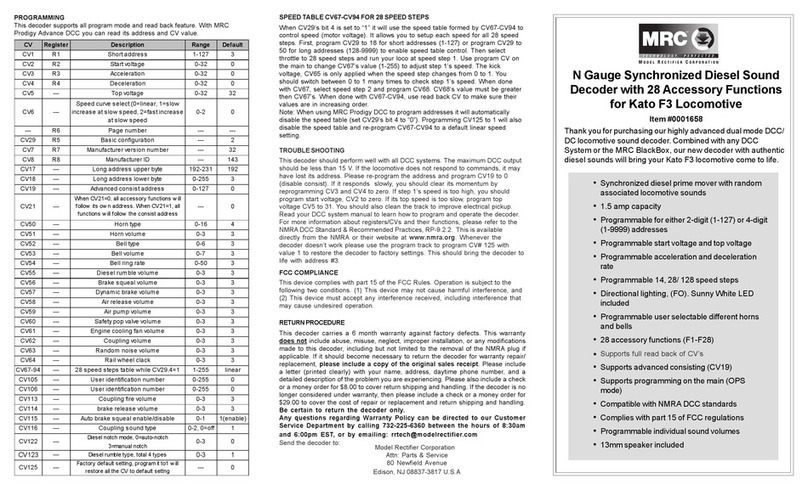
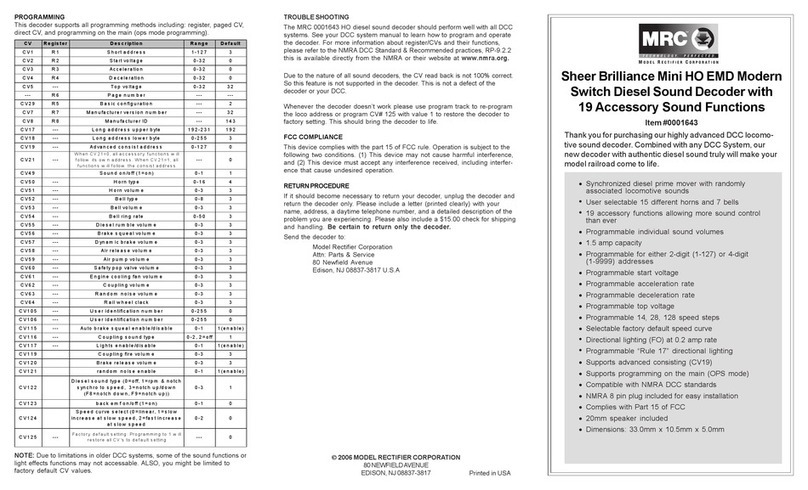
Most of the sounds have their own volume control CV. There is also a
master sound volume control CV49. Also F13 will reduce the master
volume by 1 (you will hear an air release when you reach CV49=1).
Pressing F14 will increase volume by 1 (you will hear an air release
when you reach CV49=16).
You can use F12 to turn on or turn off the sound.
The decoder is default to automatic notching. You can program CV122
to 3 to set manual notching for realistic operation. Then use F9 to notch
up and use F8 to notch down. This simulates the way a real locomotive
operates.
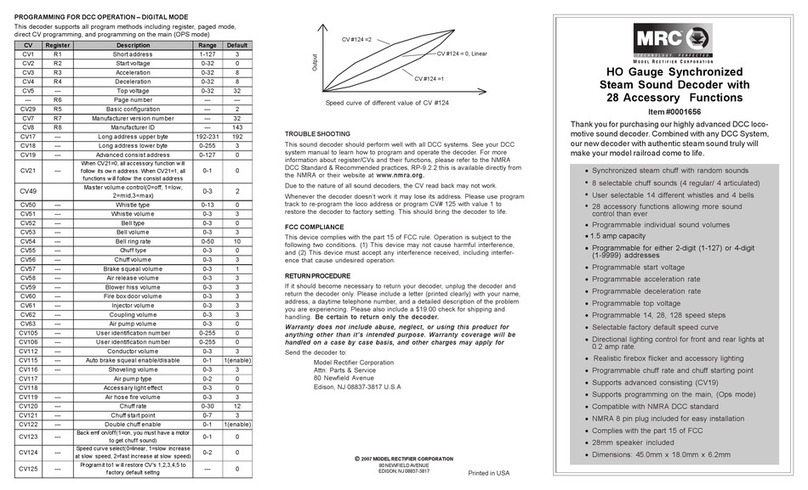
This decoder is equipped with adjustable back EMF closed loop speed con-
trol. Its proportional gain (CV113), integral gain (CV114) and derivative gain
(fixed) are pre-tuned for most locomotives. We recommend that you do not
change these settings. Too much gain may cause the motor to oscilate (be-
come unstable). Too little gain may cause slow response. Please get some
basic knowledge of PID feedback control before trying to adjust CV113/114.
To turn off Back EMF control program CV124 to 0, [factory default].
There are many more program features available with this decoder. Please
refer to the CV Chart to explore other features of the decoder.
Note:Bell,Dynamic Brake and Rail WheelClackcannotplay at the same
time. If you activate the Bell sound [F1], while either the Dynamic Brake or
Rail Wheel Clack sounds are activated, the Bell sound will override the
other 2 sounds. Rail Wheel Clack cannot play while the loco is in idle.
When you turn off Dynamic Brake and Rail Wheel Clack sound there will
be one second delay.
LIGHTEFFECT PROGRAMMING CHARTFORCV #118/119
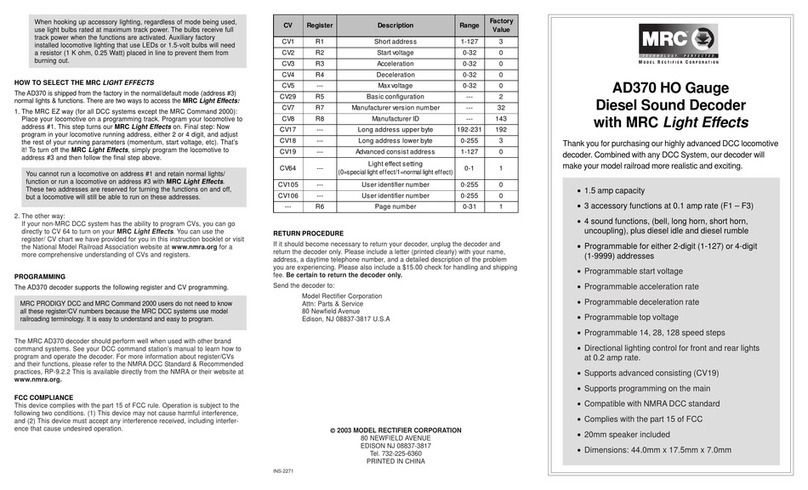
You would program CV #118/119 to choose the desired light effect.
CV118 for ACC1 and CV119 for ACC2. For ditch light both CV118 and
CV119 must to 0. F3 controls both ACC1 and ACC2. Use the brown and
green wires for the accessory light functions, along with the blue,
(common), wire.
Use DCC rated bulbs for both the directional headlights and accessory
lights.
If using 1.5 volt bulbs or LED’s use a 1K to 3K ohm resistor in series with
one of the leads.
Figure 1. Decoder wiring diagram
black
white
left
right
orange
gray
Motor
blue
red
yellow
rear light
front light
to accessory light
green
to accessory light
brown