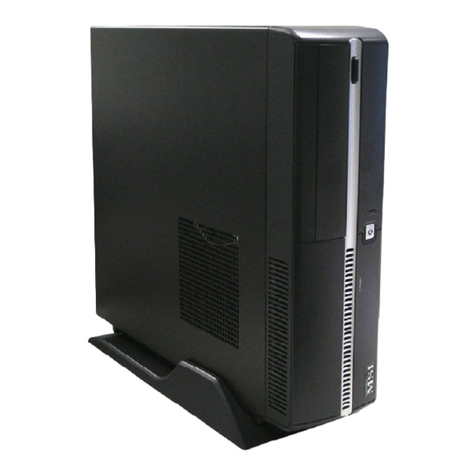
MSI Codex B930 User manual

MAG Codex Series
Personal Computer
Codex B930

2Contents
Contents
Getting Started.............................................................................................................. 3
Package Contents................................................................................................... 3
Safety & Comfort Tips ............................................................................................ 3
System Overview..................................................................................................... 4
Hardware Setup...................................................................................................... 9
System Operations ..................................................................................................... 11
Power Management ............................................................................................. 11
Network Connection (Windows 10) ...................................................................... 13
System Recovery (Windows 10)............................................................................ 16
System Recovery (F3 Hotkey Recovery) (Optional) .............................................. 20
Safety Instructions...................................................................................................... 21
Regulatory Notices..................................................................................................... 23
Revision
V2.1, 2021/02

3
Getting Started
Getting Started
This chapter provides you with the information on hardware setup procedures. While
connecting devices, be careful in holding the devices and use a grounded wrist strap
to avoid static electricity.
Package Contents
Personal Computer Codex B930
Documentation
Quick Start Guide (Optional)
User Guide (Optional)
Warranty Card
Warranty Book
Accessories
Power Cord
Mouse (Optional)
Keyboard (Optional)
⚠
Important
∙
Contact your place of purchase or local distributor if any of the items is damaged or
missing.
∙
Package contents may vary by country.
∙
The included power cord is exclusively for this personal computer and should not be
used with other products.
Safety & Comfort Tips
∙Choosing a good workspace is important if you have to work with your PC for a long
period of time.
∙Your work area should have enough illumination.
∙Choose the proper desk and chair and adjust their height to fit your posture when
operating.
∙When sitting on the chair, sit straight and keep a good posture. Adjust the chair’s
back (if available) to support your back comfortably.
∙Place you feet flat and naturally on the floor, so that your knees and elbows have the
proper position (about 90-degree) when operating.
∙Put your hands on the desk naturally to support your wrists.
∙Avoid using your PC in a place where discomfort may occur (such as on the bed).
∙The PC is an electrical device. Please treat it with great care to avoid personal
injury.

4Getting Started
System Overview
Codex B930 (H510M PRO)
109765
1
2
3
4
11
21
12
7
8
14
17
16
15
13
7

5
Getting Started
Codex B930 (Z590 PRO WIFI)
109865
1
2
3
4
22
7
11
8
24
17
20
19
15
14
23
18
25
7
13
12
16

6Getting Started
1Power Button
Press the power button to turn the system on and off.
2Ventilator
The ventilator on the enclosure is used for air convection and to prevent the
equipment from overheating. Do not cover the ventilator.
3Power Supply Switch
Switch this switch to I can turn on the power supply. Switch it to 0 to cut off
the power circulation.
4Power Jack
Power supplied through this jack supplies power to your system.
5Microphone Jack
This connector is provided for microphones.
6Headphone Jack
This connector is provided for headphones or speakers.
7USB 2.0 Port
This connector is provided for USB peripheral devices. (Speed up to 480
Mbps)
⚠
Important
High-speed devices are recommended for USB 3.2 ports whereas low-
speed devices, such as mouse or keyboard, are suggested to be plugged
into the USB 2.0 ports.
8USB 3.2 Gen 1 Port
This connector is provided for USB peripheral devices. (Speed up to 5 Gbps)
9USB 3.2 Gen 1 Port (Type-C)
This connector is provided for USB peripheral devices. This connector can
provide up to 5V/3A of power. (Speed up to 10 Gbps)
10 Hard Disk Drive LED
This indicator shows the activity status of the HDD. It flashes when the
system is accessing data on the HDD and remains off when no disk activity
is detected.
11 HDMI-Out Port
The High-Definition Multimedia Interface (HDMI) is an all-digital audio/video
interface capable of transmitting uncompressed streams. HDMI supports
all TV format, including standard, enhanced, or high-definition video, plus
multi-channel digital audio on a single cable.

7
Getting Started
12 DisplayPort 1.4 Port
Supports a maximum resolution of 4K 60Hz.
⚠
Important
∙
Graphics specifications may vary depending on the installed CPU.
∙
For processors without integrated graphics, connect your monitor to the
discrete graphics card.
13 PS/2® Keyboard / Mouse Port
The PS/2® keyboard / Mouse DIN connector for PS/2® keyboard / Mouse.
14 LAN Jack
The standard RJ-45 LAN jack is provided for connection to the Local Area
Network (LAN). You can connect a network cable to it.
Codex B930 (H510M PRO)
LINK/ACT
LED
SPEED
LED
LED Status Description
Link/ Activity
LED
Off No link
Yellow Linked
Blinking Data activity
Speed LED
Off 10 Mbps
Green 100 Mbps
Orange 1 Gbps
Codex B930 (Z590 PRO WIFI)
LINK/ACT
LED
SPEED
LED
LED Status Description
Link/ Activity
LED
Off No link
Yellow Linked
Blinking Data activity
Speed LED
Off 10 Mbps
Green 100/1000 Mbps
Orange 2.5 Gbps
15 Mic
This connector is provided for microphones.
16 Line-Out
This connector is provided for headphones or speakers.
17 Line-In
This connector is provided for external audio output devices.
18 SS-Out
Side surround sound line out in 7.1 channel mode.

8Getting Started
19 CS-Out
Center/ subwoofer line out in 5.1/ 7.1 channel mode.
20 RS-Out
Rear surround sound line out in 4/ 5.1/ 7.1 channel mode.
21 VGA Port
The VGA port supports monitors and other VGA interface devices.
22 Flash BIOS Button
Press the Flash BIOS button to flash BIOS, and the LED starts flashing. The
LED will be turned off when the process is completed.
23 Wi-Fi Antenna Connector
This connector is provided for Wi-Fi Antenna, supports the latest Intel Wi-Fi
6E solution with 6GHz spectrum, MU-MIMO and BSS color technology and
delivering speeds up to 2400Mbps.
24 USB 3.2 Gen 2x2 Port (Type-C)
This connector is provided for USB peripheral devices. This connector can
provide up to 5V/3A of power. (Speed up to 20 Gbps)
25 USB 3.2 Gen 2 Port
This connector is provided for USB peripheral devices. (Speed up to 10
Gbps)

9
Getting Started
Hardware Setup
Connect your peripheral devices to suitable ports.
⚠
Important
∙
For detailed instructions on how to connect, please refer to the manuals of your
peripheral devices.
∙
Reference image only. Appearance will vary.
Connect the power cord to the system and electrical outlet.
Power Rating
Codex B930 (H510M PRO)
•500W: 100-240V~, 50-60Hz, 7-3A
Codex B930 (Z590 PRO WIFI)
•750W: 100-240V~, 50-60Hz, 10-5A
•850W: 100-240V~, 50-60Hz, 11-5.5A
Switch the power supply switch to I.
⚠
Important
When unplugging the AC power cord, always hold the connector part of the cord.
Never pull the cord directly.

10 Getting Started
Press the power button to power on the system.
This manual suits for next models
1
Table of contents
Other MSI Desktop manuals

MSI
MSI 001EU User manual
MSI
MSI Nightblade X2 User manual

MSI
MSI Wind Box DC100 User manual
MSI
MSI Pro24 2M User manual

MSI
MSI MPG Infinite Series User manual
MSI
MSI AP1622E User manual
MSI
MSI MAG Codex 5 User manual
MSI
MSI MPC 400 User manual
MSI
MSI Gaming 24 Series User manual
MSI
MSI Cubi 5 10M 419EU User manual
MSI
MSI 092EU User manual
MSI
MSI Cubi B159 User manual
MSI
MSI Pro 22XT 10M i5-10400 User manual
MSI
MSI MAG Codex Series User manual
MSI
MSI Infinite A 8RC-265EU User manual

MSI
MSI Trident B935 User manual

MSI
MSI MS-B096 User manual

MSI
MSI Pro 24T Series User manual

MSI
MSI Wind Top AE2031 User manual
MSI
MSI MAG Infinite S3 13th i5-13400F User manual