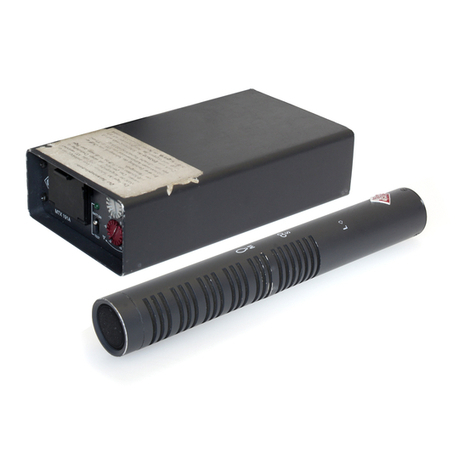
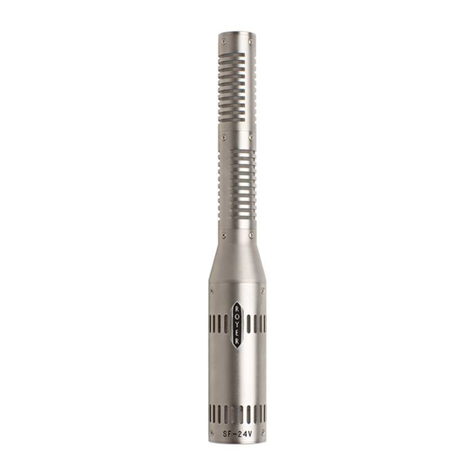
Neumann KMR 81i User manual

Bedienungsanleitung
Operating Instructions
KMR 81 i
Ollenhauerstr. 98
13403 Berlin
Germany
Tel.: +49-30 / 417724-0
Fax: +49-30 / 417724-50
Email: [email protected]
Web: www.neumann.com

23
Inhaltsverzeichnis
1. Das Kondensator-Richtrohrmikrophon
KMR 81 i
1.1 Ausführungsformen und Beschaltung des
Mikrophonausganges
1.2 Mikrophonkabel
2. Stromversorgung
2.1 Phantomspeisung
2.2 Betrieb mit Netzgeräten
2.3 Batteriespeisung
2.4 Betrieb an unsymmetrischen oder
mittengeerdeten Eingängen
3. Technische Daten KMR 81 i
4. Frequenzgänge und Polardiagramm
5. Empfehlungen für den Gebrauch der
Windschutzeinrichtungen
6. Einige Hinweise zur Pflege von Mikrophonen
7. Zubehör
1. Das Kondensator-
Richtrohrmikrophon KMR 81 i
Das KMR 81 i ist ein Studio-Kondensatormikrophon
mit hoher Richtwirkung bei vergleichsweise kleinen
Abmessungen und niedrigem Gewicht.
Die hohe Richtwirkung verdankt es seiner besonde-
ren akustischen Arbeitsweise: Die Mikrophonkapsel
befindet sich in einem akustisch offenen, aber mit ei-
nem hohen Strömungswiderstand belegten Gehäuse-
rohr.
Daraus resultiert eine hohe Membranantriebskraft
bei kleinem Druckgradientencharakter der Kapsel, und
das Mikrophon blendet (Stör-)Schall außerhalb seiner
„Blickrichtung“ wesentlich stärker aus, als es mit Mi-
krophonen ohne ein solches Gehäuserohr möglich ist.
Das KMR 81 i vereinigt die hohe Dämpfung für seitli-
che Schallanteile (ähnlich der Hyperniere, ca. 10 dB)
mit dem großen Vor-/Rückverhältnis der Superniere,
indem es von hinten einfallenden Schall ebenfalls um
ca. 10 dB dämpft.
Darüber hinaus macht dieses Prinzip das Mikrophon
unempfindlich gegen Wind- und Poppstörungen.
Table of Contents
1. The KMR 81 i Condenser Shot Gun
Microphone
1.1 Microphone Versions and
Output Wiring
1.2 Microphone Cables
2. Power Supply
2.1 Phantom Powering
2.2 Operation with AC Power Supply
2.3 Battery Powering
2.4 Operation with Unbalanced or Center
Tap Grounded Inputs
3. KMR 81 i Technical Specifications
4. Frequency Responses and Polar Pattern
5. Recommendation for the Use of
Windscreens in Combination
6. Hints on Microphone Maintenance
7. Accessories
1. The KMR 81 i Condenser Shot
Gun Microphone
The KMR 81 i is a studio condenser microphone featur-
ing excellent directional characteristics for its relative-
ly compact dimensions and low weight.
The high directivity is due to a special acoustical prin-
ciple: the microphone capsule is located inside an in-
terference tube which is acoustically open but has a
high acoustic impedance.
The result is a high diaphragm driving force at a low
capsule pressure gradient characteristic; the micro-
phone discriminates against sound originating out-
side its “field of view” to a far greater extent than is
possible for a microphone without such an interfer-
ence tube.
The KMR 81 i combines a high degree of sound
rejection at its sides (similar to the hyper-cardi-
oid: approx. 10 dB), with the high degree of front-to-
back rejection of the super-cardioid, likewise 10 dB.
This principle also makes the microphone largely
insensitive to wind and popping noises.
Griffgeräusche werden durch die elastische Lagerung
der Mikrophonkapsel unterdrückt.
Trotz des besonders niedrigen Ersatzgeräuschpegels
von 12 dB-A kann das KMR 81 i Schalldruckpegel bis
128 dB (Kges 0,5 %) übertragen, was einem Dyna-
mikumfang von 116 dB entspricht.
Der hohe Übertragungsfaktor (ca. 18 mV/Pa) lässt sich
mit einem eingebauten Schiebeschalter um 10 dB ver-
ringern, falls der Eingang des Folgegerätes sonst über-
steuert würde. Mit einem weiteren Schiebeschalter
kann das Übertragungsmaß zu tiefen Frequenzen hin
abgesenkt werden (50 Hz ca. –15 dB), wobei der Fre-
quenzbereich oberhalb etwa 200 Hz unverändert über-
tragen wird.
Aus den beschriebenen Eigenschaften ergeben sich
folgende bevorzugte Anwendungsgebiete für das
KMR 81 i:
• Übertragung im Bühnenbereich bei gleichzeitiger
Saaleinspielung
• Aufnahmen in enger Nachbarschaft von Fremd-
schallquellen, z. B. in Orchestern oder Bands
• Reportagen im Freien oder in geräuscherfüllter Um-
gebung
• als Handmikrophon für Sänger
• am Rednerpult bei Konferenzen
Für Aufnahmen im Freien wird die Benutzung des
Windschirms WS 81 empfohlen.
1.1 Ausführungsformen und Beschaltung des
Mikrophonausgangs
Das Mikrophon kann in folgenden Ausführungsformen
geliefert werden:
KMRKMR
KMRKMR
KMR 8181
8181
81 iiiii ............................ ni ............................... Best.-Nr. 06961
Ausführung mit 3-poligem Switchcraft-Steckereinsatz
und nickelmatter Oberfläche. Erforderliches Gegen-
stück: XLR 3 F.
KMRKMR
KMRKMR
KMR 8181
8181
81 iiiiimtmt
mtmt
mt .................... sw ............................. Best.-Nr. 06962
wie oben, jedoch mit schwarzmatter Oberfläche.
Die Zuordnung der Mikrophonanschlüsse entspricht
DIN 45 599, Kennzeichen „I“ bzw. IEC 268-12 (pin.
conn. 130-x-IEC 02):
Die Modulationsadern liegen an Pin 2 und 3, die Ab-
schirmung an Pin 1.
Bei einem Schalldruckanstieg vor der vorderen Mikro-
phonmembran tritt an Pin 2 eine positive Spannung auf.
Finger noises are suppressed by the internal elastic sus-
pension of the microphone capsule.
In spite of the particularly low equivalent noise of
12 dB-A, the KMR 81 i allows sound pressure levels
of up to 128 dB (THD 0,5 %), corresponding to a
116 dB dynamic range.
The high sensitivity (approx. 18 mV/Pa) may be atten-
uated by 10 dB by means of a built-in slide switch to
avoid overloading the input of subsequent circuitry. The
sensitivity may be attenuated towards lower
frequencies (approx. –15 dB at 50 Hz) by another slide
switch, leaving the response above 200 Hz unchanged.
The above characteristics make the KMR 81 i ideal for
the following applications:
• Pick-up from the stage with simultaneous audience,
reinforcement feed
• ideal instrument/section isolation, e. g. in orchestra
or bands
• outdoors news coverage or in a noisy environment
• as a hand-held microphone for vocalists
• on the conference podium
The use of the WS 81 Wind screen is recommended
for recording outdoors.
1.1 Microphone Versions and
Output Wiring
The following versions of the KMR 81 i microphone
are available:
KMRKMR
KMRKMR
KMR 8181
8181
81 iiiii.......................... ni ................................ Cat. No. 06961
Version with male 3-pin connector insert and satin nick-
el finish. Requires XLR 3 F female connector.
KMRKMR
KMRKMR
KMR 8181
8181
81 iiiiimtmt
mtmt
mt .................... blk .............................. Cat. No. 06962
as above, but with matte black finish.
Microphone output wired as per IEC 268-12 (pin conn.
130-x-IEC 02) or DIN 45 599 I.
Modulation is connected to pins 2 and 3; the shield is
connected to pin 1.
A sudden sound pressure rise in front of the front di-
aphragm causes a positive voltage to appear at pin 2.

45
2. Stromversorgung
2.1 Phantomspeisung
Das KMR 81 i wird mit 48 V phantomgespeist (P48,
IEC 1938).
Bei der Phantomspeisung fließt der Speisestrom vom
positiven Pol der Spannungsquelle über die elektrische
Mitte der beiden Modulationsadern zum Mikrophon.
Er wird hierzu über zwei gleiche Widerstände in bei-
den Tonadern eingekoppelt. Die Rückleitung des
Gleichstroms erfolgt über den Kabelschirm. Zwischen
beiden Modulationsadern besteht also keine Potenti-
aldifferenz. Daher ist mit der Phantomspeisung eine
kompatible Anschlusstechnik möglich. Auf die Anschlüs-
se können wahlweise auch dynamische Mikrophone
oder Bändchenmikrophone sowie die Modulationska-
bel röhrenbestückter Kondensatormikrophone geschal-
tet werden, ohne dass die Speisespannung abgeschal-
tet werden muss.
2.2 Betrieb mit Netzgeräten
Für die Stromversorgung des KMR 81 i sind prinzipiell
alle P48-Netzgeräte entsprechend IEC 1938 geeignet,
die mindestens 1 mA je Kanal abgeben.
Das Neumann P48-Netzgerät hat die Bezeichnung
N 48 i-2.
N 48 i-2 (230 V)N 48 i-2 (230 V)
N 48 i-2 (230 V)N 48 i-2 (230 V)
N 48 i-2 (230 V) ......... sw ............................. Best.-Nr. 06500
N 48 i-2 (117 V)N 48 i-2 (117 V)
N 48 i-2 (117 V)N 48 i-2 (117 V)
N 48 i-2 (117 V) ......... sw ............................. Best.-Nr. 06502
Es ist zur Stromversorgung zweier Mono-Kondensa-
tormikrophone oder eines Stereomikrophons mit 48 V
± 1 V, maximal 2 x 5 mA, geeignet (siehe auch Neu-
mann-Druckschrift 68832... „48 V-Phantomspeisegerä-
te“).
Die Zuordnung der Mikrophonanschlüsse und die Po-
larität der Modulationsadern ist am Ausgang der Spei-
segeräte die gleiche wie am Mikrophon.
2.3 Batteriespeisung
Steht keine Netzspannung zur Verfügung, kann die
Speisung mit einem der Geräte
BS 48 iBS 48 i
BS 48 iBS 48 i
BS 48 i (für ein Mikrophon) ......................... Best.-Nr. 06494
BS 48 i-2BS 48 i-2
BS 48 i-2BS 48 i-2
BS 48 i-2
(für zwei Mikrophone) ............. Best.-Nr. 06496
erfolgen. Beide Geräte liefern 48 V ± 1 V, maximal je
5 mA, und werden jeweils von einer 9 Volt-Blockbat-
terie Typ IEC 6 F 22 gespeist.
2. Power Supply
2.1 Phantom Powering
The KMR 81 i is phantom powered at 48 V (P48, IEC
1938).
With phantom powering the DC from the positive
supply terminal is divided via two identical resistors,
one half of the DC flowing through each audio mod-
ulation conductor to the microphone, and returning
to the voltage source via the cable shield. Phantom
powering provides a fully compatible connecting sys-
tem, since no potential differences exist between the
two audio conductors. Studio outlets so powered will
therefore also accept dynamic microphones, ribbon mi-
crophones, or modulation conductors of tube-
equipped condenser microphones without the need
to switch off the DC supply voltage.
2.2 Operation with AC Power Supply
In principle, all P48 power supplies in accordance with
IEC 1938 which provide at least 1 mA per channel
are suitable for powering the KMR 81 i.
The Neumann P48 power supply unit bears the des-
ignation N 48 i-2.
N 48 i-2 (230 V)N 48 i-2 (230 V)
N 48 i-2 (230 V)N 48 i-2 (230 V)
N 48 i-2 (230 V) ......... blk .............................. Cat. No. 06500
N 48 i-2 (117 V)N 48 i-2 (117 V)
N 48 i-2 (117 V)N 48 i-2 (117 V)
N 48 i-2 (117 V) ......... blk .............................. Cat. No. 06502
It is designed to power two mono condenser micro-
phones or one stereo microphone at 48 V ± 1 V, max.
2 x 5 mA. (See also Neumann bulletin No. 68832...
“Phantom 48 VDC Power Supplies”).
The assignment of the microphone terminals and the
modulation polarity at the power supply output are
identical to those at the microphone.
2.3 Battery Powering
If a mains power source is not available, power can be
supplied by one of the battery units
BS 48 iBS 48 i
BS 48 iBS 48 i
BS 48 i (for one microphone) ...................... Cat. No. 06494
BS 48 iBS 48 i
BS 48 iBS 48 i
BS 48 i-2-2
-2-2
-2 (for two microphones) ............... Cat. No. 06496
Both units deliver 48 V ± 1 V, at 5 mA maximum, and
are powered by a 9-volt monobloc battery Type
IEC 6 F 22.
The 3-pin Switchcraft connector has the following pin
assignments:
Pin 1: 0 V/ground
Pin 2: Modulation (+phase),
Pin 3: Modulation (–phase).
1.2 Microphone Cables
The following cables are available for the KMR 81 i mi-
crophone:
IC 3 mtIC 3 mt
IC 3 mtIC 3 mt
IC 3 mt ................................. blk .............................. Cat. No. 06543
10 m microphone cable, 5 mm in diameter, with dou-
ble twist (double helix) braiding as shield. 3-pin XLR
connectors, matte black. For feeding the audio signal
to mixing consoles, etc.
ICIC
ICIC
IC 3131
3131
31 mt (5mt (5
mt (5mt (5
mt (5 m)m)
m)m)
m) ............... blk .............................. Cat. No. 06570
5 m long microphone cable, 4.5 mm in diameter, with
double twist braiding for screening. 3-pin XLR con-
nectors, matte black. This cable is textile-braided to
avoid frictional noise due to the handling of booms or
plastic leadings (for example in windscreens).
ACAC
ACAC
AC 2222
2222
22 ........................................................................... Cat. No. 06598
0.3 m adapter cable with a 5-pin XLR connector on
one end and an unbalanced 3.5 mm stereo jack on
the other end. It is used to connect the 5-pin XLR
output of the BS 48 i-2 power supply, the MTX 191 A
power amplifier, or the N 48 R-2 power supply to units
with a 3.5 mm stereo input.
ACAC
ACAC
AC 2525
2525
25 ........................................................................... Cat. No. 06600
0.3 m adapter cable with 3-pin XLR connector and a
6.3 mm mono jack, unbalanced. It is used to connect
3-pin XLR outputs of the BS 48 i or N 48 i-2 power
supplies to units with a 6.3 mm monojack input.
ACAC
ACAC
AC 2727
2727
27 ........................................................................... Cat. No. 06602
Y-cable, 0.3 m long, with a 5-pin XLR connector and
two 6.3 mm mono jacks, unbalanced. It is used to con-
nect 5-pin XLR outputs of the BS 48 i-2 power supply
or the MTX 191 A matrix amplifier to units with
6.3 mm mono jack inputs.
Special cable lengths can be made to order.
The microphone is particularly insensitive to capaci-
tive loading. As a result, even very long cable runs do
not cause either TIM or frequency distortion.
Further articles are described in the “Accessories” cat-
alog.
Der 3-polige XLR-Stecker hat folgende Belegung:
Pin 1: 0 V/Masse
Pin 2: Modulation (+Phase)
Pin 3: Modulation (–Phase).
1.2 Mikrophonkabel
Für das KMR 81 i stehen folgende Kabel zur Verfügung:
IC 3 mtIC 3 mt
IC 3 mtIC 3 mt
IC 3 mt ................................. sw ............................. Best.-Nr. 06543
10 m langes Mikrophonkabel, Durchmesser 5 mm, mit
Doppeldrallumspinnung als Abschirmung. Schwarz-
matte 3-polige XLR-Steckverbinder. Führt am Ausgang
des Netzgerätes die Modulation weiter.
ICIC
ICIC
IC 3131
3131
31 mt (5mt (5
mt (5mt (5
mt (5 m)m)
m)m)
m) ............... sw ............................. Best.-Nr. 06570
5 m langes Mikrophonkabel, Durchmesser 4,5 mm, mit
Doppeldrallumspinnung als Abschirmung. Schwarzmat-
te 3-polige XLR-Steckverbinder. Zur Vermeidung von
Reibgeräuschen bei der Verwendung an der Angel oder
an Kunststoffdurchführungen (z.B. bei Windschutzkör-
ben) ist das Kabel textilumsponnen.
ACAC
ACAC
AC 2222
2222
22 .......................................................................... Best.-Nr. 06598
0,3 m langes Adapterkabel mit einer 5-poligen XLR-
Buchse und einem 3,5 mm Stereoklinkenstecker, un-
symmetrisch, für den Anschluss des 5-poligen XLR-Aus-
ganges des Speisegerätes BS 48 i-2, der Matrixbox
MTX 191 A oder des N 48 R-2 an Geräte mit 3,5 mm
Stereoklinkenbuchse.
ACAC
ACAC
AC 2525
2525
25 .......................................................................... Best.-Nr. 06600
0,3 m langes Adapterkabel mit einer 3-poligen XLR-
Buchse und einem 6,3 mm Monoklinkenstecker, un-
symmetrisch, für den Anschluss des 3-poligen XLR-Aus-
ganges eines Speisegerätes BS 48 i oder N 48 i-2 an
Geräte mit 6,3 mm Monoklinkenbuchse.
ACAC
ACAC
AC 2727
2727
27 .......................................................................... Best.-Nr. 06602
Y-Adapterkabel, 0,3 m lang, mit einer 5-poligen XLR-
Buchse und zwei 6,3 mm Monoklinkensteckern, unsym-
metrisch, für den Anschluss des 5-poligen XLR-Aus-
ganges eines Speisegerätes BS 48 i-2 oder der
Matrixbox MTX 191 A an Geräte mit 6,3 mm Mono-
klinkenbuchsen.
Andere Kabellängen sind auf Wunsch lieferbar.
Das Mikrophon ist besonders unempfindlich gegen ka-
pazitive Belastung. TIM- und Frequenzgangverzerrun-
gen werden daher auch bei Verwendung sehr langer
Kabel nicht hervorgerufen.
Weitere Artikel sind im Katalog „Zubehör“ beschrieben.

67
Das Gerät BS 48 i-2 ist mit 5-poligen, das BS 48 i mit
3-poligen XLR-Steckverbindern ausgerüstet.
(Siehe auch Neumann-Druckschrift 68832... „48 V-
Phantomspeisegeräte“.)
Die Zuordnung der Mikrophonanschlüsse und die Po-
larität der Modulationsadern ist am Ausgang der Spei-
segeräte die gleiche wie am Mikrophon.
2.4 Betrieb an unsymmetrischen oder
mittengeerdeten Eingängen
Die 48 V-Phantomspeisegeräte BS 48 i, BS 48 i-2,
N 48 R-2 und N 48 i-2 haben gleichspannungsfreie
Ausgänge, so dass für den Anschluss an einen unsym-
metrischen Eingang kein Übertrager erforderlich ist.
Beim KMR 81 i ist Pin 2 die „heiße Phase“, und Pin 3
muss für unsymmetrische Eingänge an Masse gelegt
werden (siehe Abbildung 1).
Bei vielen anderen als den o.g. Phantomspeisegeräten
liegen nicht nur die Modulationsleitungen zum Mikro-
phon auf dem Potential der Speisespannung von +48 V,
sondern auch die vom Speisegerät abgehenden Mo-
dulationsleitungen. Für die in der Studiotechnik allge-
mein üblichen symmetrischen
und erdfreien Verstärker- und
Mischpulteingänge ist dies ohne
Bedeutung. Dagegen wird die
Speisespannung beim Anschluss
an einseitig oder mittengeer-
dete Verstärkereingänge kurz-
geschlossen, und es ist kein Be-
trieb möglich.
Dann bestehen folgende Lö-
sungsmöglichkeiten:
a) In mittengeerdeten Gerä-
ten mit Eingangsübertrager (z.B.
einige NAGRA-Geräte) kann
die betreffende Erdverbindung
fast immer ohne Nachteile für
die Funktion des Gerätes auf-
getrennt werden.
b) In jede abgehende Modu-
lationsleitung kann zur Abblok-
kung der 48 V-Gleichspannung
eine RC-Kombination eingefügt
werden (siehe Abb. 2 und Neu-
mann-Information Nr. 84221).
The BS 48 i-2 is equipped with 5-pin XLR connectors,
the BS 48 i with 3-pin XLR connectors.
(See Neumann bulletin 68832... “Phantom 48 VDC
Power Supplies”.)
The assignment of the microphone terminals and the
modulation polarity at the power supply output are
identical to those at the microphone.
2.4 Operation with Unbalanced or Center
Tap Grounded Inputs
The 48 V phantom powering units BS 48 i, BS 48 i-2,
N 48 R-2 and N 48 i-2 have DC-free outputs, so that
no transformer is required for connecting to an un-
balanced input.
In the case of the KMR 81 i condenser microphone
pin 2 is the “hot phase”, and pin 3 must be connected
to earth for ungrounded inputs (see Fig. 1).
In the case of many phantom powering units, other
than those mentioned above, both the modulation
leads to the microphone and the outgoing modula-
tion leads from the powering unit are at the potential
of the feed voltage (+48 V). This is unimportant for
the balanced, floating ampli-
fier and mixing console in-
puts which are in general stu-
dio use. However, the feed
voltage will be short-circuited
if connected to single-sided
or center tap grounded am-
plifier inputs, and no opera-
tion will be possible.
This can be circumvented as
follows:
a) For center tap grounded
equipment with an input
transformer (e.g. some NA-
GRA units), the earth lead
can almost always be discon-
nected without affecting the
functioning of the equipment.
b) An RC network can be
incorporated into every out-
going modulation lead, in or-
der to block the 48 VDC
voltage (See Fig. 2 and Neu-
mann information sheet no.
84 221).
Abbildung / Figure 1
Abbildung / Figure 2
3. Technische Daten KMR 81 i
Akustische Arbeitsweise ....................... Druckgradienten-
interferenzempfänger
Richtcharakteristik ....................................... Superniere/Keule
Übertragungsbereich ...................................... 20 Hz...20 kHz
Feldübertragungs-
faktor1) ............................................ 18 mV/Pa = –35 dBV ± 1 dB
Nennimpedanz ............................................................ 150 Ohm
Nennlastimpedanz .................................................. 1000 Ohm
Geräuschpegelabstand
CCIR 468-3 ............................................................................. 71 dB
Geräuschpegelabstand
DIN/IEC 651 .......................................................................... 82 dB
Ersatzgeräuschpegel
CCIR 468-3 ............................................................................. 23 dB
Ersatzgeräuschpegel
DIN/IEC 651 .................................................................... 12 dB-A
Grenzschalldruckpegel für
0,5 % Klirrfaktor2) ............................................................. 128 dB
mit Vordämpfung ............................................................. 138 dB
Max. Ausgangsspannung .............................................. 1,3 dBu
Phantomspeisespannung
(P48, IEC 1938) ........................................................ 48 V ± 4 V
Stromaufnahme ................................................................. 0,8 mA
erforderlicher Steckverbinder ................................. XLR 3 F
Gewicht ...................................................................................... 145 g
Abmessungen ...................................... Ø 21 mm x 226 mm
1 Pa = 10 µbar
0 dB 20 µPa
1) bei 1 kHz an 1 kOhm Nennlastimpedanz.
1 Pa 94 dB SPL.
2) Klirrfaktor des Mikrophonverstärkers bei einer Eingangsspannung,
die der von der Kapsel beim entsprechenden Schalldruck abgege-
benen Spannung entspricht.
3. Technical Specifications KMR 81 i
Acoustical op. principle ..........................Pressure gradient
interference transducer
Directional pattern .............. Supercardioid/Lobe shaped
(Shot gun)
Frequency range ............................................... 20 Hz...20 kHz
Sensitivity 1) .............................. 18 mV/Pa = –35 dBV ± 1 dB
Rated impedance ........................................................ 150 ohms
Rated load impedance ......................................... 1000 ohms
S/N ratio
CCIR 468-3 ............................................................................. 71 dB
S/N ratio
DIN/IEC 651 .......................................................................... 82 dB
Equivalent SPL
CCIR 468-3 ............................................................................ 23 dB
Equivalent SPL
DIN/IEC 651 .................................................................... 12 dB-A
Max. SPL
for less than 0.5 % THD2) .......................................... 128 dB
with preattenuation ........................................................ 138 dB
Max. output voltage ....................................................... 1.3 dBu
Phantom powering
(P48, IEC 1938) ...................................................... 48 V ± 4 V
Current consumption .................................................... 0,8 mA
Matching Connector .................................................... XLR 3 F
Weight ........................................................................................ 145 g
Dimensions ...........................................Ø 21 mm x 226 mm
1 Pa = 10 µbar
0 dB 20 µPa
1) at 1 kHz into 1 kohm rated load impedance.
1 Pa 94 dB SPL.
2) THD of microphone amplifier at an input voltage equivalent to the
capsule output at the specified SPL.

89
5. Empfehlung für den Gebrauch der
Windschutzeinrichtungen
Zur Vermeidung von Störgeräuschen, die bei Nahbe-
sprechung, Windeinfluss oder beispielsweise bei schnel-
lem Schwenken des Mikrophons auftreten können, sind
verschiedene Windschutzeinrichtungen lieferbar (sie-
he auch 7. Zubehör).
Mit dem Einsatz von Windschutzeinrichtungen ist
immer eine, wenn auch meist geringe, Bedämpfung
hoher Frequenzen verbunden. Dieser Effekt verstärkt
sich allerdings, wenn zur Erhöhung der Wirksamkeit
mehrere Windschutzeinrichtungen miteinander kom-
biniert werden. Deshalb ist auf jeden Fall eine Betrach-
tung der Effektivität solcher Kombinationen angezeigt.
Windschutzeinrichtungen sind um so wirksamer, je
mehr freie Wegstrecke (in gewissen Grenzen) zwischen
ihnen und dem Mikrophon verbleibt.
Bei Verwendung des Windschutzkorbes WK 81, bei-
spielsweise, sollte der Raum bis zum Mikrophon wirk-
lich frei sein! Eine zusätzliche Verwendung des Wind-
schutzes WS 81 und eventuell der Windschirmhülle
WSH 81 würde nicht nur den Windschutzeffekt her-
absetzen, sie würde darüber hinaus die hohen Frequen-
zen unnötigerweise stark bedämpfen.
Die abgebildeten Kombinationen stellen zwei wirkungs-
volle Varianten für jeweils unterschiedlich starken
Windeinfall bei gleichzeitiger geringstmöglicher Fre-
quenzbeeinträchtigung dar.
5. Recommendation for the Use
of Windscreens in Combination
Different kinds of windscreens are available to avoid
problems caused by wind, close talking, and rapid
movements of the microphone (refer to chapter 7. Ac-
cessories).
The application of windscreens causes always some
attenuation of high frequencies, although mostly minor.
This loss is more noticeable when a combination of
more than one screen is used in order to increase the
amount of protection. lt is therefore necessary to con-
sider the actual combined effect of such an arrange-
ment.
Within a certain range the protection of any wind-
screen increases porportionately with the empty space
between the screen itself and the microphone. For
example, using the WK 81 windscreen the inner space
should be clear of anything except the microphone
(and mounting hardware). The additional application
of WS 81 and probably WSH 81 screens would not
only decrease efficiency of the protection but would
also reduce high frequencies unnecessarily.
The following illustrations show two successful
methods of using various windscreen combinations to
adjust to different wind disturbancies while offering a
minimum reduction in high frequency response.
Einfluß der Windschutzeinrichtungen auf den Frequenzgang
Influence of Windscreening to the Frequency Response
KMR 81 iWS 81
4. Frequenzgänge und Polardiagramm
Frequency Responses and Polar Pattern
°
gemessen im freien Schallfeld nach IEC 60268-4
measured in free-field conditions (IEC 60268-4)

10 11
6. Einige Hinweise zur Pflege von
Mikrophonen
Staubschutz verwenden: Mikrophone, die nicht im Ein-
satz sind, sollte man nicht auf dem Stativ einstauben
lassen. Mit einem Staubschutzbeutel (nicht fusselnd)
wird dies verhindert. Wird ein Mikrophon längere Zeit
nicht verwendet, sollte es staubgeschützt bei norma-
lem Umgebungsklima aufbewahrt werden.
Popschutz verwenden: Ein Popschutz hat nicht nur die
Aufgabe, bei Gesangsaufnahmen die Entstehung von
Poplauten zu verhindern. Er vermeidet auch effizient,
dass sich von der Feuchtigkeit des Atems bis hin zu
Essensresten unerwünschte Partikel auf der Membran
ablagern.
Keine überalterten Windschutze verwenden: Auch
Schaumstoff altert. Das Material kann brüchig und krü-
melig werden. Anstatt das Mikrophon zu schützen, kann
er dann zur Verunreinigung der Mikrophonkapsel füh-
ren. Überalterte Windschutze also bitte entsorgen.
Funktionstest: Moderne Kondensatormikrophone neh-
men durch lautes Ansprechen keinen Schaden. Zur
Kontrolle, ob ein Mikrophon angeschlossen ist und
funktioniert, sollte man es dennoch nicht anpusten oder
anpoppen, da dies einem akustischen Signal von mehr
als 140 dB (!) entsprechen kann. Normale Sprache ge-
nügt zum Funktionstest völlig.
Selbsthilfe kann teuer sein! Leider kommt es doch vor,
dass durch eine Selbstreparatur mehr beschädigt als
behoben wird. Insbesondere das Reinigen verschmutz-
ter Kapseln erfordert viel Erfahrung und die Hand ei-
nes Fachmanns. Der Lackschutz auf Platinen zeigt u.a.
an, dass dort nicht gelötet werden darf. Einige Bautei-
le sind speziell selektiert und können nicht durch Ma-
terial von der Stange ersetzt werden. Um unnötige Kos-
ten zu vermeiden, empfiehlt sich die Einsendung an
unsere Vertretungen oder an uns.
Inspektion durchführen lassen: Regelmäßiges Durchche-
cken des Mikrophonbestands, wie es einige Schauspiel-
häuser und Rundfunkanstalten praktizieren, kann bei
der Früherkennung von Schäden helfen. Leichte Ver-
schmutzungen lassen sich eher beseitigen, als eine un-
trennbar in die Membran eingebrannte Nikotinschicht.
Insbesondere bei Mikrophonen im Verleih und in ver-
unreinigenden Umgebungen empfiehlt sich die regel-
mäßige Kontrolle, deren Kosten im Vergleich zu einer
aufwendigen Reparatur sehr gering sind.
6. Hints on Microphone
Maintenance
Use a dust cover: Microphones not in use should not
be left on the stand gathering dust. This can be pre-
vented by the use of a non-fluffy dust cover. When
not in use for a longer period, the microphone should
be sealed against dust and stored under standard cli-
matic conditions.
Use a pop screen: A pop screen not only prevents
the occurrence of plosive pop noises in vocal record-
ings, but also efficiently prevents unwanted particles,
from respiratory moisture to food remnants, from set-
tling on the diaphragm.
Avoid the use of old wind shields: As the foam mate-
rial of a wind shield ages it can become brittle and
crumbly. Instead of protecting the microphone, an old
wind shield can thus lead to soiling of the microphone
capsule. Therefore please dispose of worn-out wind
shields.
Function testing: Although modern condenser micro-
phones are not harmed by high sound pressure levels,
one should under no circumstances use a pop-test to
check whether the microphone is connected and the
channel on the mixing console is pulled up, since this
can result in sound pressure levels of over 140 dB! Nor-
mal speech is quite sufficient for function testing.
Do-it-yourself repairs can be expensive! Unfortunate-
ly, do-it-yourself repairs sometimes do more harm than
good. Cleaning soiled capsules in particular requires
considerable experience and an expert touch. The pro-
tective lacquer on circuit boards indicates, among other
things, places which must not be soldered. Certain
components are specially selected and cannot be re-
placed by standard parts. To avoid unnecessary ex-
pense, we recommend sending defective microphones
to us or our representatives for servicing.
Regular inspections: Sending in microphones regularly
for inspection, as practiced by some theaters and
broadcasting corporations, can aid in the early detec-
tion of damage. Slight soiling can be removed much
more easily than a nicotine layer inextricably bonded
to the diaphragm. Regular inspections are particularly
to be recommended for microphones which are rent-
ed or are used in dusty or smoky environments, since
the costs are low in comparison with the cost of a
major overhaul.
WJ 81 WK 81 HG 82
oder/or SG 82
EA 82
oder/or H 82
a = KMR 81 i b = KMR 81 i + WS 81
b
a
b
a
c
a = KMR 81 i b = KMR 81 i + WK 81 c = KMR 81 i + WK 81 + WJ 81

12 13
geliefert. Sie kann bei Bedarf gegen die 21 mm-Klam-
mer ausgetauscht werden, wenn das Mikrophon statt
am Schaft eleganter am Steckver-binder gehalten wer-
den soll.
SGSG
SGSG
SG 8282
8282
82 ..................................... sw ............................. Best.-Nr. 06616
Die Elastischen Aufhängungen EA 82/EA 30 B und die
Halteschiene H 82 können unter Verwendung des Sta-
tivgelenks SG 82 auf Stativen befestigt werden, der
Gewindeanschluss hat 5/8"-27-Gang. Ein Reduzierstück
zur Verbindung mit 1/2"- und 3/8"-Gewindezapfen wird
mitgeliefert.
Mikrophonangel
MA (+MA (+
MA (+MA (+
MA (+ EAEA
EAEA
EA 21242124
21242124
2124 AA
AA
Amt)mt)
mt)mt)
mt) ........
........
.... sw ..................... Best.-Nr. 06771
Die Mikrophonangel besteht aus Carbon- und Glasfi-
ber. Sie kann auf jede gewünschte Arbeitslänge bis
4,2 m ausgezogen werden. Die Transportlänge beträgt
1,3 m, das Gewicht 0,5 kg.
Die Angel hat einen 3/8" Gewindezapfen. An der An-
gel befindet sich eine Elastische Aufhängung
EA 2124 A mt (im Lieferumfang enthalten) zur Auf-
nahme von Mikrophonen mit 21 mm bis 24 mm
Durchmesser.
Schwanenhälse
SMK 8 iSMK 8 i
SMK 8 iSMK 8 i
SMK 8 i ................................ sw ............................. Best.-Nr. 06181
Der Schwanenhals SMK 8 i hat eine Länge von 360 mm
und dient zum elektrischen und mechanischen Anschluss
eines Mikrophons mit 3-poligem XLR-Stecker. Eine Kon-
termutter arretiert das Mikrophon klapperfrei und bie-
tet einen gewissen Diebstahlschutz. Der Kabelaustritt
ist seitlich über dem Gewindeanschluss. Kabellänge
4,5 m, Kabelstecker A3M.
Gewindeanschluss: 5/8"-27-Gang zur Befestigung des
Schwanenhalses. Ein mitgeliefertes Reduzierstück er-
möglicht die Befestigung auch auf 1/2"- und 3/8"-Ge-
windezapfen.
Tisch- und Fußbodenständer
MF 2MF 2
MF 2MF 2
MF 2.................................... sw ............................. Best.-Nr. 07266
Der Mikrophonfuß MF 2 ist ein kleiner Tischständer
mit Messingfuß, Durchmesser 60 mm, 340 g schwer,
sehr standsicher. Der Ständer ist schwarzmatt lackiert
und steht gleitfest auf einer Moosgummischeibe. Der
1/2"-Gewindezapfen zur Aufnahme z.B. des Stativge-
lenkes SG 21/17 mt ist zur Körperschallunterdrückung
durch ein Gummielement vom Fuß entkoppelt.
MF 3MF 3
MF 3MF 3
MF 3 ....................................... sw ............................. Best.-Nr. 07321
Der Mikrophonfuß MF 3 ist ein Tischständer mit Eisen-
fuß, 1,6 kg schwer, Durchmesser 110 mm. Der Ständer
required to be held more elegantly by the connector
instead of by the body.
SGSG
SGSG
SG 8282
8282
82 ..................................... blk .............................. Cat. No. 06616
The EA 82/EA 30 B elastic suspensions and the H 82
holder can be fastened to tripods with the help of the
SG 82 tripod mount. It has a 5/8"-27 female thread.
Included is a threaded adapter to connect to 1/2"- and
3/8" studs.
Microphone Fishpole
MA (+EAMA (+EA
MA (+EAMA (+EA
MA (+EA 21242124
21242124
2124 AA
AA
Amt)mt)
mt)mt)
mt) ..... blk ...................... Cat. No. 06771
The microphone fishpole is made of carbon material
and fiberglass. It can be extended to 4.2 m. For stor-
age its length is 1.3 m, the weight 0.5 kg.
The MA has a 3/8" threaded stud. The fishpole comes
with an attached elastic suspension, EA 2124 A mt, suit-
able to hold microphones between 21 mm and 24 mm
in diameter.
Goosenecks
SMK 8 iSMK 8 i
SMK 8 iSMK 8 i
SMK 8 i ................................ blk .............................. Cat. No. 06181
The SMK 8 i gooseneck is 360 mm long, and is used
for the mechanical and electrical connection of a mi-
crophone with 3-pin XLR connector. A locknut se-
cures the microphone firmly and acts as a safeguard
against theft. Cable outlet at the side via thread con-
nector. Cable length 4.5 m, cable plug A3M.
Thread connector: 5/8"-27 thread for securing the
gooseneck. A reducer is for 1/2" and 3/8" studs is also
included.
Table and Floor Stands
MF 2MF 2
MF 2MF 2
MF 2 ....................................... blk .............................. Cat. No. 07266
Small table stand with brass base, 60 mm in diameter,
340 g, very stable. The stand has a matt black finish
and rests on a nonskid rubber disk. The 1/2" stud for
e.g. the SG 21/17 mt stand mount is isolated against
structure borne vibrations by means of a rubber shock
mount.
MF 3MF 3
MF 3MF 3
MF 3 ....................................... blk .............................. Cat. No. 07321
Table stand with iron base, 1.6 kg, 110 mm in diame-
ter. The table stand has a matte black finish and rests
7. Zubehör
Weitere Artikel sind im Katalog „Zubehör“ beschrie-
ben.
Elastische Aufhängungen
EAEA
EAEA
EA 8282
8282
82 .................................... ni ............................... Best.-Nr. 06846
EAEA
EAEA
EA 8282
8282
82 mtmt
mtmt
mt ............................ sw ............................. Best.-Nr. 06848
Die EA 82 ist für die Richtrohrmikrophone KMR 81 i
und KMR 82 i vorgesehen. Sie kann am Stativgelenk
SG 82 oder am Handgriff HG 82 befestigt werden und
dient auch zur Montage der Mikrophone in einem
Windschutzkorb WK 81 bzw. WK 82.
EA 2124 A mtEA 2124 A mt
EA 2124 A mtEA 2124 A mt
EA 2124 A mt ............... sw ............................. Best.-Nr. 08433
Die Elastische Aufhängung EA 2124 A mt besitzt ei-
nen schwenkbaren Gewindeanschluss 5/8"-27-Gang
mit einem Reduzierstück zur Verbindung mit 1/2"- und
3/8"-Gewindezapfen. Die Oberfläche ist schwarzmatt.
Mikrophonneigevorrichtungen
MNV 21 mtMNV 21 mt
MNV 21 mtMNV 21 mt
MNV 21 mt ...................... sw ............................. Best.-Nr. 06802
Die Mikrophonneigevorrichtung MNV 21 mt besteht
aus einer schwenkbaren Mikrophonklammer zur Auf-
nahme eines Neumann-Kleinmikrophons und aus ei-
ner Kabelführung mit Drehverschluss.
Die MNV 21 mt ermöglicht die Einstellung der Mikro-
phonneigung bei frei am Kabel hängendem Mikrophon.
Stativgelenke und mechanische Adapter
HH
HH
H8282
8282
82 ....................................... sw ............................. Best.-Nr. 07190
Halteschiene zur starren Befestigung eines Mikrophons
mit Durchmessern von 21 bis 22 mm. Die Halteschie-
ne selbst kann auf dem Stativgelenk SG 82 und dem
Handgriff HG 82 befestigt werden.
HGHG
HGHG
HG 8282
8282
82 ................................... sw ............................. Best.-Nr. 06856
Ergonomisch geformter Handgriff zur leichteren Hand-
habbarkeit von in der Hand zu haltenden Mikropho-
nen. Eine schwenkbare Aufnahme ermöglicht die Be-
festigung der Halteschiene H 82 oder der elastischen
Aufhängung EA 82/EA 30 B mit oder ohne Wind-
schutzkorb. Der Handgriff selbst hat einen Anschluss
zur Befestigung auf einem Stativ mit 3/8"-Gewinde.
SGSG
SGSG
SG 21/1721/17
21/1721/17
21/17 mtmt
mtmt
mt .................. sw ............................. Best.-Nr. 06149
Das Stativgelenk SG 21/17 mt besitzt eine Kunststoff-
klammer zur Aufnahme von Kleinmikrophonen. Es hat
einen Gewindeanschluss 5/8"-27-Gang mit Reduzier-
stück für 1/2"- und 3/8"-Gewindezapfen. Eine weitere
Kunststoffklammer mit 17 mm Durchmesser wird mit-
7. Accessories
Further articles are described in the catalog “Accesso-
ries”.
Elastic Suspensions
EAEA
EAEA
EA 8282
8282
82 .................................... ni ................................ Cat. No. 06846
EAEA
EAEA
EA 8282
8282
82 mtmt
mtmt
mt ............................ blk .............................. Cat. No. 06848
The EA 82 is designed for the KMR 81 i and KMR 82 i
shotgun microphones. It can be attached to the SG 82
swivel mount or the HG 82 handle and is also used
for the installation of the microphones in the WK 81
or WK 82 windscreen.
EA 2124 A mtEA 2124 A mt
EA 2124 A mtEA 2124 A mt
EA 2124 A mt ............... blk .............................. Cat. No. 08433
The EA 2124 A mt has a tilting 5/8"-27 female thread.
A reducer for 1/2" and 3/8" studs is included. Matt
black finish.
Auditorium Hangers
MNV 21 mtMNV 21 mt
MNV 21 mtMNV 21 mt
MNV 21 mt ...................... blk .............................. Cat. No. 06802
The MNV 21 mt auditorium hanger for Neumann min-
iature microphones comprises a tilting microphone
clamp and a cable guide with ring fastener.
The MNV 21 mt allows the microphone tilt to be ad-
justed with the microphone freely suspended from its
own cable.
Stand Mounts and Mechanical Adapters
HH
HH
H8282
8282
82 ....................................... blk .............................. Cat. No. 07190
Mounting bracket for secure fixed positioning of mi-
crophones with a diameter of 21 or 22 mm. The
mounting bracket itself can be attached to the SG 82
swivel mount and the HG 82 handle.
HGHG
HGHG
HG 8282
8282
82 ................................... blk .............................. Cat. No. 06856
Ergonomically shaped handle, especially designed to
ease the work with hand-held microphones. An ad-
justable bracket allows to attach the H 82 mounting
bracket or the EA 82/EA 30 B elastic suspension, with
or without windscreen. The handle itself can be fas-
tened to tripods with a 3/8" stud.
SGSG
SGSG
SG 21/1721/17
21/1721/17
21/17 mtmt
mtmt
mt .................. blk .............................. Cat. No. 06149
The SG 21/17 mt stand mount has a plastic clamp for
miniature microphones. It has a 5/8"-27 thread with
an adapter for 1/2" and 3/8" studs. An additional clamp,
17 mm in diameter, is included. This can be exchanged
if necessary for the 21 mm clamp if the microphone is

14 15
ist schwarzmatt lackiert und steht gleitfest auf einer Moos-
gummischeibe. Ein umwendbarer Gewindezapfen und ein
mitgeliefertes Reduzierstück ermöglichen die Verwendung
für 1/2"- und 3/8"-Gewindeanschlüsse.
MF 4MF 4
MF 4MF 4
MF 4 ....................................... sw ............................. Best.-Nr. 07339
Der Mikrophonfuß MF 4 ist ein Fußbodenständer aus
Grauguss, ca. 2,6 kg schwer, Durchmesser 160 mm.
Der Ständer ist schwarzmatt lackiert und steht gleit-
fest auf einem Gummiring. Ein umwendbarer Ge-
windezapfen und ein mitgeliefertes Reduzierstück er-
möglichen die Verwendung für 1/2"- und 3/8"-Gewin-
deanschlüsse.
Stativverlängerungen
Die Stativverlängerungen STV... werden zwischen Fuß-
bodenständer und Mikrophonhalterung geschraubt. Da-
durch entstehen unterschiedlich hohe Tisch- oder Fuß-
bodenstative.
Die STV... haben eine Länge von 40, 200, 400 oder
600 mm. Durchmesser: 19 mm.
STVSTV
STVSTV
STV 44
44
4 ...................................... sw ............................. Best.-Nr. 06190
STVSTV
STVSTV
STV 2020
2020
20 .................................. sw ............................. Best.-Nr. 06187
STVSTV
STVSTV
STV 4040
4040
40 .................................. sw ............................. Best.-Nr. 06188
STVSTV
STVSTV
STV 6060
6060
60 .................................. sw ............................. Best.-Nr. 06189
Windschutzeinrichtungen
Bei Außenaufnahmen ist ein zusätzlicher Schutz gegen
Windeinflüsse empfehlenswert. Folgende Windschutz-
einrichtungen stehen zur Verfügung:
WKWK
WKWK
WK 8181
8181
81 .................................. gr ............................... Best.-Nr. 07275
Diese erlauben auch den Einsatz der Mikrophone
KMR 81, RSM 191 bzw. KMR 82 mit einer elastischen
Aufhängung. Das Mikrophon wird hierfür in der elasti-
schen Aufhängung EA 82 (RSM 191: EA 30 B) befe-
stigt, in den Windschutzkorb WK 81(82) eingebracht
und mit einem Stativgelenk SG 82 oder Handgriff
HG 82 zusammengeschraubt.
Dämpfung des Windgeräusches ca. 24 (25) dB. Dämp-
fung bei 15 kHz ca. 2 (3) dB. Durchmesser 100 mm,
Länge 440 (610) mm. Eine Windschutzhülle (Textil)
wird mitgeliefert.
WJWJ
WJWJ
WJ 8181
8181
81 .................................... gr ............................... Best.-Nr. 07283
Dämpfung des Windgeräusches ca. 8 dB. Dämpfung bei
15 kHz ca. 3 (6) dB.
WSWS
WSWS
WS 8181
8181
81 ................................... sw ............................. Best.-Nr. 07268
(gehört zum Lieferumfang)
Windschutz für KMR 81 i. Durchmesser ca. 50 mm,
Länge 195 mm. Dämpfung des Windgeräusches ca.
15 dB. Dämpfung bei 15 kHz ca. 2 dB. Farbe schwarz.
on a nonskid rubber disk attached to the bottom. A
reversible stud and a reducer for 1/2" and 3/8" threads
are also supplied.
MF 4MF 4
MF 4MF 4
MF 4 ....................................... blk .............................. Cat. No. 07339
Floor stand with grey cast iron base, 2.6 kg, 160 mm
in diameter. The floor stand has a matte black finish
and rests on a nonskid rubber disk attached to the bot-
tom. A reversible stud and a reducer for 1/2" and 3/8"
threads are also supplied.
Stand Extensions
The STV... stand extensions are used between micro-
phone and floor stands to provide table or floor stands
of variable heights.
The STVs are 40, 200, 400 or 600 mm long. Diame-
ter: 19 mm.
STVSTV
STVSTV
STV 44
44
4 ...................................... blk .............................. Cat. No. 06190
STVSTV
STVSTV
STV 2020
2020
20 .................................. blk .............................. Cat. No. 06187
STVSTV
STVSTV
STV 4040
4040
40 .................................. blk .............................. Cat. No. 06188
STVSTV
STVSTV
STV 6060
6060
60 .................................. blk .............................. Cat. No. 06189
Wind Screening Devices
For outside recordings, some additional protection
against wind noise is recommended. The following
wind screening accessories can be supplied:
WK 81WK 81
WK 81WK 81
WK 81 .................................. gr ................................ Cat. No. 07275
These windscreens also fit KMR 81, RSM 191 or
KMR 82 microphones held by an elastic suspension.
The microphone is mounted in the EA 82 elastic sus-
pension (RSM 191: EA 30 B) and placed inside the
WK 81(82) windscreen. This assembly is then attached
to the SG 82 swivel mount, or the HG 82 handle.
Suppression of wind noise approx. 24 (25) dB. Atten-
uation at 15 kHz approx. 2 (3) dB. Diameter 100 mm,
length 440 (610) mm. A windscreen cover is includ-
ed.
WJWJ
WJWJ
WJ 8181
8181
81 .................................... gr ................................ Cat. No. 07283
Suppression of wind noise approximately 8 dB. Atten-
uation at 15 kHz approximately 3 (6) dB.
WSWS
WSWS
WS 8181
8181
81 ................................... blk .............................. Cat. No. 07268
(included in the supply schedule)
Windscreen for KMR 81 i. Diameter is approx. 50 mm,
length 195 mm. Suppression of the wind noise ap-
prox. 15 dB. Attenuation at 15 kHz approx. 2 dB.
Color black.
IC 3 mt IC 31 mt
AC 27AC 25
BS 48 i BS 48 i-2
AC 22
N 48 i-2
EA 82 (mt)
EA 2124 A mt MNV 21 mt H82

HG 82 SG 82
SG 21/17 mt
SMK 8 i
MA MF 3 MF 4
MF 2
WK 81 WJ 81 WS 81
Irrtümer und technische Änderungen vorbehalten • Errors excepted, subject to changes
Printed in Germany • Publ. 09/03 69264/A02
Table of contents
Other Neumann Microphone manuals

Neumann
Neumann KMS 105 User manual
Neumann
Neumann KM 53c User manual

Neumann
Neumann TLM 49 User manual
Neumann
Neumann KMF 4 i User manual
Neumann
Neumann KMR 82 i User manual
Neumann
Neumann KMA User manual
Neumann
Neumann M 150 Tube User manual
Neumann
Neumann KM-100 System User guide
Neumann
Neumann BS 9a Guide
Neumann
Neumann M 149 Tube User manual
Neumann
Neumann SM 69 fet User manual
Neumann
Neumann USM 69 i User manual
Neumann
Neumann M 49c User manual
Neumann
Neumann TLM 103 Stereo User manual
Neumann
Neumann KM 100 F User manual
Neumann
Neumann TLM 103 Stereo User manual
Neumann
Neumann TLM 102 User manual
Neumann
Neumann U 47 User manual
Neumann
Neumann TLM 103 Stereo User manual
Neumann
Neumann KMR 81 i User manual