Instructions translated from Italian Istruzioni originali
1 - Avvertenze per la sicurezza
ATTENZIONE! – Istruzioni importanti per la sicu-
rezza: conservare queste istruzioni.
ATTENZIONE! – Per la sicurezza delle persone è
importante rispettare queste istruzioni.
• Prima di iniziare l’installazione leggere il presente
manuale e quello del ricevitore radio (o della centrale
dell’automazione) per verificare se il prodotto è adatto
all’uso ipotizzato; prestare attenzione ai dati riportati
nel capitolo “Caratteristiche tecniche”. • Non tenere il
trasmettitore vicino a fonti di calore intenso, né espor-
lo a fiamme libere; tali azioni possono danneggiarlo
ed essere causa di malfunzionamenti o situazioni di
pericolo. • Attenzione! – Le pile, anche se esaurite,
potrebbero contenere sostanze inquinanti; quindi non
devono essere buttate nei rifiuti comuni ma occorre
smaltirle secondo i regolamenti locali, con i metodi pre-
visti per le pile. • Nice S.p.A. non risponde dei danni
rilsultanti da un uso improprio del prodotto, diverso da
quanto previsto nel presente manuale.
2 - Descrizione del prodotto e destinazione
d’uso
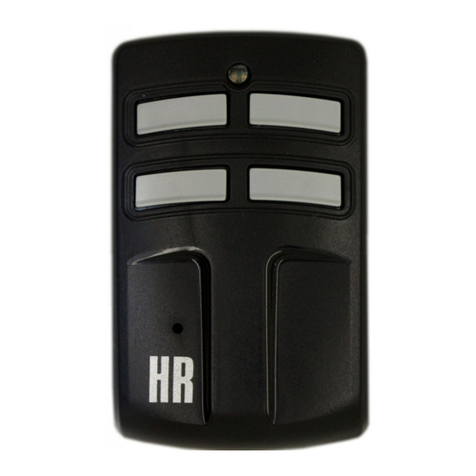
Il trasmettitore STX100 è destinato esclusivamente al
comando a distanza dei ricevitori radio (o delle centrali
di comando) presenti nelle automazioni Nice Home per
tende da esterno, schermi solari o tapparelle. Qual-
siasi altro uso diverso da quello descritto è da
considerarsi improprio e vietato! Usi impropri
possono essere causa di pericoli o danni, a cose
e persone.
STX100 ha 3 tasti associati a un unico codice di tra-
smissione. I tasti possono essere programmati per
comandare 1 singola automazione con i 3 comandi
definiti nella centrale, oppure per comandare separata-
mente fino a 3 automazioni, destinando a queste i tasti
e i comandi desiderati.
Il trasmettitore è dotato di un occhiello (B, nella fig.
2) che consente di fissarlo a un portachiavi, e di un
supporto a parete (fig. 3). Per fissare il supporto uti-
lizzare l’adesivo in dotazione (se la superficie è liscia e
compatta), oppure utilizzare la vite e il tassello in do-
tazione (fig. 3).
3 - Memorizzazione del codice e associazio-
ne dei comandi ai tasti del trasmettitore
Per poter utilizzare il trasmettitore è necessario me-
morizzare il suo codice di trasmissione nella memoria
del ricevitore radio o della centrale dell’automazione.
Durante la memorizzazione avviene anche l’associa-
zione dei comandi (definiti nella centrale) ai tasti del
trasmettitore, con le modalità descritte di seguito.
• Modo 1 – Durante l’esecuzione della procedura che
adotta questa modalità il sistema memorizza in una
sola volta i 3 tasti che fanno capo a un codice di
trasmissione, assegnando automaticamente ad ogni
tasto un comando presente nella centrale, secondo
una lista e un ordine prestabilito in fabbrica (vedere
la fig. 5). L’utilizzo di questa modalità consente alla
fine di comandare 1 automazione con 1 trasmettito-
re, utilizzando i primi 3 comandi presenti nella lista
comandi della centrale.
• Modo 2 – Durante l’esecuzione della procedura che
adotta questa modalità il sistema memorizza un sin-
golo tasto. In questo caso è l’installatore che sceglie
quale tasto memorizzare e quale comando associar-
vi: quest’ultimo scelto nella lista di quelli disponibili
nella centrale. Per memorizzare un secondo tasto è
necessario eseguire di nuovo la procedura. L’utilizzo
di questa modalità consente alla fine di memorizza-
re soltanto i tasti desiderati ed associarvi i comandi
desiderati, con il risultato di poter comandare fino a
3 automazioni, dedicando ad ognuna i tasti e i co-
mandi desiderati.
In generale, per le procedure di memorizzazione fare
riferimento a quelle riportate nel paragrafo successivo
e a quelle riportate nel manuale istruzioni del ricevitore
radio (o della centrale); copia di questo è disponibile
anche nel sito www.niceforyou.com
Nello stesso ricevitore radio (o centrale) i trasmetti-
tori possono essere memorizzati sia in Mode 1 sia
in Mode 2.
3.1 - Procedure di memorizzazione “a distanza”
dal ricevitore radio
Le seguenti procedure servono solo per memorizzare
ulteriori trasmettitori quando nel ricevitore radio è gia
memorizzato almeno un trasmettitore.
Il presente trasmettitore (“nuovo”) viene memorizzato
nel ricevitore radio senza agire direttamente sul tasto di
quest’ultimo, ma operando semplicemente nel raggio
di ricezione del ricevitore radio (massimo a 20 m da
questo) con un altro trasmettitore “vecchio” ovvero, già
memorizzato e funzionante. La procedura consente al
“nuovo” trasmettitore di memorizzare gli stessi coman-
di presenti in quello “vecchio”.
Per sapere la modalità nella quale è memorizzato il tra-
smettitore “vecchio”, procedere nel modo seguente:
1) - nel manuale della centrale: prendere visione della
lista dei comandi disponibili e soprattutto della loro nu-
merazione; 2) - sul trasmettitore “vecchio”: premere un
tasto alla volta, partendo dal primo fino all’ultimo per
comandare l’automazione.
Se il 1° tasto esegue il comando 1 della lista, il 2° tasto
esegue il comando 2 della lista e così via (come nell’e-
sempio sotto), vuol dire che il trasmettitore è memoriz-
zato in Modo 1. Se queste relazioni non ci sono vuol
dire che è memorizzato in Modo 2.
esempio
lista dei comandi tasti trasmettiotre
1Apre = 1° tasto (apertura)
2Stop = 2° tasto (ferma la manovra)
3Chiude = 3° tasto (chiusura)
3.1.1 - Effettuare la seguente procedura soltanto
se il “vecchio” trasmettitore è memorizza-
to in Modo 1
01. Sul “nuovo” trasmettitore, mantenere premuto per
almeno 5 secondi un tasto qualsiasi e poi rilasciarlo.
02. Sul “vecchio” trasmettitore, premere e rilasciare per
3 volte un tasto qualsiasi.
03. Sul “nuovo” trasmettitore, premere e rilasciare 1
volta lo stesso tasto premuto al punto 01.
Ripetere tutta la procedura per ogni trasmettitore che
si desidera memorizzare.
3.1.2 - Effettuare la seguente procedura soltanto
se il “vecchio” trasmettitore è memorizza-
to in Modo 2
01. Sul “nuovo” trasmettitore, mantenere premuto per
almeno 5 secondi il tasto che si desidera memorizzare
e poi rilasciarlo. 02. Sul “vecchio” trasmettitore, preme-
re e rilasciare per 3 volte il tasto associato al comando
desiderato. 03. Sul “nuovo” trasmettitore, premere e
rilasciare 1 volta lo stesso tasto premuto al punto 01.
Ripetere tutta la procedura per ogni tasto che si desi-
dera memorizzare.
4 - Verifica del funzionamento
Per verificare il funzionamento del trasmettitore è suf-
ficiente premere uno dei tasti e accertarsi che il led A
rosso lampeggi nello stesso istante e che l’automazio-
ne esegua il comando previsto. Il comando associato
ad ogni tasto dipende dalla modalità con cui è stato
memorizzato il trasmettitore (leggere il capitolo 3).
5 - Sostituzione della pila
Quando si preme un tasto del trasmettitore, se il led
Asi accende per un istante, significa che la pila è par-
zialmente scarica; in questi casi occorre tener premuto
il tasto per almeno mezzo secondo affinché il trasmet-
titore possa inviare il comando. Se invece la pila è
troppo scarica per portare a termine il comando (ed
attendere un’eventuale risposta), il led si affievolisce e
il trasmettitore si spegne.
In questi casi, per ripristinare il normale funzionamento
del trasmettitore, sostituire la pila facendo riferimento
alla fig. 4 (utilizzare una pila al litio tipo CR2032).
6 - Smaltimento
Questo prodotto è parte integrante dell’automazione,
e dunque, deve essere smaltito con essa. Per i detta-
gli fare riferimento al manuale istruzioni del ricevitore
radio o della centrale dell’automazione.
Attenzione! – Le pile possono contenere
sostanze inquinanti. Pertanto non gettarle nei
rifiuti comuni ma utilizzare i metodi di raccolta
differenziata previsti dai regolamenti locali.
Il materiale dell’imballaggio deve essere smaltito nel
pieno rispetto della normativa locale.
7 - Caratteristiche tecniche
• STX100 è prodotto da NICE S.p.a. (TV) Italy, Nice
Home è un marchio commerciale del gruppo NICE
S.p.a. • Allo scopo di migliorare i prodotti, NICE S.p.a.
si riserva il diritto di modificare le caratteristiche tecni-
che in qualsiasi momento e senza preavviso, garan-
tendo comunque funzionalità e destinazione d’uso
previste. • Tutte le caratteristiche tecniche sono riferite
alla temperatura di 20°C.
nTipologia: Trasmettitore radio per il controllo di
automatismi per tende, tapparelle e schermi solari n
Tecnologia adottata: Modulazione codificata AM
OOK nFrequenza: 433.92 MHz nCodifica: Rol-
ling code con codice a 64 Bit (18 miliardi di miliardi
di combinazioni) nPotenza irradiata: 1mW circa n
Alimentazione: 3Vdc +20% -40% con una pila al litio
tipo CR2032 nDurata della pila: 3 anni, stimata su
una base di 10 comandi/giorno della durata di 1s a
20°C (alle basse temperature l’efficienza della pila di-
minuisce) n Temperatura ambientale di funziona-
mento: -20°C...+55°C nGrado di protezione: IP40
(utilizzo in casa o ambienti protetti) nDimensioni /
peso: Senza supporto 38 x 93 x h 14mm / 23 g - Con
supporto 50 x 93 x h 17 mm / 25 g
Dichiarazione CE di conformità
Dichiarazione in accordo alla Direttiva 1999/5/CE
STX100 è prodotto da NICE S.p.a. (TV) Italy; Nice Home è
un marchio commerciale del gruppo Nice S.p.a.
Nota: Il contenuto di questa dichiarazione corrisponde a
quanto dichiarato nel documento ufficiale depositato pres-
so la sede di Nice S.p.a., e in particolare, alla sua ultima re-
visione disponibile prima della stampa di questo manuale.
Il testo qui presente è stato riadattato per motivi editoriali.
Copia della dichiarazione originale può essere richiesta a
Nice S.p.a. (TV) Italy.
Numero dichiarazione: 578/STX100 Revisione: 0
Lingua: IT
Il sottoscritto Roberto Griffa, in qualità di Amministratore
Delegato, dichiara sotto la propria responsabilità che il pro-
dotto: • nome produttore: NICE S.p.A.; • indirizzo: Via
Pezza Alta n°13, 31046 Rustignè di Oderzo (TV) Italy; •
modello / tipo: trasmettitore STX100; • accessori: nes-
suno; risulta conforme ai requisiti essenziali richiesti dall’ar-
ticolo 3 della seguente direttiva comunitaria, per l’uso al
quale i prodotti sono destinati: Direttiva 1999/5/CE DEL
PARLAMENTO EUROPEO E DEL CONSIGLIO del 9 marzo
1999 riguardante le apparecchiature radio e le apparec-
chiature terminali di comunicazione e il reciproco ricono-
scimento della loro conformità, secondo le seguenti norme
armonizzate: • Protezione della salute (art. 3(1)(a)): EN
62479:2010 • Sicurezza elettrica (art. 3(1)(a)): EN 60950-
1:2006 + A11:2009 + A1:2010 + A12:2011 + A2:2013 •
Compatibilità elettromagnetica (art. 3(1)(b)): EN 301 489-1
V1.9.2:2011; EN 301 489-3 V1.6.1:2013 • Spettro radio
(art. 3(2)): EN 300 220-2 V2.4.1:2012
In accordo alla direttiva 1999/5/CE (Allegato V), il prodotto
STX100 risulta di classe 1 e marcato: CE 0682
Oderzo, 21 aprile 2016
Ing. Roberto Griffa
((Amministratore Delegato)
1 - Safety warnings
CAUTION! – Important safety instructions: keep
these instructions in a safe place.
CAUTION! – To ensure personal safety, it is es-
sential to observe these instructions.
• Before starting installation, read this manual and that
of the radio receiver (or automation control unit) to en-
sure that the product is suitable for the hypothetical
use; take care to check the data in the chapter “Tech-
nical specifications”. • Never keep the transmitter near
sources of intense heat, or naked flames; these actions
may damage it or cause malfunctions and hazards. •
Caution! – Even if discharged, the batteries may con-
tain pollutant substances; therefore never dispose of
in public waste; observe the relative local regulations
and procedures envisaged for battery disposal. • Nice
S.p.A. declines all liability for damage resulting from
improper use of the product and other than as speci-
fied in this manual.
2 - Product description and intended use
This transmitter
STX100
is designed exclusively for
the remote control of the radio receivers (or control
units) present in the Nice Home automations for exter-
nal awnings, sun screens or shutters. Any use other
than as specified herein is strictly prohibited! Im-
proper use may cause hazards, damage or phys-
ical injury.
STX100 has 3 keys associated with a single transmis-
sion code. The keys can be programmed to control 1
single automation, with 3 controls defined on the control
unit, or to separately control up to 3 automations, as-
sociating the specific keys and commands as required.
The transmitter is equipped a small eyelet (B, in fig.2)
to enable attachment to a key ring, and a wall support
(fig. 3). To fix the support, use the adhesive strip sup-
plied (if the surface is smooth and compact) or use the
screw and plug supplied (fig. 3).
3 - Memorising the code and associating
the commands with transmitter keys
To enable use of the transmitter, its transmission code
must be stored in the memory of the radio receiver or
control unit of the automation. During memorisation,
the commands (set on the control unit) are also asso-
ciated with the transmitter keys, according to the pro-
cedures described below.
• Mode 1– During the procedure using this mode, the
system memorises the three keys associated with a
specific transmission code once only, automatically
assigning each key with a command set on the con-
trol unit, according to a factory set list and order (see
fig. 5). Use of this mode enables the control of 1
automation with 1 transmitter, using the first 3 com-
mands present in the list of commands on the con-
trol unit.
• Mode 2– During the procedure using this mode, the
system memorises a single key In this case it is the
installer’s task to select which key is to be memo-
rised and which key is to be associated; the latter is
chosen from the list of those available on the control
unit. To memorise a second key, the procedure must
be repeated. Use of this mode only enables mem-
orisation of the keys required, with association of
the commands required, with the possibility of con-
trolling up to 3 automations, dedicating the required
keys and commands.
In general, for the memorisation procedures, refer to
those provided in the next paragraph and those in the
radio receiver (or control unit) instruction manual; a
copy of this manual is also available on the website
www.niceforyou.com
On the same radio receiver (or control unit) transmit-
ters can be memorised in either Mode 1 or Mode 1.
3.1 - Procedures for “remote memorisation”
from the radio receiver
The following procedures serves only to memorise ad-
ditional transmitters when at least one transmitter has
already been memorised on the radio receiver.
the current (“new”) transmitter is memorised on the re-
ceiver without acting directly on the radio receiver key,
but simply by acting within the reception range of the
receiver (at max. 20 m from the latter) with another
“old” transmitter, i.e. one already memorised and op-
erative. The procedure enables the “new” transmitter
to memorise the same commands as those present on
the “old” transmitter.
To check which mode was used to memorise the “old”
transmitter, proceed as follows: 1) - in the control unit
manual: check the list of controls available and above
all the specific numbering in the control unit manual; 2)
- on the “old” transmitter: press one key at a time, start-
ing from the first to the last to control the automation.
If the first key executes command 1 on the list, the
second key executes command 2 on the list and so
on (as shown in the example below), this means that
the transmitter was memorised in Mode 1. If the asso-
ciations are different then it was memorised in Mode 2.
example
list of commands
keys on transmitter
1Open = 1st key (opening)
2Stop
= 2
nd
key (stops the manoeuvre)
3Close = 3rd key (closing)
3.1.1 - Perform the following procedure only if the
“old” transmitter is memorised in Mode
1
01. On the “new” transmitter, press and hold any key
for at least 5 seconds, then release.
02. On the “old” transmitter, briefly press and release
any key 3 times.
03. On the “new” transmitter, briefly press and release
the same key pressed in point 01, once.
Repeat the entire procedure for each transmitter to be
memorised.
3.1.2 - Perform the following procedure only if the
“old” transmitter is memorised in Mode
2
01. On the “new” transmitter, press and hold the key to
be memorised for at least 5 seconds, then release. 02.
On the “old” transmitter, briefly press and release the
key associated with the required command 3 times.
03. On the “new” transmitter, briefly press and release
the same key pressed in point 01, once.
Repeat the entire procedure for each key to be mem-
orised.
4 - Operation check
To check operation of the transmitter, simply press one
of the keys and ensure that the red led Astarts flash-
ing immediately, and that the automation executes the
envisaged command. The command associated with
each key depends on the mode in which the transmit-
ter was memorised (refer to chapter 3).
5 - Battery replacement
When a transmitter key is pressed, if led A illuminates
briefly, this means that the battery charge is low; in this
case press and hold the key for at least half a sec-
ond to enable the transmitter to attempt delivery of the
command. Otherwise if the battery charge is too low
to execute the command (and wait for a response) the
led fades and the transmitter turns off.
In these cases, to restore normal transmitter operation,
replace the battery with reference to fig. 4 (use a lithi-
um battery type CR2032).
6 - Disposal
This product is an integral part of the automation and
therefore must be disposed together with the latter. For
more details, refer to the instruction manual of the au-
tomation radio receiver or control unit.
Caution! – Batteries main contain pollutant
substances. Therefore never dispose of in pub-
lic waste and observe the procedures for sep-
arate waste collection envisaged by local legislation.
The product packaging material must be disposed of
in full observance of current local legislation.
7 - Technical specifications
• STX100 is produced by NICE S.p.a. (TV) Italy, Nice
Home is a commercial trademark owned by Nice
S.p.a. • In order to improve products, NICE S.p.a. re-
serves the right to modify technical specifications at
any time without notice, while maintaining the original
functionality and intended use. • All technical specifica-
tions refer to an ambient temperature of 20°C.
nType: Radio transmitter for the control of automa-
tions for awnings, shutters and sun screens nTech-
nology adopted: Coded modulation AM OOK n
Frequency: 433.92 MHz nEncoding: 64 Bit roll-
ing code (18 billion billion combinations) nRadiated
power: approx. 1mW nPower supply: 3Vdc +20%
-40% with a lithium battery type CR2032 nBattery
lifetime: 3 years, estimated on the basis of 10 com-
mands/day with a duration of 1s at 20°C (battery ef-
ficiency is reduced at low temperatures). n Environ-
mental operating temperature: -20°C...+55°C n
Protection rating: IP40 (use in homes or protected
environments) nDimensions / weight: Without sup-
port 38 x 93 x h 14 mm / 23 g - With support 50 x 93
x h 17 mm / 25 g
EC declaration of conformity
Declaration in accordance with Directive 1999/5/EC
STX100 is produced by NICE S.p.a. (TV) Italy; Nice Home
is a commercial trademark owned by Nice S.p.a.
Note: The contents of this declaration correspond to decla-
rations in the official document deposited at the registered
offices of Nice S.p.a. and in particular to the last revision
available before printing this manual. The text herein has
been re-edited for editorial purposes. A copy of the original
declaration can be requested from Nice S.p.a. (TV)
Italy
.
Number of declaration: 578/STX100 Revision: 0
Language: EN
The undersigned Roberto Griffa, in the role of Chief Ex-
ecutive Officer, declares under his sole responsibility, that
the product: • manufacturer’s name: NICE S.p.A.; • ad-
dress: Via Pezza Alta n°13, 31046 Rustignè di Oderzo (TV)
Italy; • model / type: transmitter STX100; • accessories:
none; conform to the essential requirements stated in arti-
cle 3 of the following EC directive, for the intended use of
products:
Directive 1999/5/EC OF THE EUROPEAN PAR-
LIAMENT AND COUNCIL of 9 March 1999 regarding ra-
dio equipment and telecommunications terminal equipment
and the mutual recognition of their conformity according
to the following harmonised standards:
• Health protection
(art. 3(1)(a)): EN 62479:2010 • Electrical safety (art. 3(1)(a)):
EN 60950-1:2006 + A11:2009 + A1:2010 + A12:2011 +
A2:2013 • Electromagnetic compatibility (art. 3(1)(b)): EN
301 489-1 V1.9.2:2011; EN 301 489-3 V1.6.1:2013 • Ra-
dio spectrum (art. 3(2)): EN 300 220-2 V2.4.1:2012
In accordance with the directive 1999/5/EC (appendix V),
the product STX100 is class 1 and marked: CE 0682
Oderzo, 21 April 2016
Ing. Roberto Griffa
(Chief Executive Officer)
ENGLISH ITALIANO