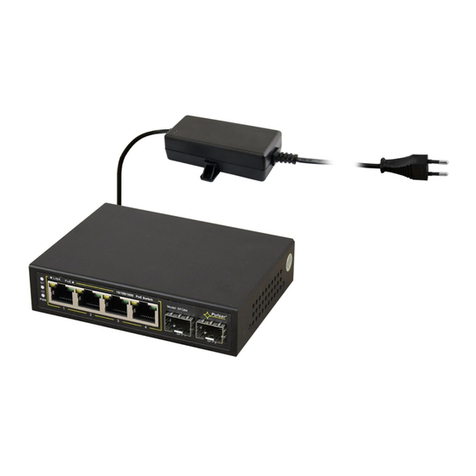
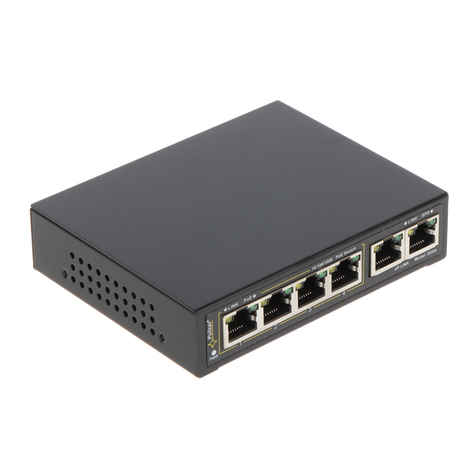
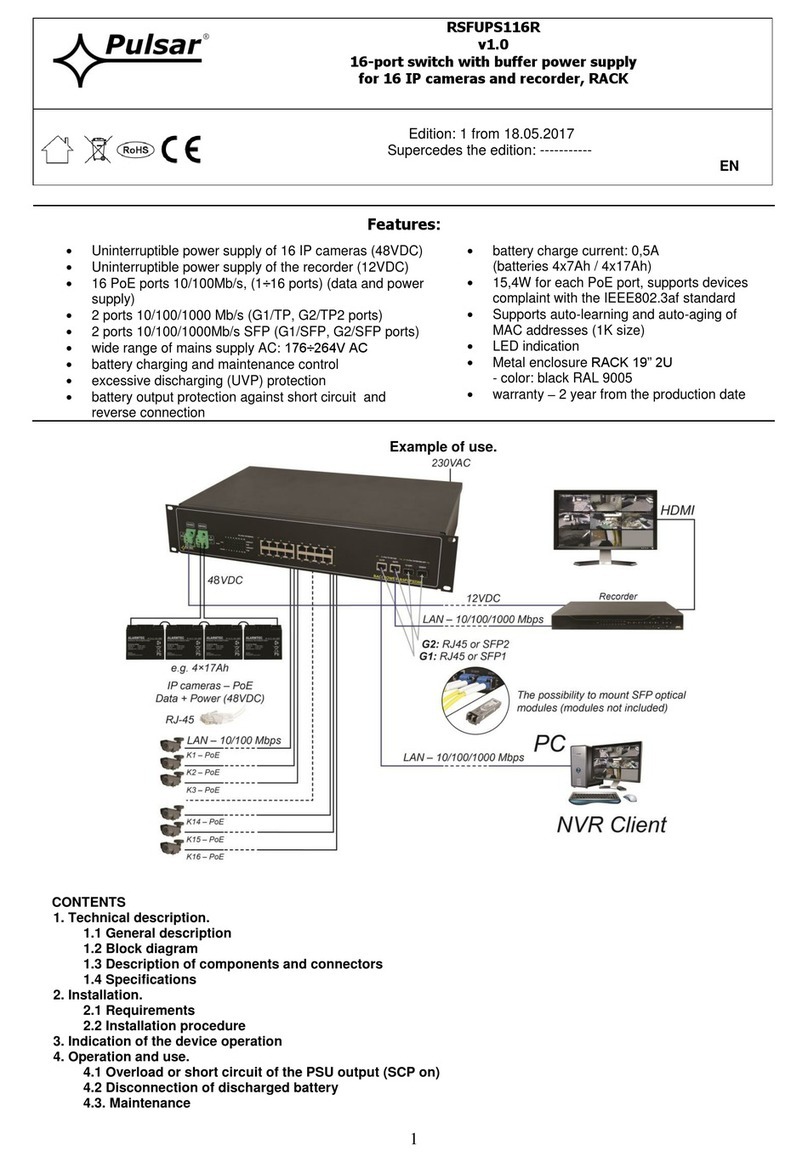
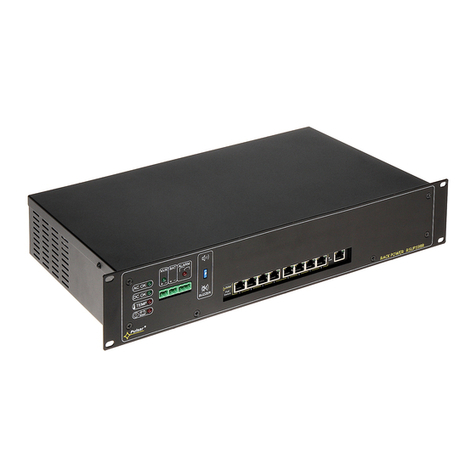
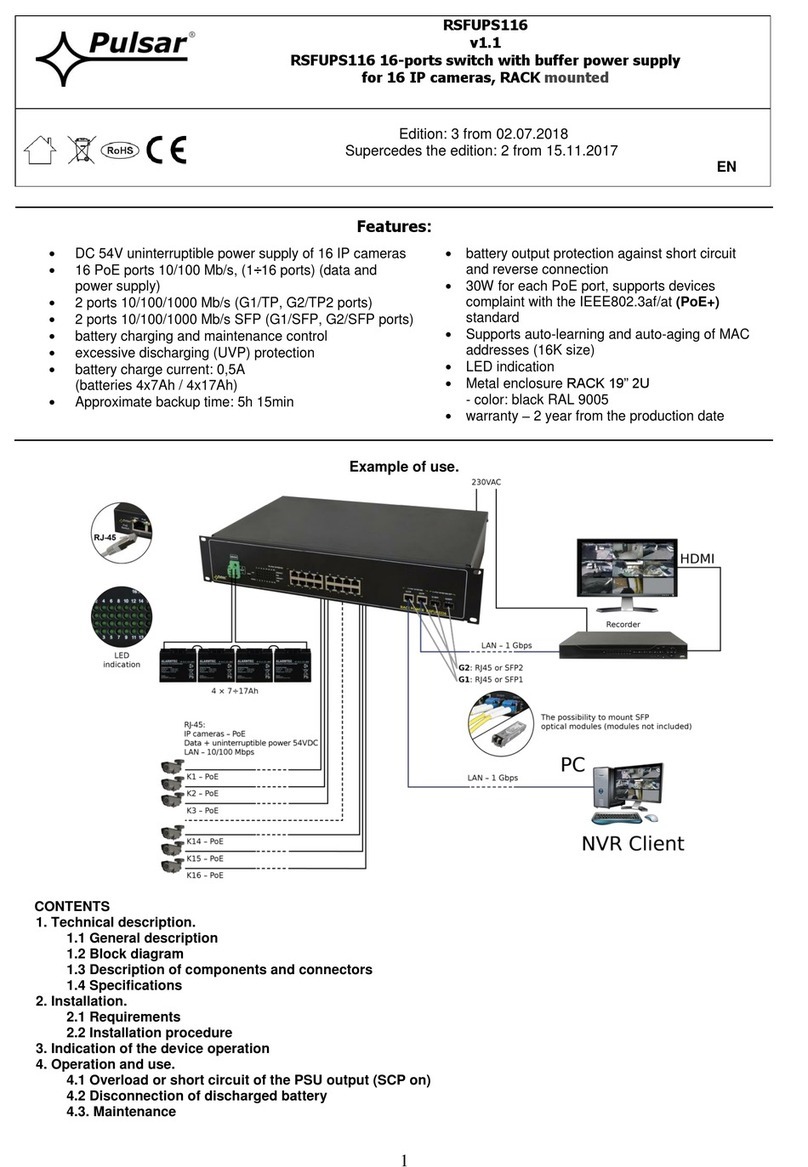
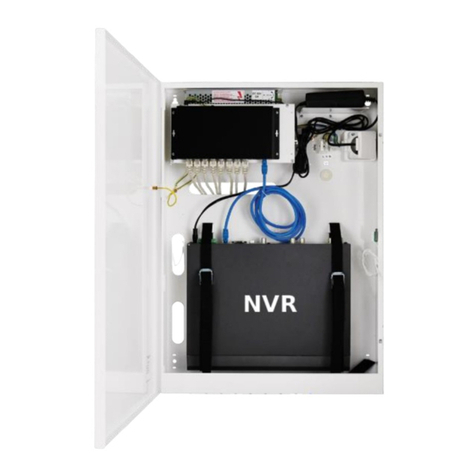
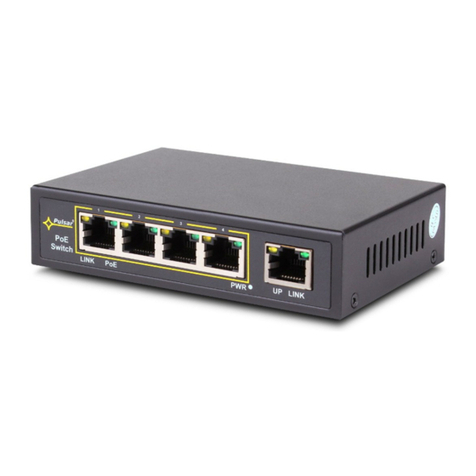
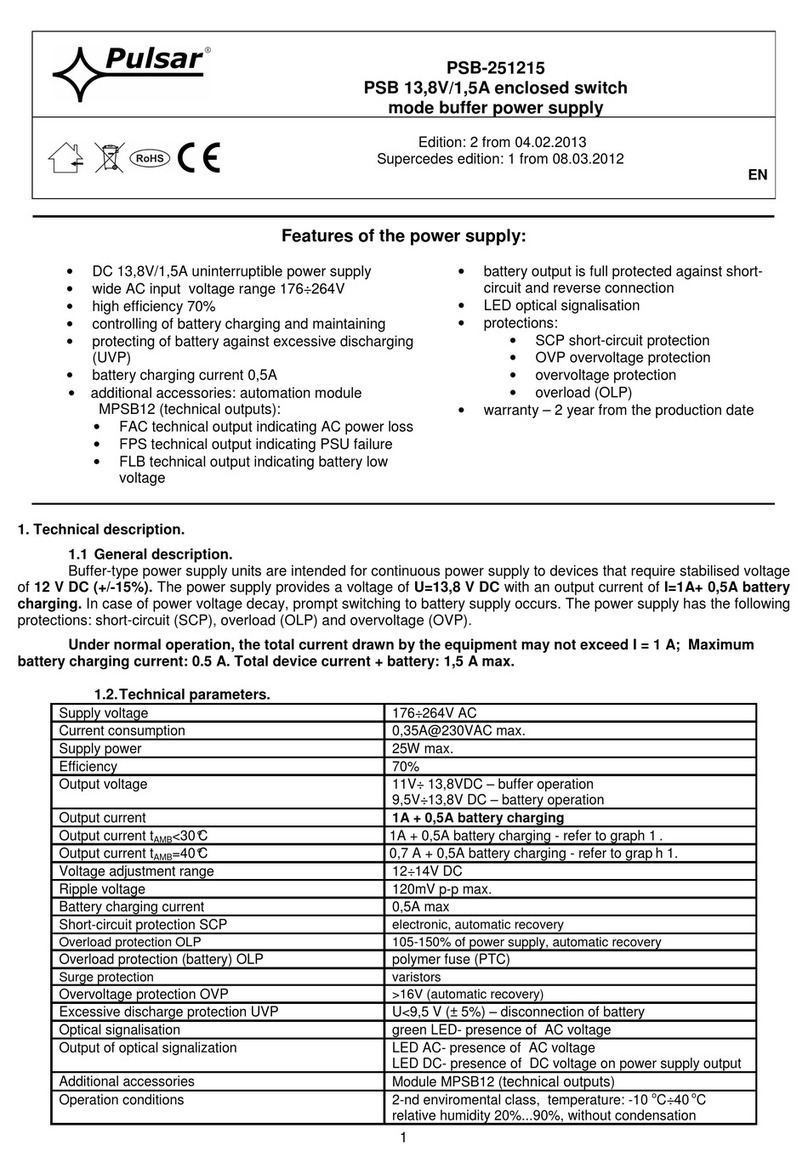
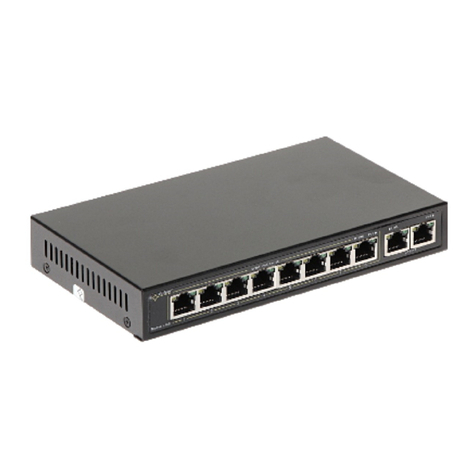
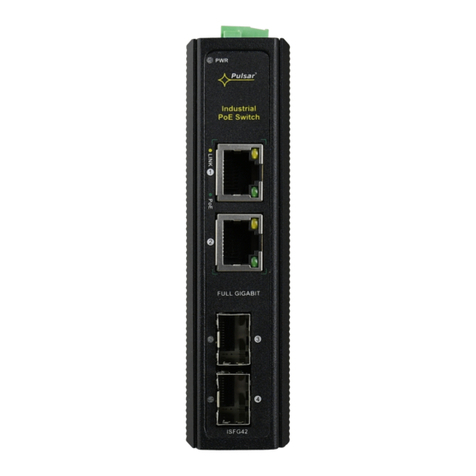
*The given value of 30 W per port is the maximum value. The total power consumption should not exceed 120 W.
2. Installation
2.1. Requirements
The unit should be mounted in confined spaces, in accordance with the 2nd environmental class, with normal relative
humidity (RH=90% maximum, without condensation) and temperature from -10°C to +40°C. Ensure the free flow of air around
the unit. The PSU shall work in a vertical position that guarantees sufficient convectional air-flow through ventilating holes of the
enclosure.
The switch load balance should be done before installation. Depending on application, appropriate power supply should
be selected (recommended 52 V)The given value of 30 W per port is the maximum value referring to a single output.
The total power consumption should not exceed 120 W and depends on the current efficiency of the PSU, taking account of the
power intake for the own needs of the device. The increased demand for power is particularly evident in the case of cameras
with heaters or infrared illuminators - when launching these features, the power consumption increases rapidly, which may
adversely affect the operation of the switch. As the device is designed for a continuous operation and is not equipped with a
power-switch, therefore an appropriate overload protection in the power supply circuit should be provided. The electrical system
shall be made in accordance with applicable standards and regulations.
2.2. Long Range mode
Switch enables operation in two modes: standard and extended range. When the Long Range switch is in STANDARD
position (see Fig. 5), PoE ports operate at 100 Mb/s up to 100 meters. After switching to EXTEND position, range is increased
to 250 meters and speed is reduced to 10 Mb/s. Additionally, VLAN function, which isolates the PoE ports between each other
(communication takes place between the UpLink ports and individual PoE), is activated. In both modes, the UpLink port speed
is 100 Mb/s.
Note: Changing the modes requires a power restart!
2.3. Installation procedure
1. Connect switch to power supply unit.
2. Connect the power supply to the 230 V socket.
3. Connect the camera wires to the RJ45 connectors (connectors PoE).
4. Check the optical indication of switch operation (see Table 3).
Connection schemes.