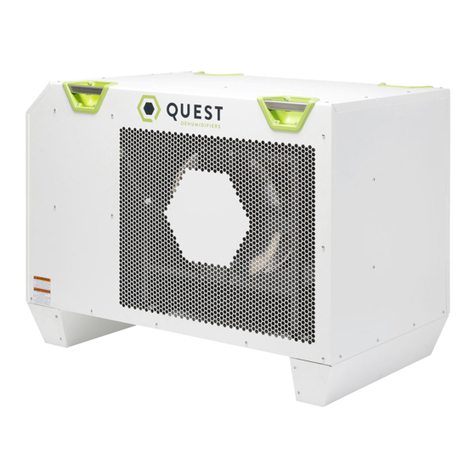
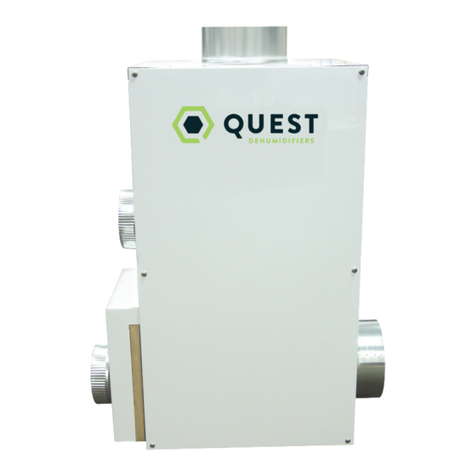
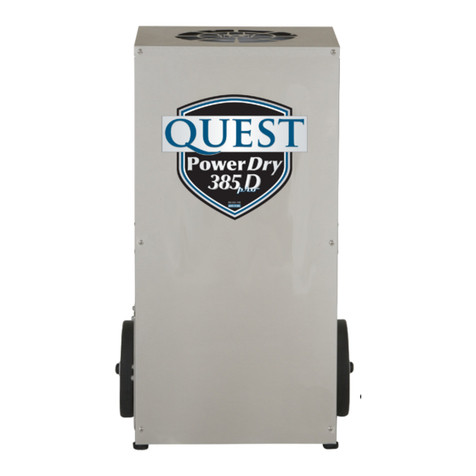
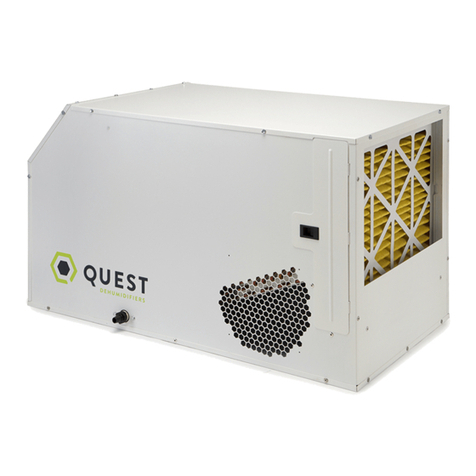
Quest DRY 105, 155, and 205 Installation, Operation and Maintenance Instructions
1-877-420-1330 7www.QuestProtect.com
info@QuestProtect.com
the unit to attach to the 6” hole in the filter enclosure. The 6” collar should be capped if fresh make-up air is not desired.
If fresh make-up air is desired, see Section 3.4C.
A 10” round (ovaled) collar is supplied with the unit for the outlet of the Quest Dry.
A length of flexible ducting on all Quest Dry duct connections is recommended to reduce noise and vibration
transmitted to rigid ductwork in the structure.
Ducting the Quest Dry as mentioned in Sections 3.4A-3.4G requires consideration of the following points:
Duct Sizing: For total duct lengths up to 25’, use a minimum 10” diameter round or equivalent rectangular. For longer
lengths, use a minimum 12” diameter or equivalent. Grills or diusers on the duct ends must not excessively restrict
airflow.
Isolated Areas: Eective dehumidification may require that ducting be branched to isolated, stagnant areas. Use 8” or
larger diameter branch ducting to each of two or three areas, use 6” or larger to each of four or more areas.
Connecting to existing HVAC systems: An optional 10” check damper is available from the factory to prevent reverse
flow through the Quest Dry. If the Quest Dry is ducted to the supply ducting air handler, it is recommended that the
check damper be placed in the Quest Dry supply duct. Contact the factory when connecting to a static pressure of
greater than or equal to +0.5” WG.
3.4C Ducting for Fresh Air
Fresh air can be brought into the structure by connecting an insulated duct from outside to the 6” Quest Dry inlet and
by turning on the fan switch or activating the humidity control (on units with the humidity control panel). Activate
the ventilation timer on units with the ventilating and humidity control panel to bring in fresh air. Refer to Section
4.5 for programming instructions for the ventilation timer. Advantages of this form of ventilation include:
1. Outside air is filtered before entering the building.
2. Outside air will be dehumidified before entering if the Quest Dry is running in dehumidification mode.
3. Drawing air from outside and blowing inside aids in slightly pressurizing the structure. This helps prevent dirty and
humid air from entering elsewhere. It also reduces the potential for carcinogenic radon gas to enter and provides
make-up air for open combustion and exhaust devices like the clothes drier, fireplace, and water heater.
In cold climates or areas where the outdoor dew point is low at times, ventilation can be used to dehumidify the structure.
This is accomplished by bringing the dry, low dew point air into the structure during these times. This approach is often
more economical than running the dehumidifier to remove excess moisture from the structure. In cold climates, it is
critical to adequately ventilate to reduce the inside moisture content to avoid moisture accumulating in the wall cavities.
For example; in a structure that experiences condensation on the interior surface of the windows during the winter,
increasing the amount of ventilation will often cure the problem.
An insulated 6” diameter duct is generally sucient to provide up to 100 CFM of outside air. Large quantities of outside
air will either positively or negatively impact the performance of the Quest Dry, depending upon inside and outside air
conditions. Consult the factory by calling 1-800-533-7533 for recommendations regarding the use of higher flows with
your specific application.
The outside air duct should be connected to the 6” round collar on the filter enclosure of the unit. The 6” round collar
includes a manual damper. Adjust the manual damper to provide the desired amount of fresh air for ventilation. The
amount of fresh air should be based on the size and occupancy of the residence. If you are unsure of your ventilation air
requirements, consult the factory by calling 1-800-533-7533 for assistance.
FOR HVAC INSTALLER ONLY