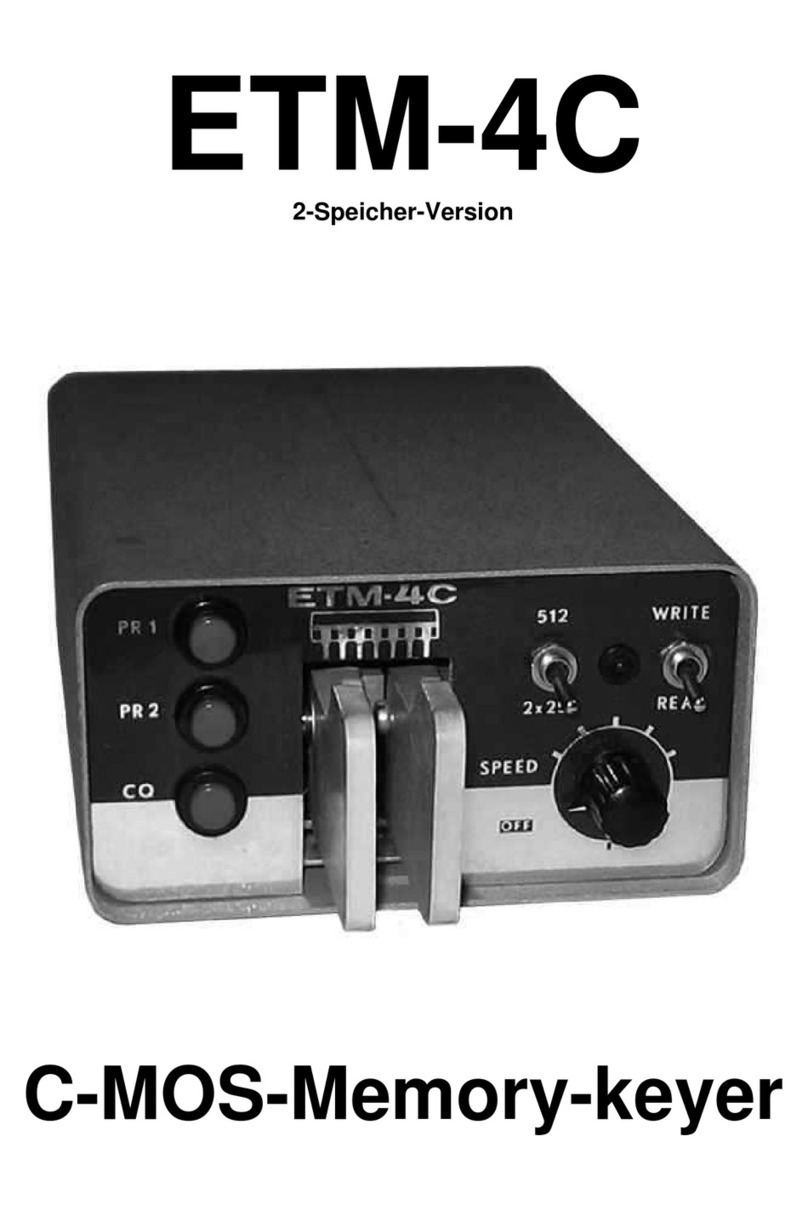
General Description
The electronic keyer model ETM-4C contains of an automatic SQUEEZE-keyer and 4 independet
code stores (4 × 256 bit). Each of the memories can be loaded with up to about 22 letters of text by
simply operating the keyers paddle. Either memory may be recalled independently as often as de-
sired. For longer messages the two stores can be coupled together thus doubling the storage capa-
city.
Once a message is loaded it remains stored until it is erased by loading a new message or by swit-
ching off the power. Model ETM-4C's careful design using C-MOS-ICs reduces the idling current of
the entire set to only a few microamps doing away with the necessity for switching off, even if the
keyer is not to be used for a longer period.
Keyer and store have a common clock running start-stop with the keyer and continuously when the
store is in WRITE or READ mode. Therefore messages edited by the store and texts produced by
keyer operation have necessarily the same speed. It is, however, possible to load the store at any
convenient speed and then to vary the speed of the edited message within the entrie speed range.
The two separate circuit boards for keyer and store are "plugin-type" allowing easy serving. A faulty
circuit board may simply be unpluged and mailed for maintenance. Unplugging the store board do-
es not affect the function of the keyer.
The keyer output is factory assembled for relay operation (all purpose, 250 V or 0.5 A max.). To
make use of the more economical grid-block keying (max. 300 V NEGATIVE to ground) the jumper
across pins "R" must be removed and put across pins "G" on the keyer board.
Note: POSITIVE voltages can only be keyed via the relay.
Operating Instruction
Note: Do not switch off the power, if you want to preserve the stored message.
a) Installation
Loosen the two mounting screws on the rear panel and remove the chassis from the case. Insert 4
standard size AA batteries (1.5 volts each) into the battery holder. Check polarity signs on both bat-
teries and holder. The polarity in the holder is marked (+) and (–). Note that the polarity of tip and
case with Mercury cells is different from that of normal batteries. Low battery voltage will be indica-
ted by dim LED indication during memory operation. Discharged batteries will not operate the keyer
properly. If at any time the keyer appears to be operating abnormally, the batteries should be che-
cked for low voltage. If the keyer is to remain unused for a longer time, it is recommended to remo-
ve the batteries from the holder.
Use shielded cable to connect the keyer with your transmitter. Solder the shield to pin 2 and the in-
ner conductor to pin 3 of the supplied DIN-connector.
b) Operating the Keyer
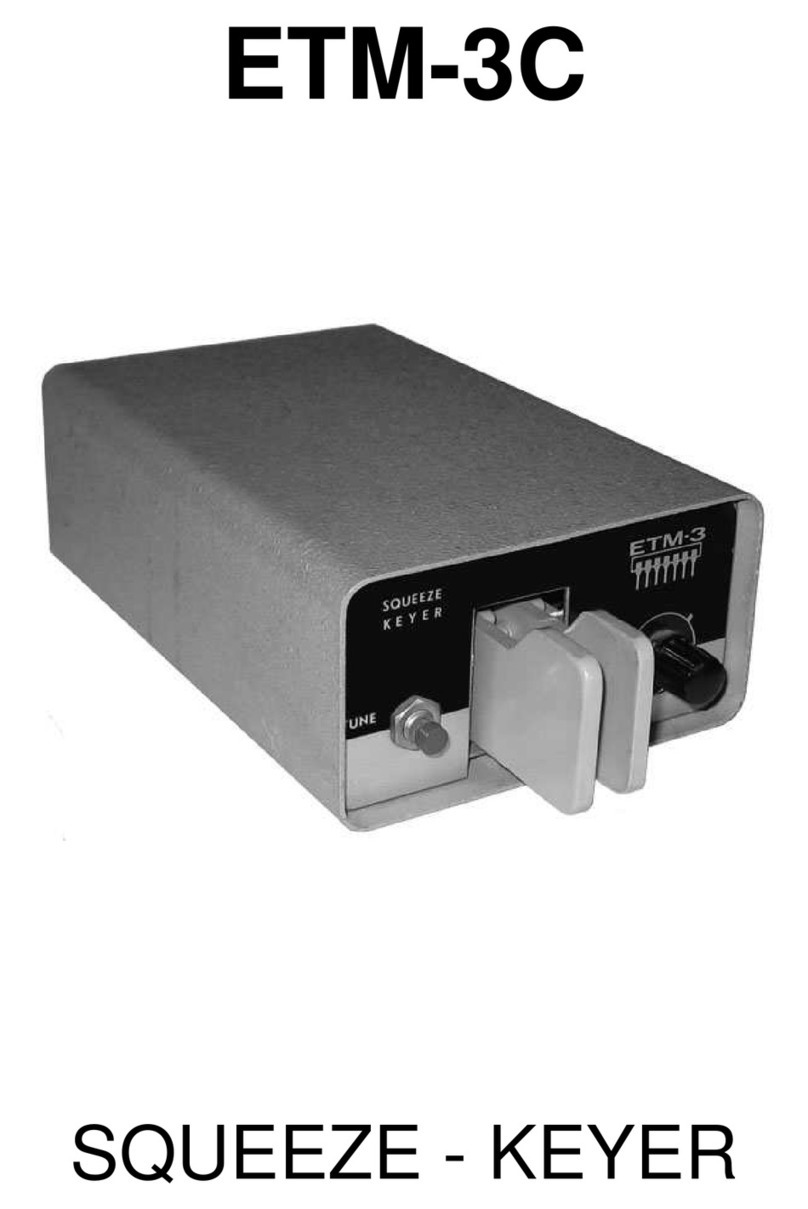
The ETM-4C may be operated in the conventional manner by touching either side of the double
paddle for generating dots and dashes. For Iambic operation the double paddle must be squeezed
to produce a dash-dot or dot-dash sequence according to the lever operated first. The SQUEEZE-
technique enables you to key characters like C, Q, Y, L, F, ar, ka, sk with fewer motion of the padd-
le as compared to the conventional manner of keying.
The keying speed can be varied with the speed control from about 8 to 50 words per minute.
To adjust the contacts of the paddle loosen the two mounting screws on the rear panel and remove
the chassis from the case. The gaps of the silver contacts for dots and dashes can be adjusted in-
dependently with the milled screws on both sides of the paddle case. A setscrew using an allen
wrench (cf. fig 1) allows the adjustment of the paddle tension.
c) Loading the Stores
Adjust the speed control for a suitable speed.
Set switch "READ/WRITE" to "WRITE" and switch "512/256" to "256". Press button "PR 1" to choo-
se program 1.
Operate the paddle to key the message into the store.
The loading process is initiated by the first pulse from the keyer. A red LED in the front panel indi-