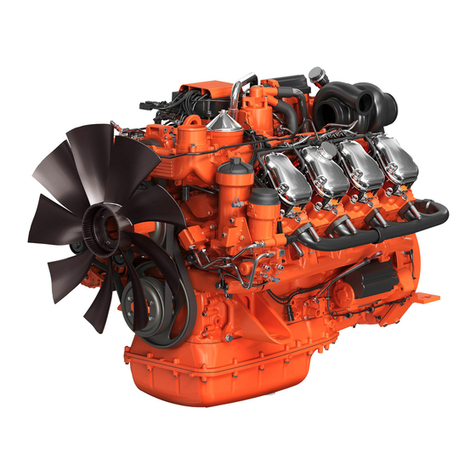
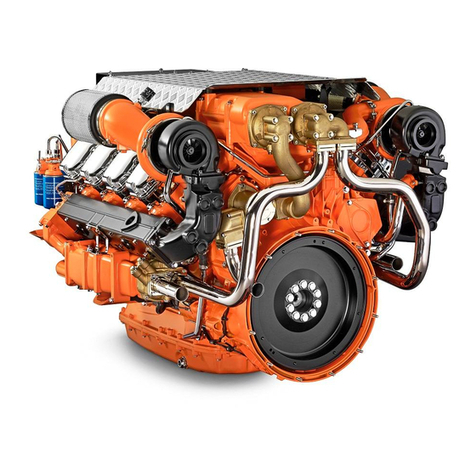
Scania DC16OC16 User manual
01:01 Issue 9.0 en-GB
© Scania CV AB 2018, Sweden
Installation manual
Engine
Industrial engines
DC09, DC13, DC16
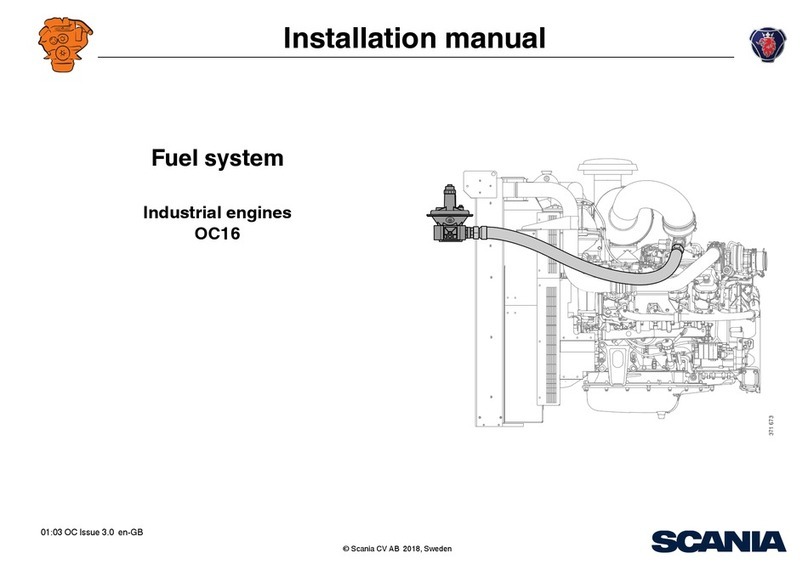
OC16
333 291

INSTALLATION
MANUAL
© Scania CV AB 2018, Sweden
01:01 Issue 9.0 en-GB 2
Changes from the previous issue............................................................................3
Engine suspension....................................................................................................4
Suspension design requirements ......................................................................... 4
Rigid engine suspension...................................................................................... 5
Flexible engine suspension.................................................................................. 5
Tightening torque for engine suspension ............................................................ 8
Permissible installation and operating angles ..................................................... 9
Flywheel housing .............................................................................................. 10
Generator set dynamics ..................................................................................... 12
Lifting the engine .............................................................................................. 13
Accessibility for maintenance and repairs .......................................................... 16
Installation requirements ................................................................................... 16
Clearances ......................................................................................................... 17
Engine alignment...................................................................................................18
Aligning engine and shafts................................................................................ 19
Power transmission ...............................................................................................24
Flexible coupling............................................................................................... 24
Friction clutch ................................................................................................... 25
Transmission types ................................................................................................26
Mechanical transmissions ................................................................................. 26
Belt transmissions ............................................................................................. 26
Power take-off........................................................................................................28
Front-mounted power take-offs......................................................................... 29
Side-mounted power take-offs .......................................................................... 32
Calculation example for torque take-off from power take-off.......................... 39
Air compressor ...................................................................................................... 40
Torsional oscillations ............................................................................................ 41
Data for torsional oscillation calculation.......................................................... 41
Torsional oscillation calculations from Scania................................................. 42
General tightening torques for screw joints ....................................................... 43
Specification of normal tightening torques....................................................... 43
Tightening torques ............................................................................................ 44
Sticker “Powered by Scania”............................................................................... 47

INSTALLATION
MANUAL
© Scania CV AB 2018, Sweden
Changes from the previous issue
01:01 Issue 9.0 en-GB 3
Changes from the previous issue
The changes made in this document compared with the previous issue are marked
with a black line in the left-hand margin. The changes are also described below.
• Section Suspension design requirements has been made clearer.
• In section Insulators, maximum and minimum loads and dimensions for Scania
insulators have been added.
• In section Tightening torque for engine suspension, a tightening sequence for the
engine brackets has been added.
• Section Calculation example for bending torque on flywheel housing has been
added.
• Working procedures for Lifting the engine have been added.
• Clearances for Downward facing centrifugal oil cleaner have been added.
• Section Flexible coupling has been made clearer.
• In section Power take-off, a text and illustration has been added, informing the
reader that components from other manufacturers cannot be used in the belt trans-
mission.
•Hydraulic diagram for hydraulic pump has been added.
•Calculation example for torque take-off from power take-off has been added.
• In section Data for torsional oscillation calculation, information has been added
on what values Scania needs in order to approve an external torsional oscillation
calculation.

INSTALLATION
MANUAL
© Scania CV AB 2018, Sweden
Engine suspension
01:01 Issue 9.0 en-GB 4
Engine suspension
Suspension design requirements
The type of engine suspension that is appropriate varies for different engine installa-
tions. In general, the following applies:
• The engine suspension should be designed for the forces it is exposed to, both
continuously and momentarily during operation. Such forces are reaction forces
from the transmitted torque and in some cases longitudinal acceleration, retarda-
tion and reaction forces in the engine.
• Both the engine suspension and the engine bed should be designed so that there
are no resonant oscillations within the engine speed range. They should also be
designed so that annoying vibrations from the engine are not transmitted to the
surroundings.
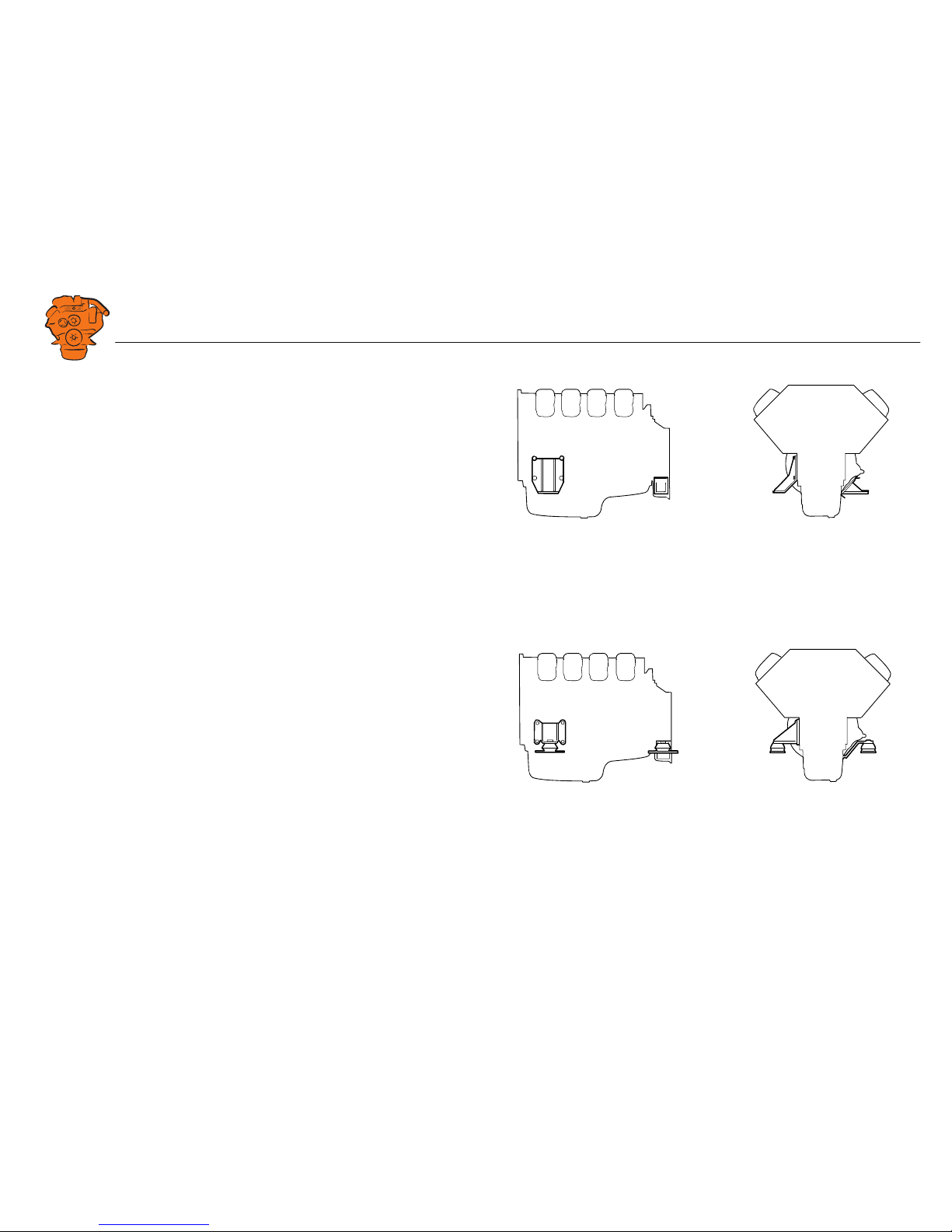
• The suspension should be as rigid as possible. Use all 4 screw holes in the cylinder
block and flywheel housing for the respective engine bracket. See illustration.
• The engine bed location and the engine suspension must be designed so that the
permissible angles of inclination for the engine are not exceeded. See Permissible
installation and operating angles.
• The engine suspension and engine bed should be designed in a way which allows
access for maintenance and repairs.
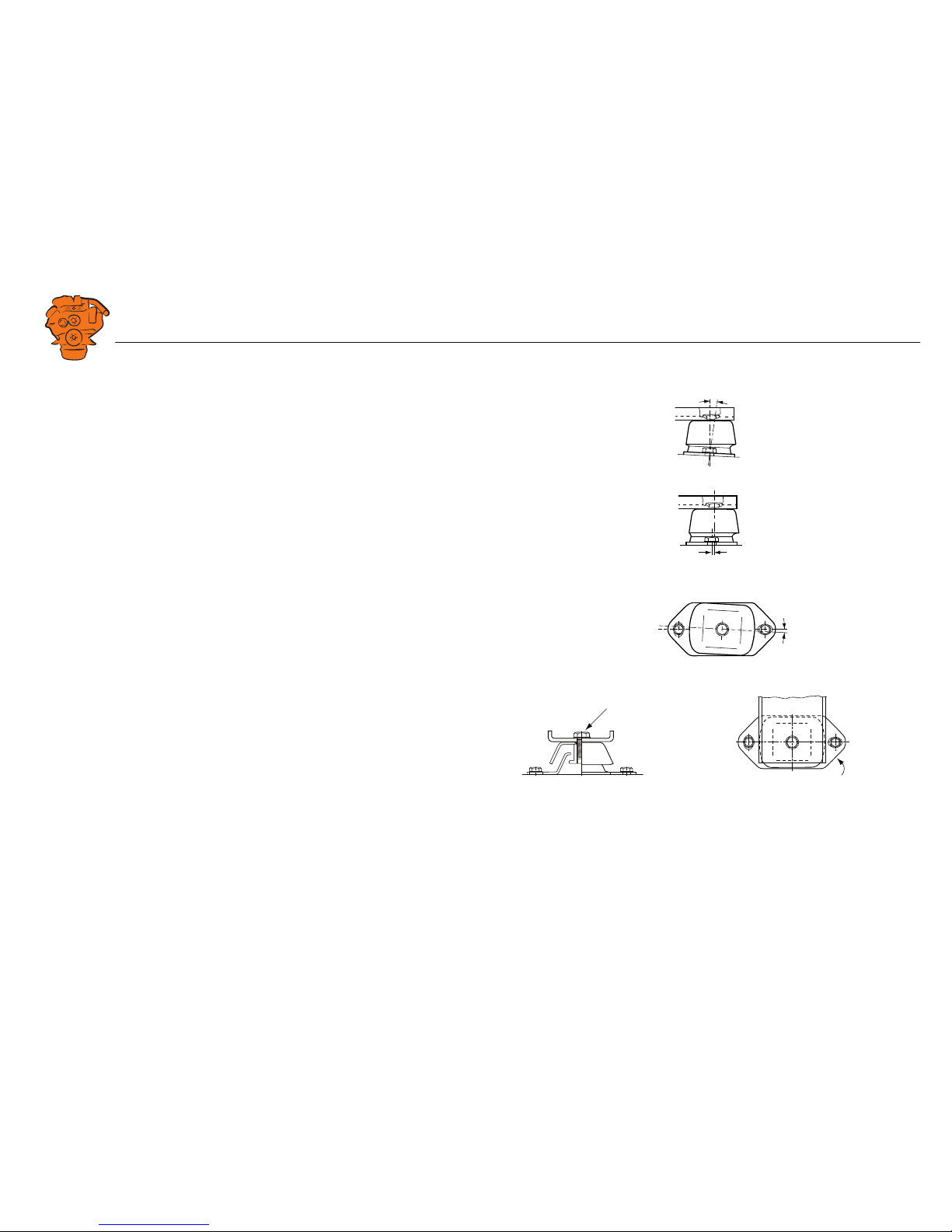
There are two standard engine suspension designs:
•Rigid engine suspension
•Flexible engine suspension
393 928
INSTALLATION
MANUAL
© Scania CV AB 2018, Sweden
Engine suspension
01:01 Issue 9.0 en-GB 5
Rigid engine suspension
A rigid engine suspension can absorb greater forces in all directions than flexible en-
gine suspension. It requires highly accurate alignment of the engine in relation to the
driven unit. On the other hand, it requires no special flexibility in the hoses, pipes and
controls connected to the engine.
A rigid engine suspension can be used in engine installations where vibration causes
no significant problems and where other characteristics make it desirable.
Even with a rigid engine suspension, the transmission of vibration to the engine bed
can be kept low if the masses of the engine bed and connected parts are large in re-
lation to the mass of the engine.
It is also possible to construct flexible engine suspension between the frame and the
engine bed to reduce the transmission of vibration to the engine bed.
Flexible engine suspension
Flexible engine suspension dampens vibrations more effectively than rigid engine
suspension. Flexible engine suspension does not require such careful alignment of
the engine as rigid engine suspension. However, flexible engine suspension does not
absorb longitudinal and lateral forces in the engine to the same extent as rigid engine
suspension.
344 281
Examples of rigid engine suspension.
334 280
Examples of flexible engine suspension.
INSTALLATION
MANUAL
© Scania CV AB 2018, Sweden
Engine suspension
01:01 Issue 9.0 en-GB 6
Insulators
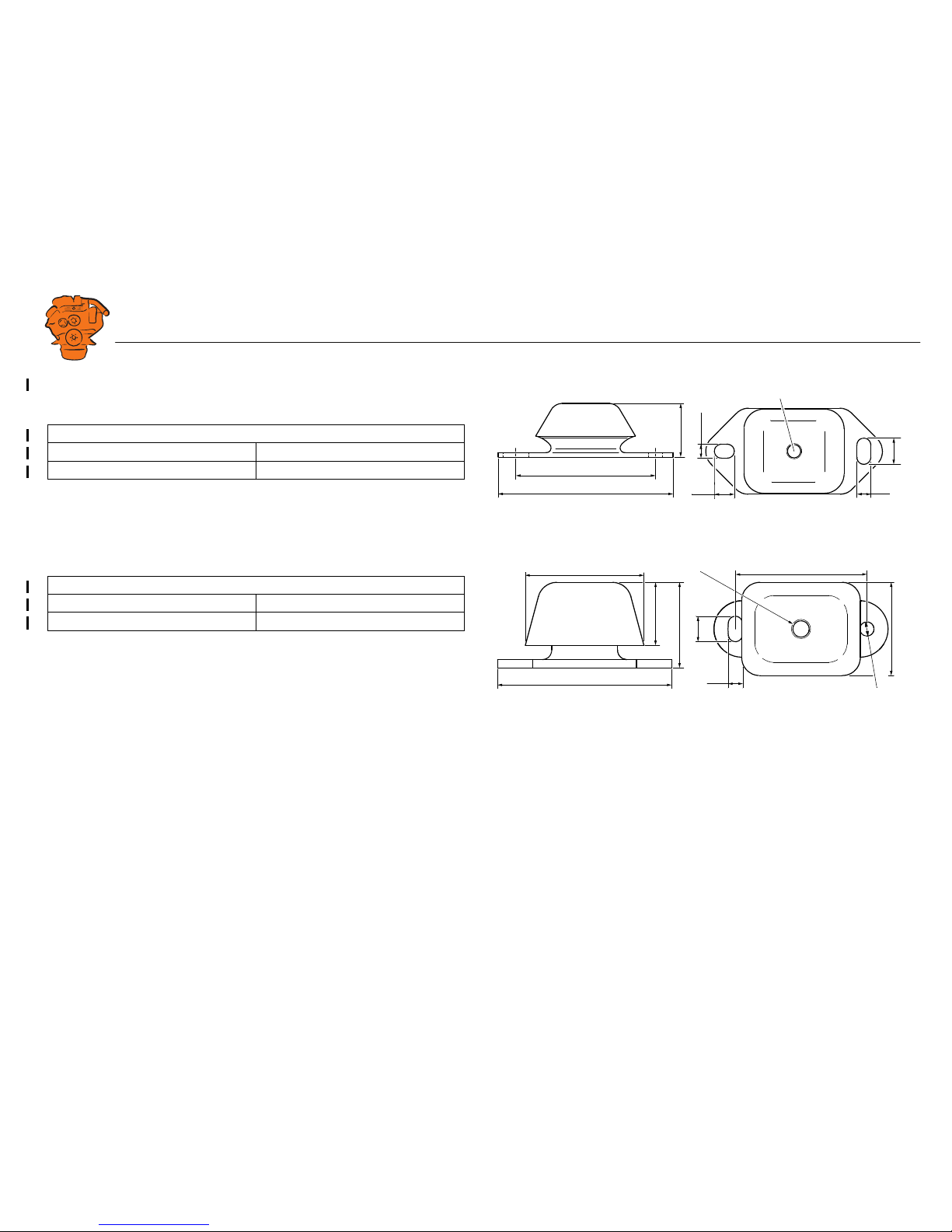
Cushyfloat insulators with hardness 55 or 65 Shore can be ordered as option. The fol-
lowing applies for these parts:
• The engine bracket and frame or engine bed should be parallel.
• The vertical centre lines should coincide laterally.
• The upper and lower parts of the insulators should be parallel longitudinally.
Tightening torque. Hardness marking.
max 1°
396 084
0
396 085
55
0°
396 086
310 404
160±10 Nm
310 405
55
55
alt. 65
INSTALLATION
MANUAL
© Scania CV AB 2018, Sweden
Engine suspension
01:01 Issue 9.0 en-GB 7
The illustration shows the dimensions of the insulators.
Vertical load, kg 55 Shore for DC09, DC13
Min. Max.
150 250
Vertical load, kg 65 Shore for DC16, OC16
Min. Max.
300 500
182
228
A
26
18
18
34
M20
394 808
Insulators 55 Shore for DC09 and DC13.
Dimension A: Without load = 70 mm. With load = 66 mm.
140
185
67
15
27
126
A
99
Ø15
M20
394 807
Insulators 65 Shore for DC16 and OC16.
Dimension A: Without load = 91 mm. With load = 86 mm.

INSTALLATION
MANUAL
© Scania CV AB 2018, Sweden
Engine suspension
01:01 Issue 9.0 en-GB 8
Tightening torque for engine suspension
The engine brackets can look different on different engine types, but all types of en-
gine bracket are tightened crosswise.
1. Torque tighten screws 1 and 2.
2. Torque tighten screws 3 and 4.
3. Angle-tighten screws 1 and 2.
4. Angle-tighten screws 3 and 4.
Front engine suspension
Rear engine suspension
Type of screw Tightening torques
25 mm clamping length, M16, 10.9 130 Nm, 90°
50 mm clamping length, M16, 10.9 130 Nm, 135°
Type of screw Tightening torques
M14, 8.8 149 Nm
1
3
4
2
394 815
Example of engine bracket.

INSTALLATION
MANUAL
© Scania CV AB 2018, Sweden
Engine suspension
01:01 Issue 9.0 en-GB 9
Permissible installation and operating angles
IMPORTANT!
If the angles of inclination are exceeded, lubrication system performance will deteri-
orate, which can cause damage to the engine or reduce its service life.
Maximum installation angle means maximum permissible installation angle for an
engine relative to the horizontal plane. The angle indicates the limit for engine incli-
nation during continuous operation.
Maximum operating angle means maximum permissible angle of inclination for an
engine in operation and with minimum oil level. The angle may only be used for
short periods. The maximum forward or rearward operating angles are not applicable
to their full extent if the engine is inclined laterally at the same time.
Engine type Type of oil sump Max. installation angle Max. operating angle Oil capacity (litres)
Inclination rear-
wards and for-
wards
Inclination lat-
erally
Inclination rear-
wards and for-
wards
Inclination lat-
erally
Min. Max.
DC09 Deep front without ladder frame 12° 12° 30° 30° 31 36
DC09 Low 12° 12° 25° 30° 28 35
DC13 Deep front without ladder frame 12° 12° 30° 30° 30 36
DC13 Deep front with ladder frame 12° 12° 30° 30° 39 45
DC13 Low 12° 12° 25° 30° 28 34
DC13 With deep centre part 12° 12° 35° 45° 33 39
DC16, OC16 Deep front without ladder frame 12° 10° 25° 30° 40 48
DC16 Low 12° 10° 25° 30° 29 37

INSTALLATION
MANUAL
© Scania CV AB 2018, Sweden
Engine suspension
01:01 Issue 9.0 en-GB 10
Flywheel housing
Silumin housings are supplied as standard on all industrial engines. The maximum
permissible bending torque for a silumin housing is 10,000 Nm. This presumes that
there are no axial loads from, for example, the propeller shaft, abnormal G forces or
vibration.
For certain engine types, it is also possible to select a nodular iron flywheel housing.
Nodular iron housings can dampen vibrations at certain engine speeds but increase
vibrations at other engine speeds. Nodular iron is stronger than silumin and can there-
fore tolerate greater bending and torsional forces.
The stronger nodular iron housings are recommended in installations where transport
causes serious stress on the flywheel housing, such as in dumper type trucks or gen-
erator sets with high outputs.
If it is difficult to determine the size and nature of the load, contact your nearest Sca-
nia distributor.
Table of contents
Other Scania Engine manuals






Scania
Scania DC09 User manual
Scania
Scania DI09 User manual

Scania
Scania D11 User manual

Scania
Scania DI09 User manual
Scania
Scania DI16 XPI series User manual
Scania
Scania DC16 User manual
Scania
Scania OC16 User manual
Scania
Scania DI09 User manual
Scania
Scania DC09 User manual

Scania
Scania DI9 55 User manual