Hybrid 1
3
1.B: Safety First
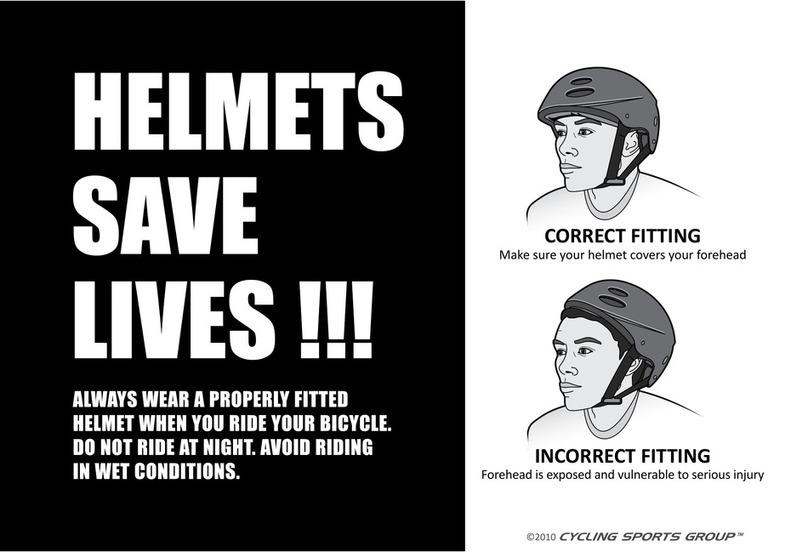
1. Always wear an approved helmet when riding your bike, and
follow the helmet manufacturer’s instrucons for t, use
and care.
2. Do you have all the other required and recommended safety
equipment? See Secon 2. It’s your responsibility to familiarize
yourself with the laws of the areas where you ride, and to
comply with all applicable laws.
3. Do you know how to correctly secure your front and rear
wheels? Check Secon 4.A.1 to make sure. Riding with an
improperly secured wheel can cause the wheel to wobble or
disengage from the bicycle, and cause serious injury or death.
4. If your bike has toeclips and straps or clipless (step-in) pedals,
make sure you know how they work (see Secon 4.E). These
pedals require special techniques and skills. Follow the pedal
manufacturer’s instrucons for use, adjustment and care.
5. Do you have toe overlap?On smaller framed bicycles your toe
or toeclip may be able to contact the front wheel when a pedal
is all the way forward and the wheel is turned. Read Secon 4.E.
to check whether you have toeclip overlap.
6. Does your bike have suspension? If so, check Secon 4.F.
Suspension can change the way a bicycle performs. Follow the
suspension manufacturer’s instrucons for use, adjustment
and care.
1.C: Mechanical Safety Check
Rounely check the condion of your bicycle before every ride.
Nuts, bolts screws & other fasteners: Because manufacturers
use a wide variety of fastener sizes and shapes made in a
variety of materials, oen diering by model and component,
the correct ghtening force or torque cannot be generalized.
To make sure that the many fasteners on your bicycle are
correctly ghtened, refer to the Fastener Torque Specicaons
in Appendix E of this manual or to the torque specicaons in
the instrucons provided by the manufacturer of the
component in queson.
Correctly ghtening a fastener requires a calibrated torque
wrench. A professional bicycle mechanic with a torque wrench
should torque the fasteners on you bicycle. If you choose to
work on your own bicycle, you must use a torque wrench and
the correct ghtening torque specicaons from the bicycle or
component manufacturer or from your dealer. If you need to
make an adjustment at home or in the eld, we urge you to
exercise care, and to have the fasteners you worked on
checked by your dealer as soon as possible.
Note: there are some components that require special tools
and knowledge. In Secons 3 and 4 we discuss the items that
you may be able to adjust yourself. All other adjustments and
repairs should be done by a qualied bicycle mechanic