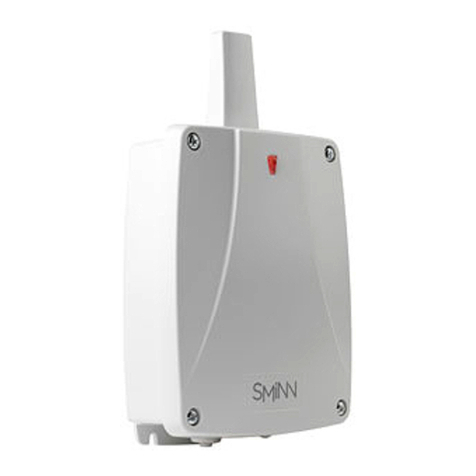
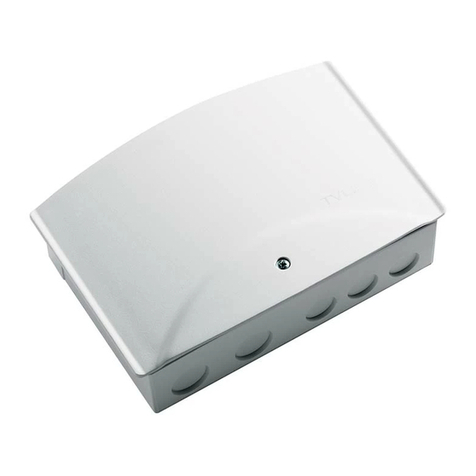
SMINN'S BASE STATION CONTROLLERS ARE EQUIPPED WITH A LED TO LET KNOW
IF THE DEVICE IS POWERED.
WIRING.
Wiring is easy using the terminal block for three circuits.
Readers are connected using just 4 wires on the terminals 3 to 6,
with two wires for power and two for the RS485 data BUS.
.
Terminal Function Note
Power
1
2
Positive (+)
Negative (-)
Line (A)
Line (B)
NO contacts
230V AC power input
Power output to readers/keypads
Apply to the BUS RS485 line
The RS485 BUS is used in Half / Duplex mode with two wires: A and B.
All elements of the BUS must have the same connection. A wires connected to A,
and B to B (they must not be exchanged).
.
3
4
5
6
7-8
9-10
11-12
13-14
Code memorization Plug-in memory of 250 codes
Memory expansion 500 / 1000 / 2000
Operation temp. -20ºC / +85º C
Dimensions 182 x 145 x 65 mm (antenna not included)
Watertight Ip54 - (IP65 with cable glands)
TECHNICAL CHARACTERISTICS
RADIO
TAG
COMMON
Type Read-write 125KHz
Energy consumption < 5W
Comunication BUS RS485 Half / Duplex
Encryption High security encryption
Wiring 4 wire (recommended shielded cable CAT5)
Sensibility < -115 dBm
Radio Superheterodine
Encoding High security Cryptocode
Antenna Internal helicoidal
Min./Max. consumption at 12/24VDC 20mA / 80mA (without readers)
Max. capacity of peripherals 2 RD125 readers + 2 KB120 keyboards
Maximun distance > 200m
Power suply 230VAC (125VAC optional)
BOX M 440 433.92 MHz
BOX M 480 868.3 MHz
BOX M 444 433.92 MHz
BOX M 484 868.3 MHz
230 VAC
230 VAC
12/24 VAC/DC
12/24 VAC/DC
B
A
-
+
BA
-
+BA
-
+
BA
-
+
230
VAC
LNActivation signals
to control pannel
RD125 RD125 KB120
Fig.2
GENERAL WIRING
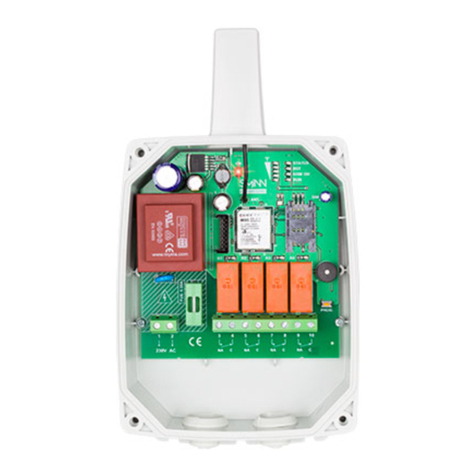
1. ON Led
2. RUN/Status/Error Leds
3. Radio Module
4. Radio PROG button
5. Radio memory card
6. Register card (optional)
7. Relays
12
8. Terminal strip
9. 230VAC power connector
10. Fuse 0.3A
11. Buzzer
3
4
5
6
7
8
9
10
11
Fig.1
13
12.
Transformer
14
15
13.
Key-TAG memory card
14.
Key-TAG programming button
COMPONENTS
NO contacts
NO contacts
NO contacts
Cannal 1 relay
Cannal 2 relay
Cannal 3 relay
Cannal 4 relay
OPERATION
.
When a code from a SMINN key-tag or emitter is received, the receiver + base station controller
checks if it is already registered in the memory. If it is registered and not blocked, the relay will
activate.
.
ERASE MEMORY
.
The memory can only be erased using SMINN's programming console and knowing its PIN,
avoiding accidental or malicious erasures.
.
BLOCKING A CODE IN THE MEMORY
.
A transmitter code cannot be simply erased from the memory, but it can be blocked so it
won't work anymore. Blocking codes in the memory can only be done using a SMINN
programming console and knowing its PIN.
..
MANUAL PROGRAMMING
.
Step by step instructions on how to program a receiver are detailed next. The first code must
be stored following all these steps.
TRANSMITTERS
1. Press and hold the MEMO RADIO PROG button (Fig.1 Item 4).
2. Press the button of the transmitter channel we want to learn that will be assigned to the
corresponding relay. When receiving the code and channel sent by the transmitter, the
receiver will store it in its memory and beep twice as a validation signal.
3. Release the programming button of the receiver.
Repeat this process with as many transmitter codes as you want to manually register in the
memory, using the same channel as with the first transmitter. Pressing any other channel will
not have any effect.
TAGS
1. Press and hold the MEMO KEY-TAG PROG button (Fig.1 Item 14).
2. Position the TAG to learn near the reader. When receiving the code sent by the TAG, the
receiver will store it in its memory and beep twice as a validation signal.
3. Repeat this process for all the TAGS to learn.
4. Release the programming button of the receiver.
Holding a KEY-TAG near the reader for 10 sec. opens the memory enabling the user to learn
new TAGS just by positioning them near the reader one by one without pressing the PROG
button.
REGISTRATION VIA RADIO
Depending on the level of security configured in the receiver's memory it is possible to register
transmitter codes via radio.
Security level 1 (Basic).- Transmitter can be programmed in invitation mode knowing the PIN
(the certified number of the installation) using a SMINN programming console. Invited
transmitters are automatically registered by level 1 receivers.
Security level 2 (Intermediate).- Transmitters already in use can INVITE new transmitters that
share the same PIN (the certified number of the installation).
Security level 3 (Advanced).- Emitters will be registered in the receiver manually. Radio-based
registration is disabled.
CODE REPLACEMENT DUE TO LOSS
This function allows to replace a transmitter code stored in the receiver with a new one, be it
due to loss or mislaying. The replacement of a transmitter code is only possible with a SMINN
programming console. Knowing the PIN of the installation and the code number of the lost
transmitter is required.
Note: This function is not available for Key Tags.
BACKUP COPY
Although the device is protected against power line disturbances and electrical surges,
it is important to keep a backup of the memory card in case of breakdown or damages caused
by external circumstances such as electric storms, theft, improper handling, etc.
INSTALLATION
.SMINN's Base-Station controller is designed to be easily fixed on a wall using the supplied wall
plugs and screws. Before connecting or operating the device, the power supply switch or
differential shall be disconnected. Specialized and/or skilled personnel will do the installation,
using properly protected cable of enough gauge. Take into account that devices permanently
connected to the mains need to have an accessible connection device
(i.e. a magnetothermic switch). The wiring should be done following the instructions printed
in the serigraphy of the circuit board. Make sure that the memory is inserted and properly
configured. After programming and verifying the equipment, close the case with
the supplied top.
Note: Reinforced concrete, metallic components and/or any other receiving device reduce
dramatically the radiofrequency signal, so installation close to these elements should be
avoided.
12
15.
Selector Switch