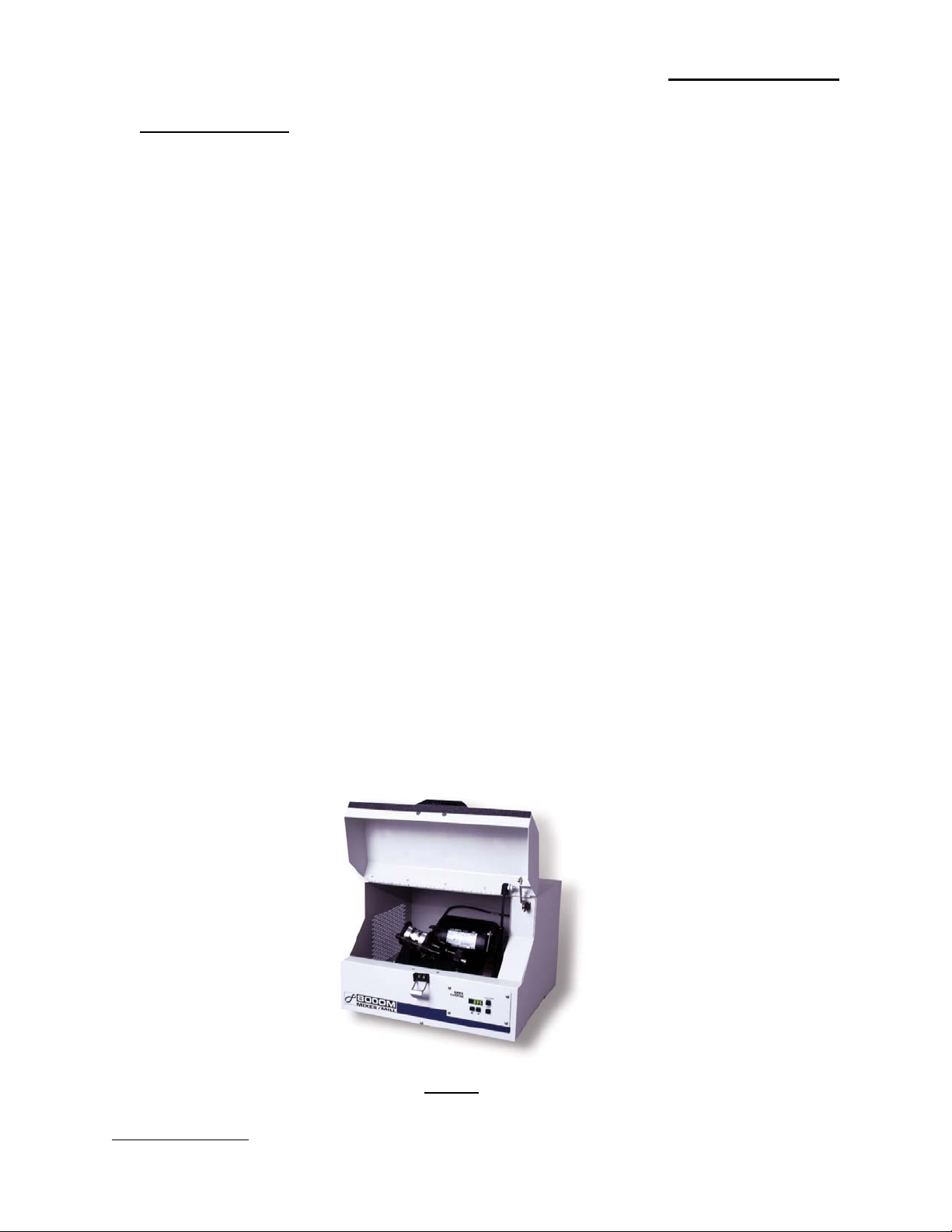
8000M Mixer/Mill
5.0 OPERATION
(Cont’d) 5.1 MIXING AND GRINDING
Mixing is usually done in a plastic vial with plastic balls. Depending on the nature and amount of
material to be mixed, one or several balls may be used. With a small amount of material and
more than one or two balls, the impact may break the bottom of the plastic vial, so keep the
number of balls to a minimum. Plastic vials and balls can also be used to grind soft metals (e.g.
antimony), carbon, and other easily friable materials. If the Mixer/Mill clamp swings wide and
hits the motor when a plastic (lightweight) vial is used, it may be necessary to use the 8012
Adapter, which adds weight to the clamp and prevents extra-wide oscillation.
Grinding is done in the metallic and ceramic containers: steel, tungsten carbide, alumina,
zirconia, agate, and silicon nitride. Dry grinding is the simplest approach. For samples that cake
during mixing or grinding, a grinding aid may be necessary. Water, alcohol, or other liquids may
be used. We recommend Vertrel XF (cat. no. 3650), a fluorocarbon fluid that does not
chemically affect the sample and quickly evaporates after use. Water may be dried out
afterwards by heating plastic vials in a low-temperature oven.
The criteria for container selection are usually those of grinding efficiency vs. contamination;
steel and tungsten carbide grind more rapidly than ceramics or agate, but contaminate more.
Most 8000-series vials accept 3 to 10 ml of sample for grinding, while a typical mixing load is
up to 25 ml, or about 40% of the vial’s volume. If a sample is not being ground fine enough, one
can a) decrease the amount of sample, b) increase grinding time, c) add a grinding aid or a liquid.
Wet grinding keeps the sample from caking and will give a smaller final particle size, but there
are handicaps: 1) an extra drying step is required; 2) the fluid used for wet grinding must be
chosen carefully not to alter the sample or attack the container; 3) not all the vials are leak-proof.
The steel, tungsten carbide, and plastic vials have screw tops, and are more or less watertight.
The alumina vial (8003) has optional clamps (8014) for slurry grinding.
Avoid grinding small loads in brittle containers such as alumina and agate. If there is not enough
material to cushion the impact of the balls, they will generate excess contamination and can in
extreme cases chip the container. Always use grinding balls that match the material of the
container, e.g. steel balls for a steel container, agate balls for an agate container, etc. This will
limit contamination. An inappropriate choice of balls, such as tungsten carbide balls in an
alumina container, can damage the container.
Two balls are standard for most grinding containers, though some users feel that only one ball
should be used in the most brittle containers (alumina and agate). Three balls can hasten grinding
in the strongest containers, the steel ones.
When using grinding containers with threaded caps, be careful to keep the threads clean. Over
time, if care is not exercised to maintain the threads clean, as sample accumulates in the threads
it can jam the caps. Also be careful not to drop these caps on edge, as if they are knocked out of
round they can be very difficult to use.
Page 9 of 9 SPEX Certiprep 4.4.03
SN 03000 and Higher