4
ASV
Stübbe
GmbH
&
Co.
KG
•
Hollwieser
Straße
5
•
D-3
2602
Vlotho
• Fon +49(0)5733 - 799-0 • Fax +49(0)5733 - 799-200 • www.asv-stuebbe.de • [email protected] Operating instructions:
ATTENTION
Safe operation of the valve can only be ensured if it is
properly installed, operated, serviced or repaired by
qualified personnel according to its intended use while
observing the accident prevention regulations, safety
regulations, relevant standards and technical regula-
tions or data sheets such as e.g. DIN, DIN EN, DIN ISO
and DVS* for example. 9
*DVS = German Welding Society
The intended use includes adhering to the specified li-
mit values for pressure and temperature as well as che-
cking the chemical resistance with regard to the
operating conditions.
For this purpose, ensure that all components coming
into contact with the media are "resistant" in accor-
dance with the ASV resistance guide.
The owner/user must inform the authorized qualified
personnel instructed to perform the assembly, inspec-
tion and/or maintenance work of any potential danger
emanating from the machine line/medium, and ensure
that suitable safety measures are observed. This also
includes the consideration of local regulations and laws
of the territories of use.
The connection of electric or pneumatic actuators and/
or accessories to the power/compressed air supply re-
quires special knowledge. Ensure that this work is per-
formed only by authorized qualified personnel
according to the operating instruction of the manufac-
turer.
If no operating and maintenance manual is available to
the authorized qualified personnel, please request a
manual prior to installation, maintenance or repair.
Non-observance of the specified instructions and safety
regulations may cause damage to health and/or dama-
ge to assets. 9
Adjustment of lift limit
• Turn indicator pin (6) with appropriate screw driver
counter-clockwise.
• The maximal lift limit is appr. 2/3 of valve lift.
1. Disassembly
• The pipe section is to be shut off upstream and
downstream and to be emptied properly.
• Any fluid rest is to be disposed properly (see above).
• Adhere to the workers protection rules - if required
protection clothes must be worn.
2. Exchange of diaphragm
• Shut off compressed air towards diaphragm valve.
• Release compressed air connections of diaphragm
valve and remove them.
• Release hexagonal socket screws (17) with appro-
priate tool and remove them.
• Pull off bonnet (2) from body (1).
• Turn out diaphragm (7) from spindle (5).
• Pull off pressure piece (4) from diaphragm, assem-
bly see point 4.
3. Exchange of O-rings or piston
• Disassembly as described under point 2.
• Unscrew the insert (3) out of the bonnet (2) with an
appropriate spanner.
ATTENTION
The insert is under tension of spring. 9
• Unscrew indicator pin (6) from the spindle (5).
• Lever the O-ring (13) out of the O-ring groove with
a blunt tool and replace it.
• Pull out the spindle (5) out of the insert with rotating
movements.
• Release nut (11) and remove it together with wash-
er (8) from the shaft.
• Pull off piston (12) from the spindle and replace it.
• Carefully remove O-ring (14) from the insert and re-
place it.
• Dismount O-ring (15) from insert and replace it.
4. Assembly
• In the reverse order to disassembly.
Take care of correct installation of each component
according to sectional drawing.
• Always use new sealing elements when refitting.
• Neutral gliding agents (e.g. soap and water) eases
assembly.
• After each disassembly all connections are to be
checked for leakages prior using.
NOTE
Elastomeres, especially the EPDM sealing elements,
should not be touched or cleaned with synthetic oils,
mineral oils, fats or cleaning agents. 9
Danger of swelling. Only appropriate fats should be
used, e.g. silicone greases.
Subject to technical modifications
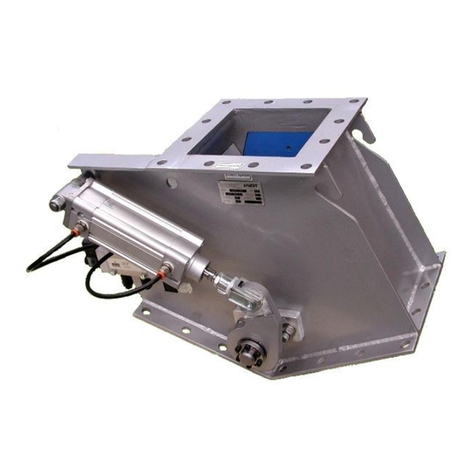
Diaphragm Valve MV 308
330019 – 2001/10/01