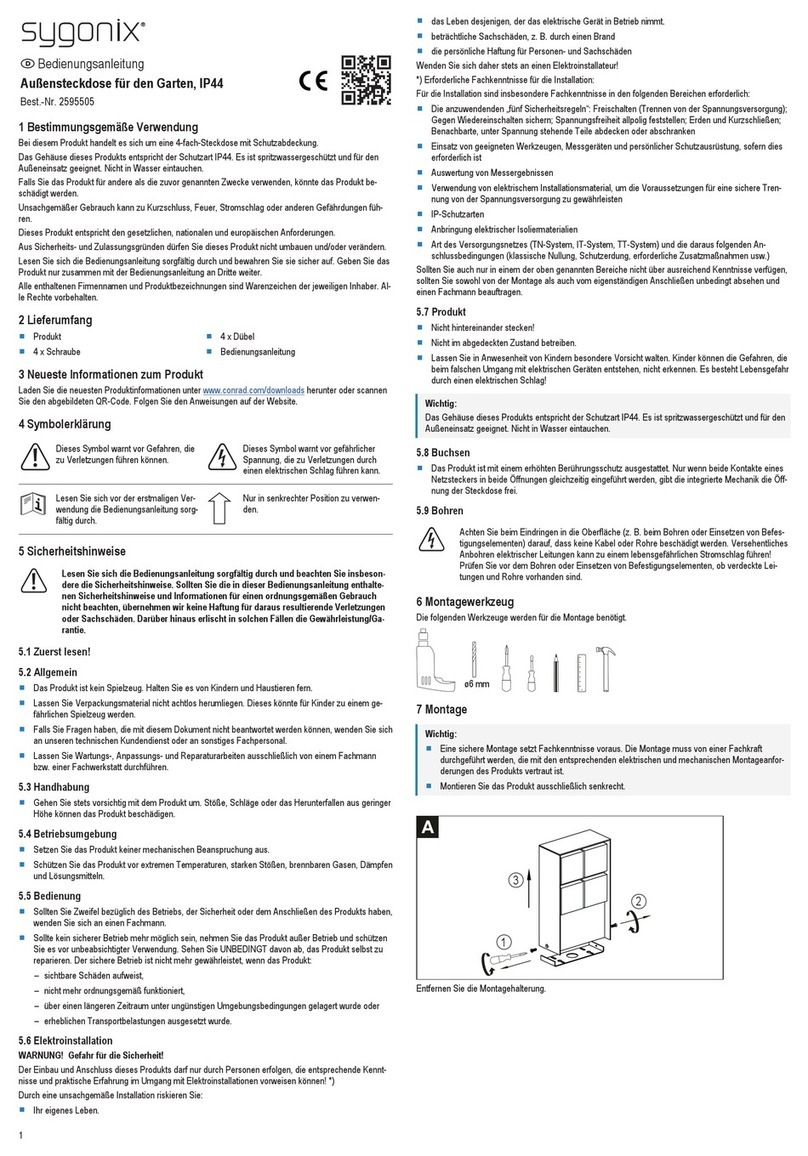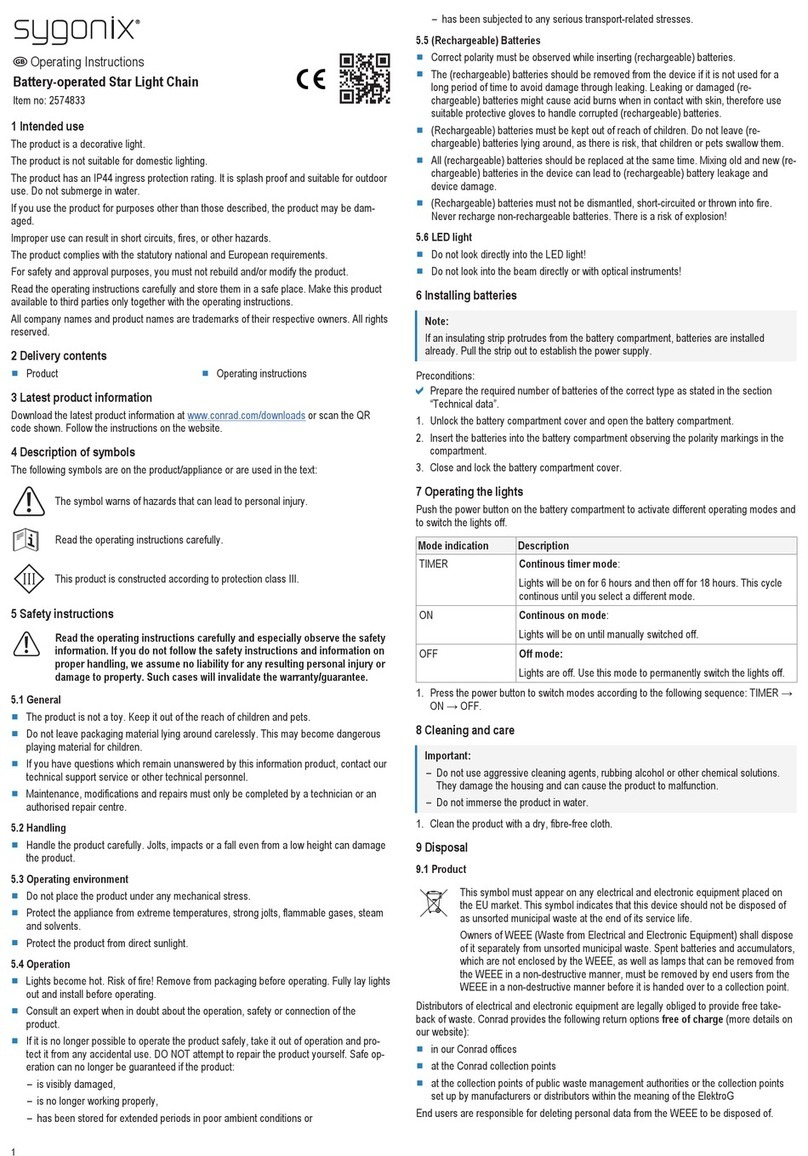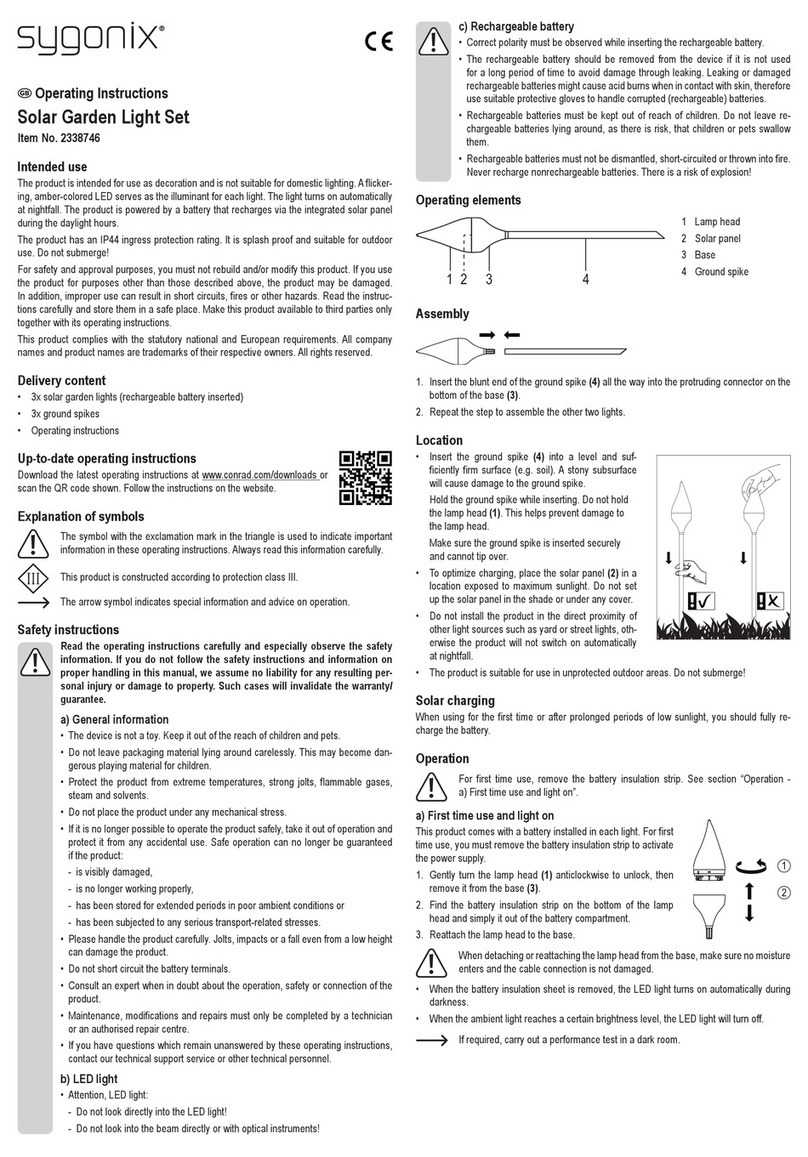
• When the battery insulation sheet is removed, the LED light turns on automatically during
darkness.
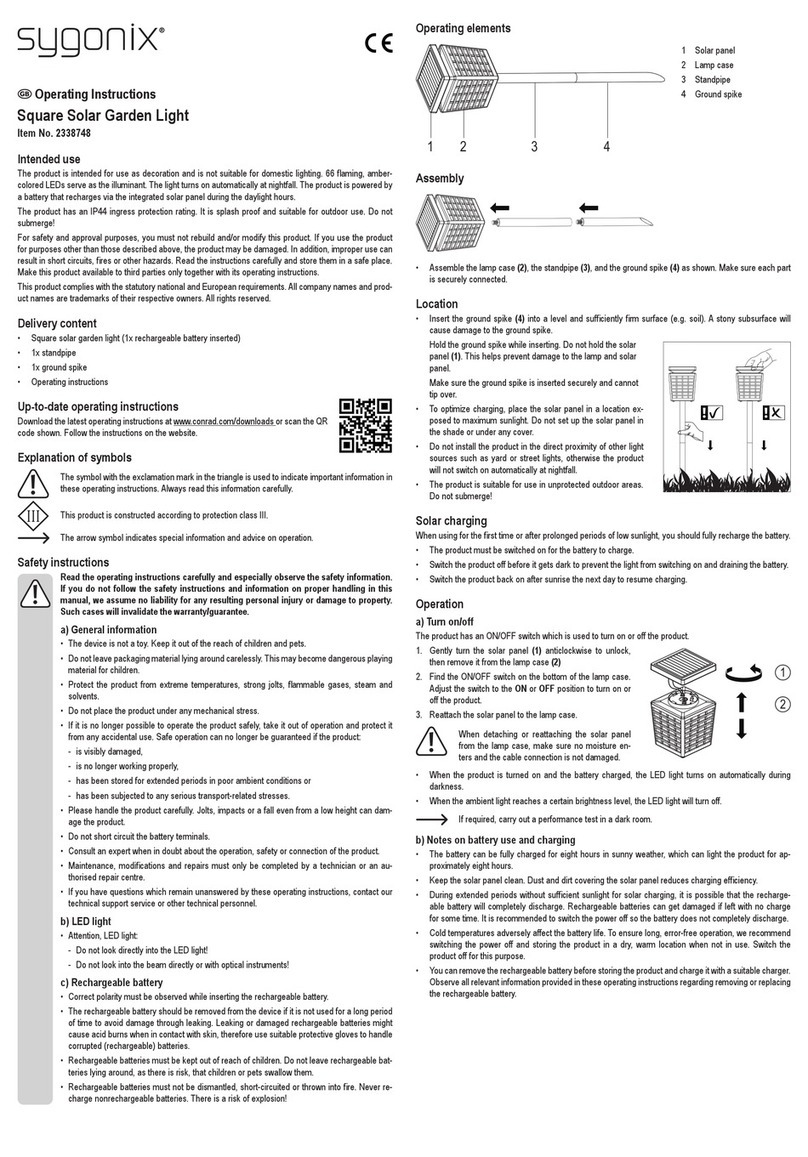
• When the ambient light reaches a certain brightness level, the LED light will turn off.
If required, carry out a performance test in a dark room.
b) Notes on battery use and charging
• The battery can be fully charged for eight hours in sunny weather, which can light the prod-
uct for approximately eight hours.
• Keep the product clean. Dust and dirt covering the solar panel reduces charging efciency.
• During extended periods without sufcient sunlight (especially in winter), the rechargeable
battery charges less energy during the day than the lights use at night. So it is possible
that the rechargeable battery’s charge state will only light the product for a brief time only.
• Cold temperatures adversely affect the battery life. To ensure long, error-free operation, we
recommend storing the product in a dry, warm location when not in use.
• You can remove the rechargeable battery before storing the product and charge it with a
suitable charger. Observe all relevant information provided in these operating instructions
regarding removing or replacing the rechargeable battery.
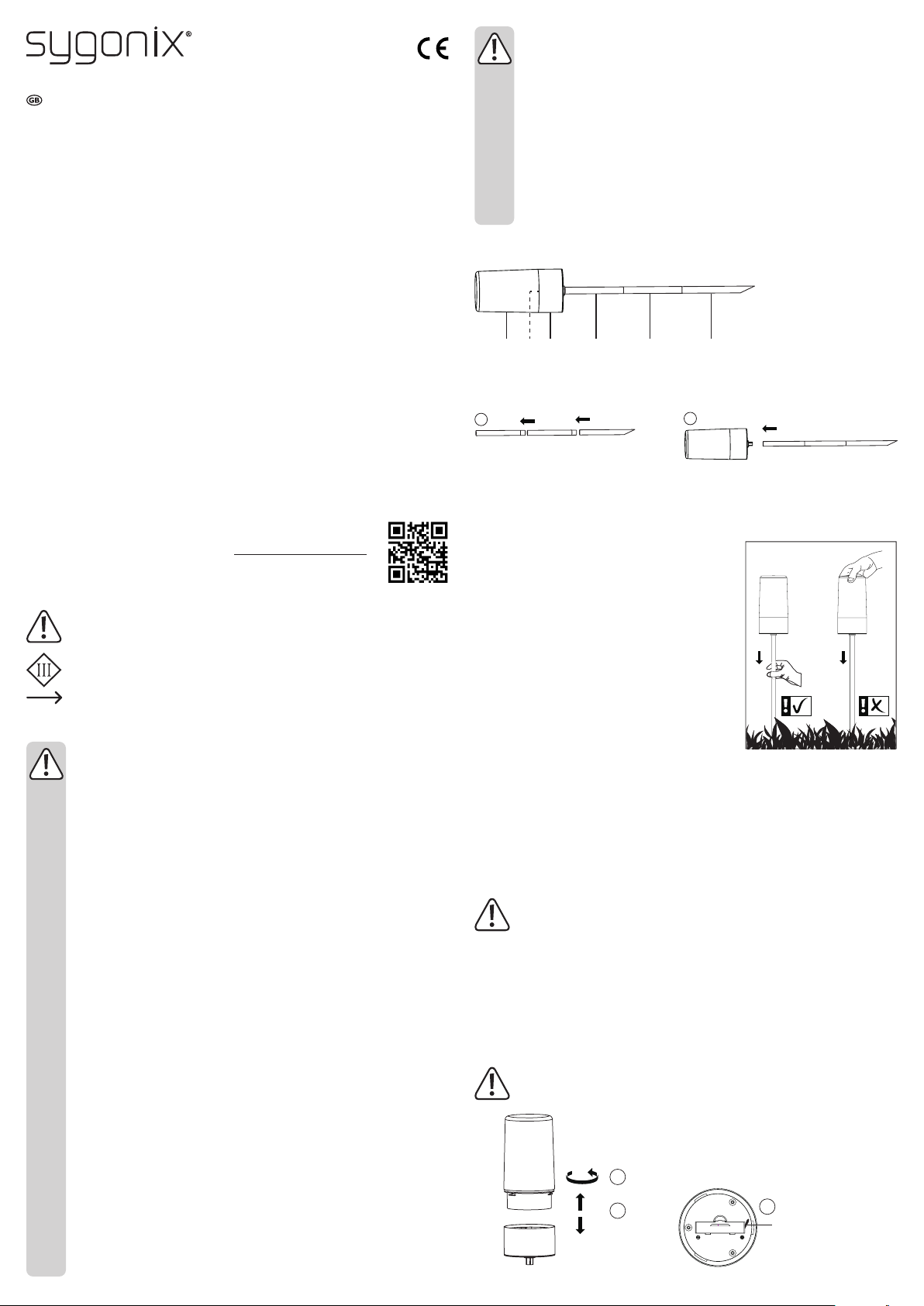
c) Remove/Insert rechargeable battery
Replace the rechargeable battery if the illumination time reduces signicantly de-
spite the battery being sufciently charged.
When replacing the rechargeable battery, make sure no moisture enters the battery
compartment.
1. Remove the lamp head (1) from the base (3). See section “Operation - a) First time use
and light on”.
2. Find the battery compartment on the bottom of the lamp head and remove the battery
compartment.
3. Replace the battery matching the polarity shown inside the compartment.
Only use a rechargeable battery of the same type and specication as indicated in
the section “Technical data”.
4. Reverse these steps to reassemble the product.
Troubleshooting
Problem Solution
The light does not
turn on automati-
cally.
• There is a nearby light source which causes interfer-
ence with the product. Make sure the product is placed
in darkness to activate the light.
• The battery power is not sufcient to light the product.
Charge the battery.
The light stays on
for short periods.
• Long periods of low sunlight (e.g. cloudy weather or in
winter) will cause the battery to recharge less during
the day. We recommend using a commercially avail-
able charger to charge the battery.
• The battery is old and cannot store sufcient charge.
Replace with a new one.
• See sections “Solar charging” and “Operation - b)
Notes on battery use and charging”.
Care and cleaning
• Do not use any aggressive cleaning agents, rubbing alcohol or other chemical solutions as
they can cause damage to the housing and malfunctioning.
• Never point a water jet, e.g. of a high-pressure cleaning device, at the product.
• Besides occasional cleaning, the product is maintenance-free.
• Let the product cool down sufciently before cleaning.
• Use a clean, soft and dry cloth to clean the housing. For more stubborn dirt, slightly moisten
the cloth with lukewarm water.
Disposal
a) Product
Electronic devices are recyclable waste and must not be disposed of in the house-
hold waste. At the end of its service life, dispose of the product in accordance with
applicable regulatory guidelines.
Remove the rechargeable battery and dispose of it separately from the product.
b) Rechargeable batteries
You as the end user are required by law (Battery Ordinance) to return all used re-
chargeable batteries. Disposing of them in the household waste is prohibited.
Contaminated rechargeable batteries are labeled with this symbol to indicate that
disposal in the domestic waste is forbidden. The designations for the heavy metals
involved are: Cd = Cadmium, Hg = Mercury, Pb = Lead (name on rechargeable bat-
teries, e.g. below the trash icon on the left).
Used rechargeable batteries can be returned to collection points in your municipality, our stores
or wherever rechargeable batteries are sold.
You thus fulll your statutory obligations and contribute to the protection of the environment.
Technical data
Power supply................................ 1.2 V, 600 mAh Ni-MH, AAA (HR03) rechargeable battery
Power consumption...................... max. 0.07 W
Solar panel ................................... 2 V, 100 mA, monocrystal
Illuminant type .............................. LED
LED quantity................................. 1 pcs
LED service life............................. 25000 hours
Charging time ............................... 8 hours (in optimum conditions)
Illumination time............................ max. 8 hours with fully charged battery
Light output................................... max. 10 lm
Light activation threshold.............. ≤10 lux
Colour temperature....................... 1900 K
Ingress protection......................... IP44
Protection class ............................ III
Material......................................... Stainless steel + PC
Operating/Storage conditions....... -20 to +40 ºC, ≤100 % RH (non-condensing)
Dimensions (Ø x H) ...................... 90 x 1080 mm
Weight .......................................... 380 g
This is a publication by Conrad Electronic SE, Klaus-Conrad-Str. 1, D-92240 Hirschau (www.conrad.com). All rights in-
cluding translation reserved. Reproduction by any method, e.g. photocopy, microlming, or the capture in electronic data
processing systems require the prior written approval by the editor. Reprinting, also in part, is prohibited. This publication
represent the technical status at the time of printing.
Copyright 2021 by Conrad Electronic SE. *2338745_V1_0121_02_mxs_m_en