Page 8
5Operation
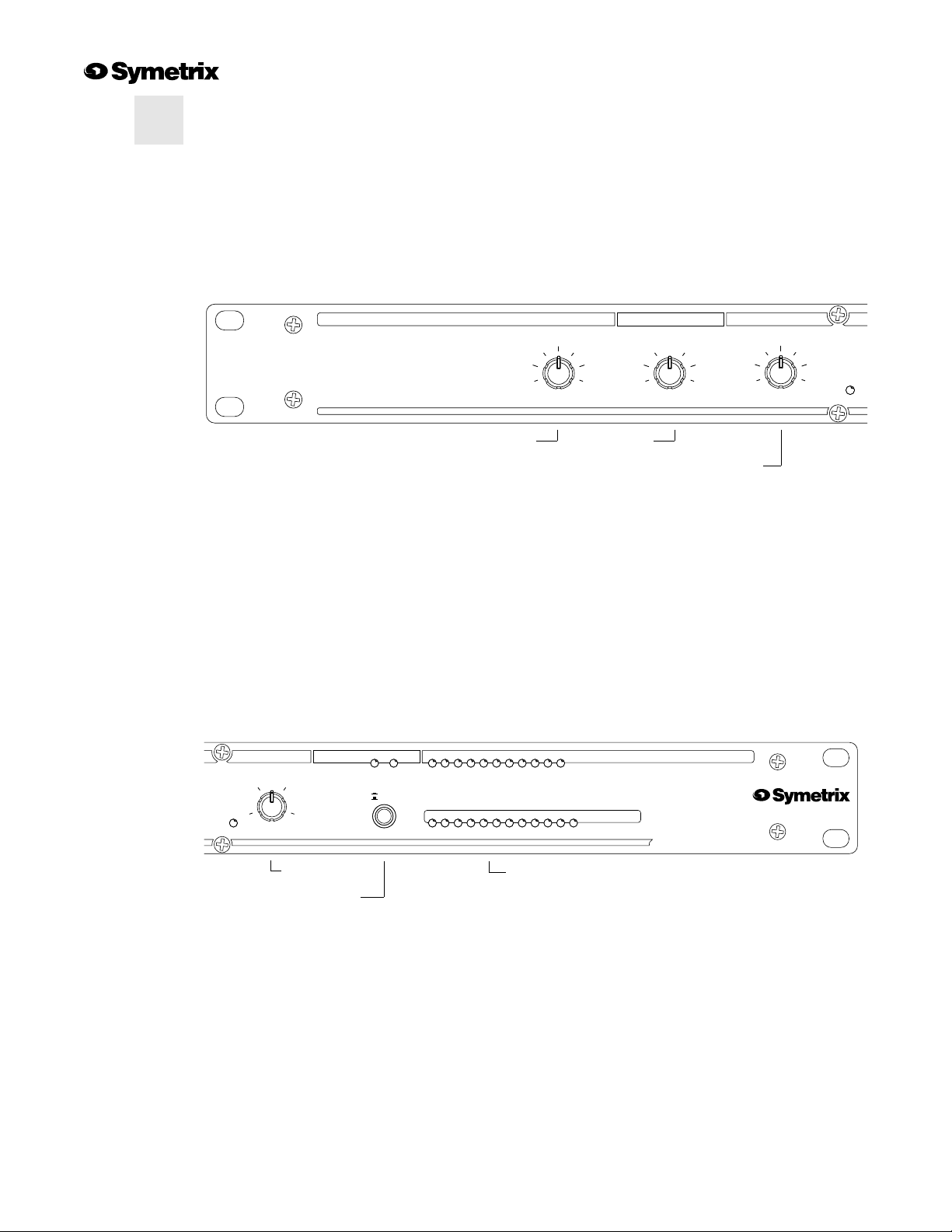
This section describes in detail the functions of the 422's front panel controls and LED indicators.
TheTARGET LEVEL control
When setting up the 422, this is generally the control that you should adjust first. The TARGET
LEVEL control does just what the name implies. It establishes the volume where you want it.
Technically, the control sets a threshold. Incoming signals that exceed this threshold are com-
pressed downward towards the threshold. Incoming signals below the threshold are expanded
(leveled) upward towards the threshold. The 422's output is a reduced dynamic range replica of
its input, 'centered' around the target level.
As you adjust the TARGET LEVEL control, it's very easy to see and hear the results. A quick
glance at the OUTPUT level VU meter will show you the exact effects of increasing or decreas-
ing TARGET LEVEL.
The DETECTOR control
The DETECTOR control increases or decreases the sensitivity of the 422 to low level audio
signals and noise. As you turn this control counterclockwise, the 422 'reaches down' and in-
creases the gain of low level audio and/or noise. The optimum setting of this control is entirely
dependent upon the nature of the audio that the 422 is processing. For example, if the audio
source is relatively clean and quiet (like a CD), the position of the DETECTOR may be noncriti-
cal. To greatly increase the volume of the low level signals on the CD, try a full counterclockwise
setting of the control (-45). On the other hand, if you try the same extreme setting with a noisy
cassette recording, you may not find the results to be pleasing. If you're processing a very noisy
source, then turn the detector control clockwise towards the -20 setting until the desired sound is
achieved.
If you're unsure of where to position the DETECTOR control, then start with it straight up in the
twelve o'clock position. We've found this to be a good compromise for unpredictable audio
sources.
The RATIO control
The RATIO control is used to increase or decrease the degree of leveling. At high ratios, the
program density increase results in a more 'present' or 'up front' sound. At low ratios, the 422
performs subtle, yet effective, automatic gain riding. At a setting of 5:1 (maximum) the effect of
the 422 AGC/leveling process is very audible.
The optimum setting of this control is usually dictated by the particular type of material one is
processing, and the desired effect. For example, if the 422 is part of a foreground/background
music/paging system in a high ambient noise environment, a higher ratio will produce maximum
intelligibility. As part of a broadcast chain, where the process itself must be as subtle as possible,
a 2.5:1 or lower ratio is advisable.
If you're unsure of where to position the ratio control, then we suggest you start in the twelve
o'clock position and make upward and downward adjustments from there as you listen and
evaluate the results.