____________________________________________________________________________________________________________________________
TechGrow | Innovative Growing Solutions 9
1. Installation
1. Mount the CO2sensor on the wall near the CO2
source, with a minimum distance of 50 cm. It is
preferred not to place the sensor directly above the
CO2source if it becomes very hot (CO2generator).
Mount the sensor at a height of +/- 1 meter above
the floor.
2. Do not place the sensor in the direct airflow of fans
as this may affect the measurements.
3. Connect the sensor(s) to the bottom of the T-Nano
with the supplied (UTP) cable(s).
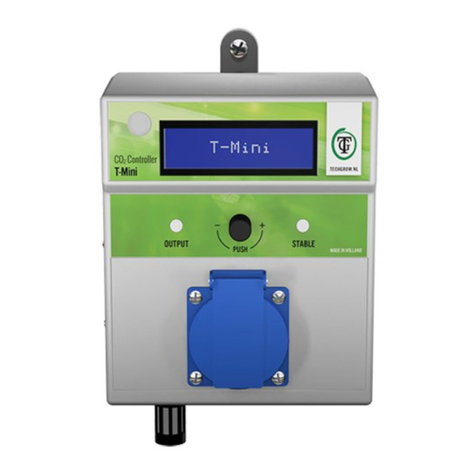
4. Plug the CO2 source to the T-Nano.
5. Plug the plug of the T-Nano into a 230V socket.
6. Ready!
2. Connecting controllers and sensors
Most of TechGrow's controllers and sensors can be
interconnected to ensure an optimal user experience.
Interconnecting the controllers enables to control the
total climate with only one S-4 Sensor. Since each
device has 2 UTP ports, it is not only possible to
interconnect the devices, but also to connect a
Datalogger DL-1, for example.
Make sure that all controllers are equipped with mains
voltage, and check if the controllers are switched off
before you connect sensor(s) to prevent any
malfunctions. The sensor can be connected to any UTP
port.
The regular TechGrow sensors are comparable to the
sensors from the TechGrow Pro Series and can
therefore also be used for controllers from the Pro
Series.
3. Connecting additional sensors or
other devices
The T-Nano can measure the values of connected CO2,
RH and temperature sensors, and transmit the data to
the connected controller, provided it is linked to an S-4
Sensor. However, the T-Nano only regulates
the CO2.
If you want to connect another sensor or device to the
T-Nano, first switch off the controller, wait a few
seconds, connect the sensor/device, and then reconnect
the controller to the power outlet.
4. Which sensors can be connected to
the T-Nano?
The minimum sensor required is a S-Eco CO2Sensor.
ATTENTION: NEVER connect two of the same type
of sensors to your controller! For example: a S-Eco
CO2Sensor and a S-2 Sensor must not be connected
at the same time.
5. Automatic functions of the T-Nano
1. When it is dark, no CO2is released. So make sure
that the sensor can detect the light source directly.
2. If the CO2sensor is not detected, no CO2is
released.
6. Meaning LED
Between the two rotary knobs you see the "OK" LED,
which can indicate a number of things:
•Green: there is sufficient CO2in the room (stable).
•Red: the CO2source is on (active).
•Led is off (white) : the relay is turned off (off).
7. Operation of the T-Nano
If the CO2value in the room drops under the set value
(setpoint minus hysteresis), the CO2source is switched
on.
Over time, the CO2value rises and as it reaches the CO2
setpoint, the source is switched off.
Example
The CO2setpoint is 670 ppm.
The CO2hysteresis is 40 ppm.
The current CO2value in the room is 733 ppm: that is
higher than the CO2setpoint, so the CO2source is turned
off. The LED is off.
The CO2level now slowly decreases to 670 ppm: there is
no action yet. Only when the value drops below the CO2
setpoint minus the CO2hysteresis, that is below 670 - 40
= 630 ppm, the CO2source switches on and the red light
comes on.
Now, the CO2level rises and when the setpoint (670
ppm) is reached, the CO2source is switched off again
and the LED lights green.
By playing with the settings of the CO2hysteresis, a
stable atmosphere can be reached.