7
TEKNETICS
Comprehensive Operating Manual & Guide to Metal Detecting
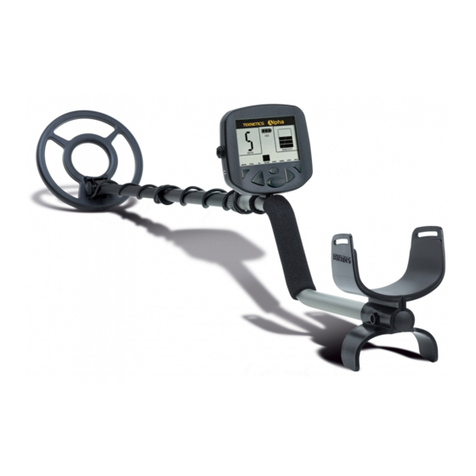
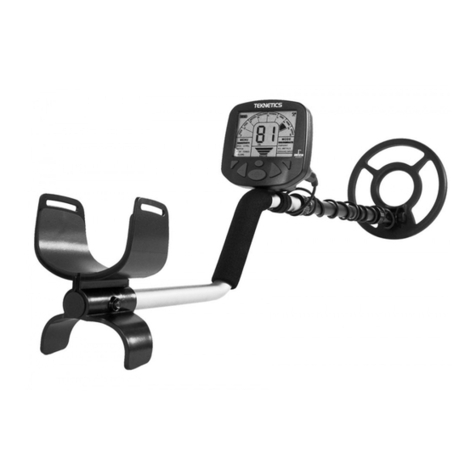
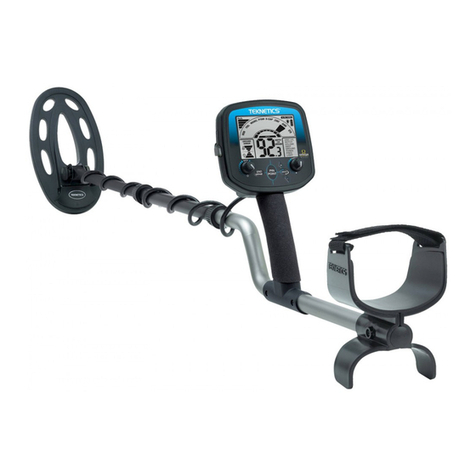
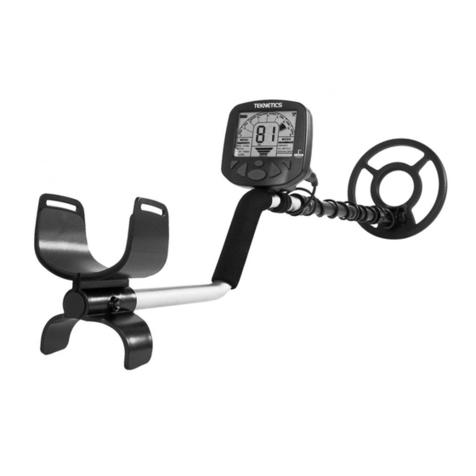
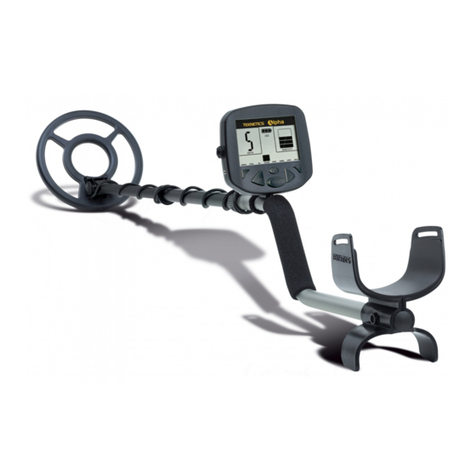
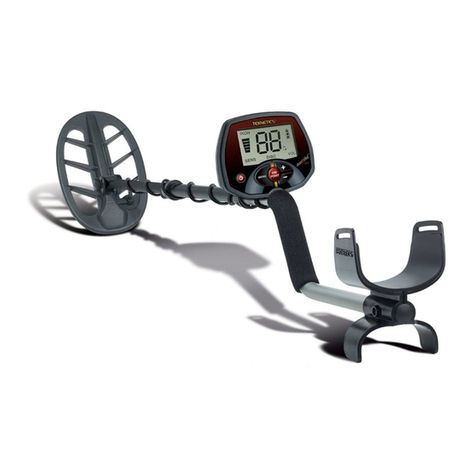
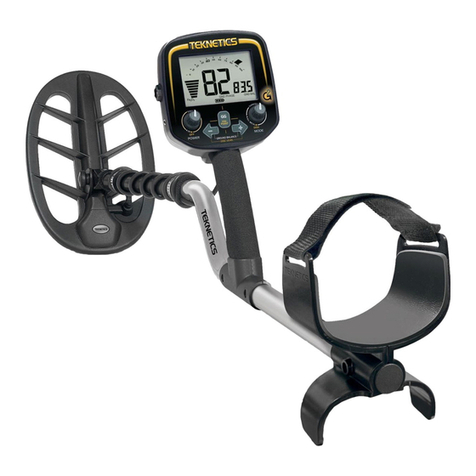
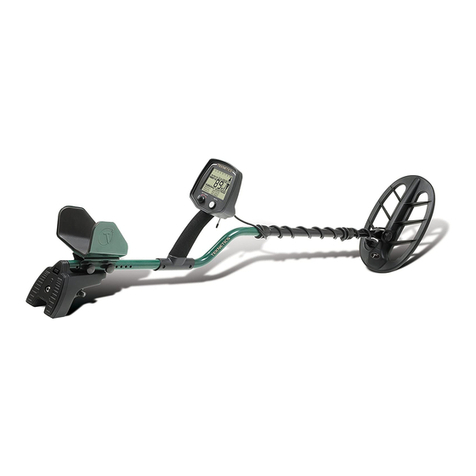
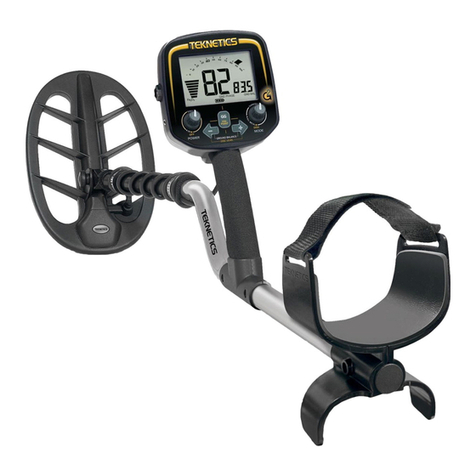
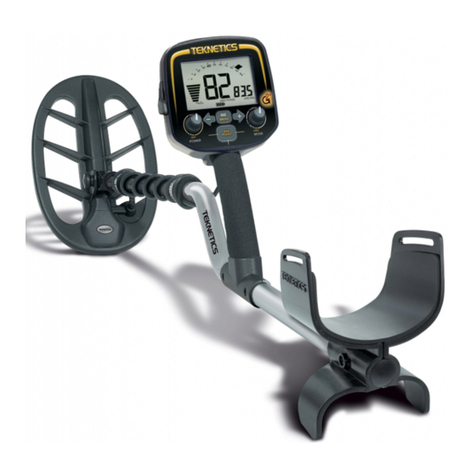
Armrest Position on Pole: Remove the two bolts to position the armrest farther forward
or back, to adapt to your arm’s length.
— To reinsert the bolts, spin and twist them into place. Be careful not to damage the
power cable that runs through the aluminum tube.
— Insert both bolts completely through both sides of the bracket before attaching the nut
to the opposite side.
— For maximum stability, the bolts fit very tightly into the holes; you may have to wiggle
each one a bit to push it through the holes.
— After reinserting the bolts, tighten them very securely. As you swing the detector from
side-to-side, you want the bolts tight enough so that you do not feel any movement
between the pole and armrest mounting bracket.
If you notice unwanted movement while swinging detector, check the tightness
of the locking collars. The locking collars must be rotated a full 270° to reach the
locking position.
HEADPHONES (not included)
The T2is equipped with a standard 1/4-inch stereo headphone jack at the rear of the unit,
located under the elbow as you hold the detector for use. Any headphone with a 1/4”
stereo jack should work. Mono headphones will not work.
Using headphones improves battery life, and prevents the sounds from annoying bystanders.
It also allows you to hear subtle changes in the sound more clearly, particularly if
searching in a noisy location.
For safety reasons, do not use headphones near traffic or where other dangers, like
rattlesnakes, are present.
This device is to be used with interconnecting cables/headphone cables shorter than three
meters.
MECHANICALS ( ontinued)
Adjust the armrest in or out accordingly Adjust the armrest forward or back, to adapt to
your arm’s length.
Dete ting A tivities ( ontinued)
Gold Prospecting
(continued)
In some cases the parent mountain no longer exists. When a desert placer land surface is no
longer situated where deposition processes are active, weathering disintegrates the surface
material and it is washed away by surface erosion. The gold, being heavy, is not so readily
removed by erosion. Over many thousands of years the gold becomes concentrated in the
surface material, resulting in an alluvial deposit.
Weathered-in-place residual gold (typically in soil above a gold-bearing quartz vein) is a good
situation for metal detecting, fairly similar to a hill slope setting. The difference is that if you see
quartz stones and are thinking there might be a gold-bearing quartz vein beneath, prospectors
before you probably saw and thought the same thing. So, there will probably be prospect holes,
and possibly even nearby hard rock mines. The early miners were looking for a mineable hard
rock vein, but without a metal detector the overlying soil was useless to them. So always check
the zone around prospect holes, as well as the prospect hole itself if it’s safe to do so.
Mine tailings (mullock heaps) from hard rock mines are another favorite place to search.
Previous miners in an area typically threw the rocks out if they didn’t see gold with their eyes,
and they often got so busy throwing out rocks that they missed seeing visible gold. A metal
detector can find the mistakes of ancient or recent miners.
In many placer deposits, metal detectors go together well with the non-electronic traditional
artisanal mining methods of panning, sluicing, and dredging. The larger rocks in the gravels
cannot be processed by these methods, so they have to be thrown out. Someone already dug
these rocks from a suspected or known pay streak: now they’re on the surface loose, and
probably even clean. Unless you happen to know that the larger rocks in this placer deposit
virtually never contain gold, the rock piles can be a good place to use a metal detector.
In humid regions the soil is usually 20 inches (1/2 meter) or more thick, protected from surface
erosion by vegetation cover. Gold is heavier than soil and tends to settle to bedrock. Therefore
the gold is in these regions are too deep to be detected with a metal detector. With the geology
hidden underground, it’s hard even to know where one ought to be searching. Therefore in
humid regions the use of metal detectors is usually restricted to searching material which is not
covered by soil—river gravels, rock outcrops, and rocky material excavated in mining
operations. The use of metal detectors has historically been most profitable in arid regions.
Desert soils are usually thin and rocky, with gold often lying exposed on the ground due to
removal of lighter material from the land surface by erosion. And unlike in most humid regions,
you can see the geology to guide you to where you should be searching.
Gold is valuable because it is a scarce commodity. Even in a good gold producing area, you
may spend an entire day without finding any gold. Meanwhile you may dig bits and pieces of
other metal. “Hot rocks” -- rocks containing concentrations of iron oxides that sound like metal
when you pass over them -- are also a nuisance in many gold areas.
If you have gone many hours without finding gold and are wondering if there is something wrong
with your metal detector or how you are using it, the most important clue is this: if you are digging
tiny pieces of trash metal, then if you had swept over gold nuggets, you would have dug them too!
34
TEKNETICS Comprehensive Operating Manual & Guide to Metal Detecting