TeNMARS
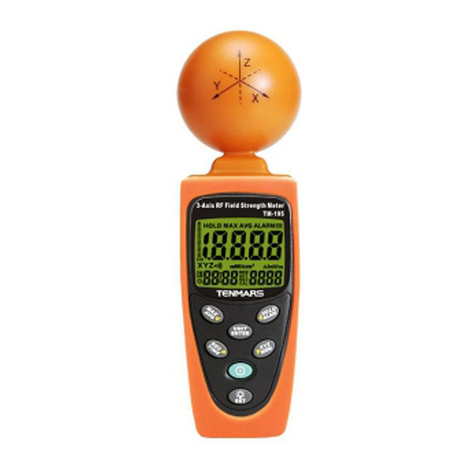
TM-196
3 Fundamentals
El
ec
tromag
net
ic
p
ollut
i
on
This meter is used to indicate electromagnetic
pollution generated artificially. Wherever there
is a voltage
or
a current, electric (E) and
magnetic (H) fields arise.All types
of
radio
broadcasting and TV transmitters produce
electromagnetic fields, and they also arise
in
industry, business and the horne, where they
affect us even
if
our sense organs perceive
nothing.
4
Electric
fie
ld
strength
(E)
A field vector quan
ti
ty that represents the
force (F) on an in
fi
nites
im
al
unit positive
test charge (q) at a point divided by that
ch
arge. Electric field strength is expressed
in units
of
volts per meter (mV/m). This
meter measures electric field strength
directly.
4.1
Magnetic
field
strength
(H)
A field vector that is equal to the magne
ti
c
flux density divided by the permeability
of
the medium Magnetic field strength is
express
ed
in units
of
amperes per meter
EN-3
TeNMARS
TM-196
calculate the magnetic field for the electric
field value. This meter can display the
calculated magnetic field strength.
4.2
Power
density
(S)
Power per unit area normal to the direction
of propagation, usually expressed
in
units
of
watts per square meter (W/m2)
or,
for
convenience, units such as mill watts per
square centimeter (mW/cm2)
4.3 The
characteristic
of
electromagne
t
ic
fiel
ds
Electromagnetic fields propagate as
waves and travel at the speed
of
light (C).
The wavelength is proportional to the
fr
eq
uency.
" (wavelength) =C (speed
of
light) /
f (frequency)
If the distance to the field source is less
than three wavelengths, then we are
usually
in
the near field. Ifthe distance is
more than three wavelengths, the far-field
conditions usually hold.
In
near field conditions, the magnetic fie
ld
value cannot be calculated from the
electric field value. This meter is designed
for reliable far field measurements only.
EN-4