HD450 GB Issue 08
9
8 Small Animal Care
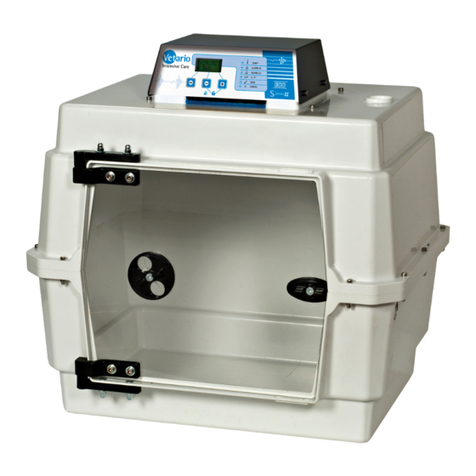
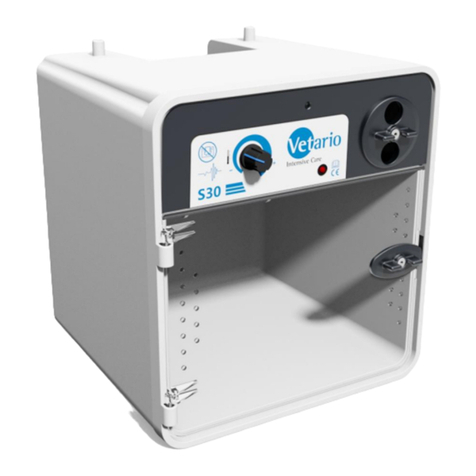
8. 1 Your Vetario has been specifically designed for the care of injured or sick small animals. Animals should always be
cared for following the instructions and advice given by your veterinary surgeon.
8. 2 The first stage of treating a cold animal (hypothermia) is to prevent further heat loss, by wrapping the casualty in
insulating materials such as blankets, bubble wrap or silver foil. It is recommended to pre-heat the Vetario and allow
the temperature to stabilise before adding young birds or small animals. If you are aware of an incoming animal
patient, the Vetario may be switched on so that it is ready for immediate use when the patient arrives.
8. 3 Once the Vetario is warmed to the correct temperature the animal can be transferred. The amount of bedding should
be reduced at this stage to allow warming from the environment in the Vetario. All animals will benefit from some
bedding in the bottom of the cabinet such as an absorbent pad to help reduce soiling. Small animals such as fox or
badger cubs can benefit from having a soft toy for company while single ducklings or pheasant chicks can be provided
with a safe mirror. Wild animals may become very distressed when handled by humans. Place the Vetario where there
is minimal disturbance.
8. 4 All small mammals and birds will benefit from being kept in an environmental temperature within their
‘thermoneutral range’. This is the range of temperatures in which an animal expends no energy to maintain its body
temperature. The thermoneutral temperatures for typical adult mammals and birds are given in table 1. For birds,
the thermoneutral range depends upon size, with smaller birds requiring higher temperatures. Reptiles and
amphibians should be kept within an ‘activity temperature range’ (ATR) in which it can control its body temperature.
ATR values for typical reptiles and amphibians are also given in table 1.
8. 5 Hypothermic adult animals should be warmed in the Vetario set to their thermoneutral range. The temperature of
both the Vetario and the animal should be recorded at regular intervals. Careful monitoring and observation of the
animal should be undertaken to ensure that it is not showing signs of distress. i.e. panting or shivering. These animals
are also likely to be dehydrated and/or ‘shocked’ (hypovolaemic) so warming alone will not correct these things and
may make them worse. All adult animals must therefore be provided with adequate fluid therapy at the same time
as warming and veterinary care (in person, over the telephone or in written Standard Operating Procedures). Injured
animals also require pain relief (analgesia) which can be prescribed by a veterinary surgeon.
8. 6 If the animal will drink, then an oral rehydration fluid can be provided in a shallow bowl. If the animal will not, or
cannot drink, then fluid must be given in other ways. In birds, rehydration fluids can most easily be provided by crop
tubing, provided the bird can lift its head and swallow. In mammals, intravenous or intraosseous fluids are usually
required to rehydrate patients. These must only be administered by a veterinary surgeon or veterinary nurse.
8. 7 Only feed a poorly animal once it is warm and always start with liquids only. Do not place moist, solid food in the
intensive care unit as it will rapidly go bad due to the warm environment.
8. 8 Dependent animals (those that would naturally be in a nest) should be kept in the Vetario set at 28-32°C (82.5-89.5°F)
until they are of an age where they can maintain their own body temperature when the heat can be reduced to the
thermoneutral range for that species. Carefully observe their behaviour for signs of panting or shivering to help
determine the best temperature for them at that stage. Very small baby animals may require an artificial fabric ‘nest’
to be created in the Vetario, lined with paper towel.
8. 9 Like adult animals, baby animals are frequently dehydrated upon arrival and should be fed with an oral electrolyte
solution. They also frequently have a low blood glucose level (hypoglycaemia) and should be fed appropriately soon
after the initial electrolyte feed. If the animal is unable to lift its head, and/or swallow, then it will need to be given
fluids and glucose by injection –this should be under veterinary direction.