4DE3643
WARNING: Never remove batteries to stop a nuisance alarm.
Open a window or fan the air around the detector to get rid of the
smoke. The alarm will turn itself off when the smoke is gone. If
nuisance alarms persist, attempt to clean the detector as
described in this manual.
WARNING: Do not stand close to the detector when the alarm is
sounding. The alarm is loud in order to wake you in an
emergency. Too much exposure to the horn at close range may
be harmful to your hearing.
4.3 Smoke Detector Limitations
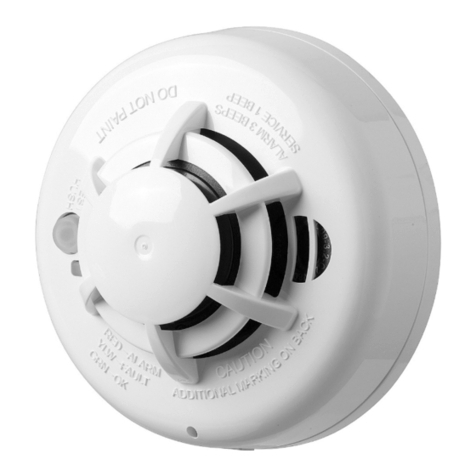
•Smoke detectors will not sense a fire if the smoke does not
reach the sensor or if the air temperature does not reach
57°C (135°F). In order for a smoke detector to sense smoke, it
must be installed in the immediate vicinity of the fire. In
addition, smoke from fires in chimneys, in walls, on roofs, in
remote parts of the building, or on another level from where the
smoke detector is located, may not reach the smoke detector
quickly enough for occupants to escape unharmed. For this
reason, the installer shall install smoke detectors on every
level, in every sleeping area, and in every bedroom of the
household.
•Smoke detectors may not be heard. The alarm horn in this
smoke detector meets or exceeds current Underwriter’s
Laboratories standards. However, if the smoke detector is not
located in the same room as the occupant, or if it is blocked by
a closed door or normal noise, the alarm horn may not be
heard. In addition, sound sleepers, or persons who are under
the influence of drugs or alcohol may not hear the alarm or be
able to react to it. Therefore, locate this smoke detector,
which has a sounder rated at 85 dB at 10 feet, on every
level, in every sleeping area, and in every bedroom of the
household.
•In general, detectors may not always warn you about fires
caused by carelessness and safety hazards like smoking in
bed, violent explosions, escaping gas, improper storage of
flammable materials, overloaded electrical circuits, children
playing with matches, or arson.
•Smoke detectors are not fool-proof. Like all electronic
devices, smoke detectors have limitations. No type of
smoke detector can sense every kind of fire every time. In
addition, smoke from slow, smoldering fires rises slowly
and may not reach the smoke detector until actual flame
breaks out. This type of smoke may not reach the smoke
detector in time for occupants to escape unharmed.
•Smoke detectors are not a substitute for life or property
insurance. Though smoke detectors have been responsible for
saving many lives, they are not warranted or implied to protect
lives or property in the event of a fire.
•To keep your equipment in excellent working order, ongoing
maintenance is required per the manufacturer’s recommen-
dations and UL and NFPA standards. At a minimum, the
requirements of Chapter 7 of NFPA 72, The National Fire
Alarm Code, shall be followed. A preventative maintenance
agreement should be arranged through the local manufac-
turer’s representative. Though smoke detectors are designed
for long life, they may fail at any time. Any smoke detector, fire
alarm equipment, or any component of that system which fails
shall be repaired or replaced as soon as possible.
5. MAINTENANCE
5.1 Battery Replacement
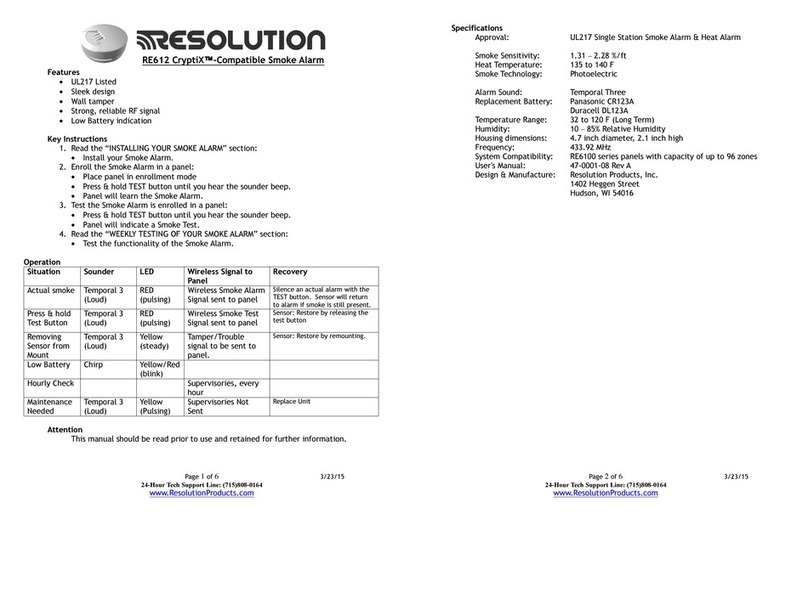
The detector checks for low batteries at least every 60 minutes. If
the batteries are low, the transmitter sends a low battery message
to the control panel. This condition will exist for a minimum of seven
days, and then the detector's horn will "chirp" about every 40
seconds. The batteries should be replaced before the chirps begin.
Be sure to replace both batteries with fresh ones.
To replace batteries:
A. Remove the detector from its bracket by twisting the detector
counterclockwise, remove batteries, and dispose properly.
B. Install two new 3-volt CR123A lithium batteries in the battery
compartment. Follow the polarity diagram inside the
compartment.
C. Reinstall the smoke detector onto the bracket by turning the
detector clockwise.
D. Test the detector as described in Para. 1.2 of this manual.
The LED should flash about once every 40 seconds to
indicate normal operation. If the batteries are not installed
correctly, the smoke detector will not operate and the batteries
may be damaged. If the detector does not appear to be
sending a signal during any of the tests, check for correct
battery installation.
5.2 Cleaning
Before removing the detector, notify the proper authorities that
the smoke detector system is undergoing maintenance and will
be temporarily out of service. Disable the zone or system
undergoing maintenance to prevent unwanted alarms.
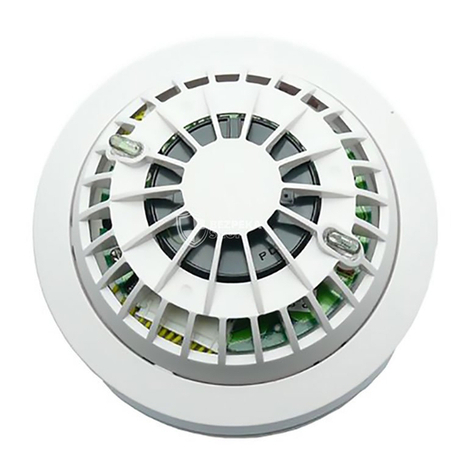
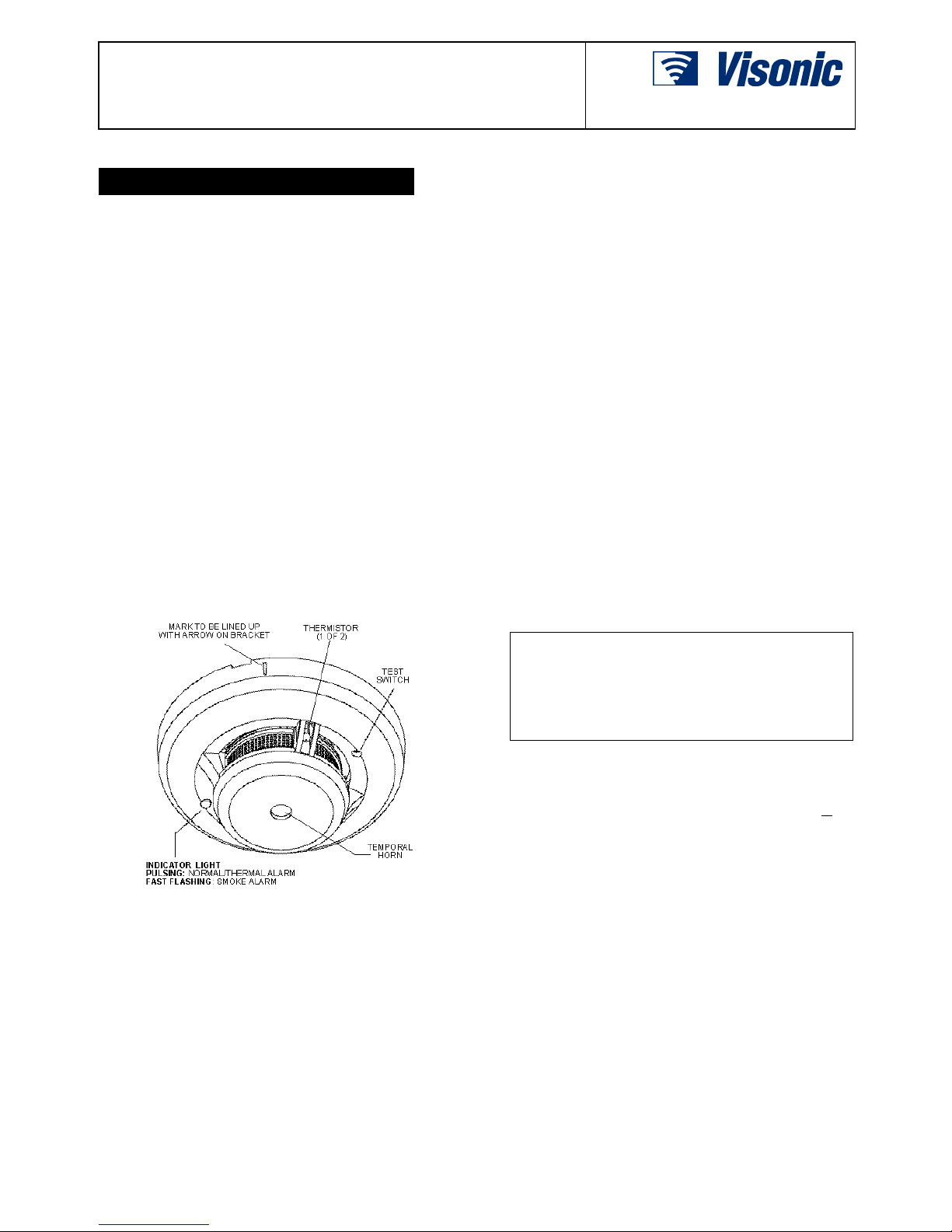
Before removing the detector cover, note the position of the
thermistors (see Figure 1). Make sure the thermistors are not
bent over when the housing is replaced.
Refer to Figure 9 and proceed as follows:
A. Grasp the detector’s body with your hands, rotate it slightly
counterclockwise and pull it off the wall-mounted bracket.
B. Remove the batteries at the bottom.
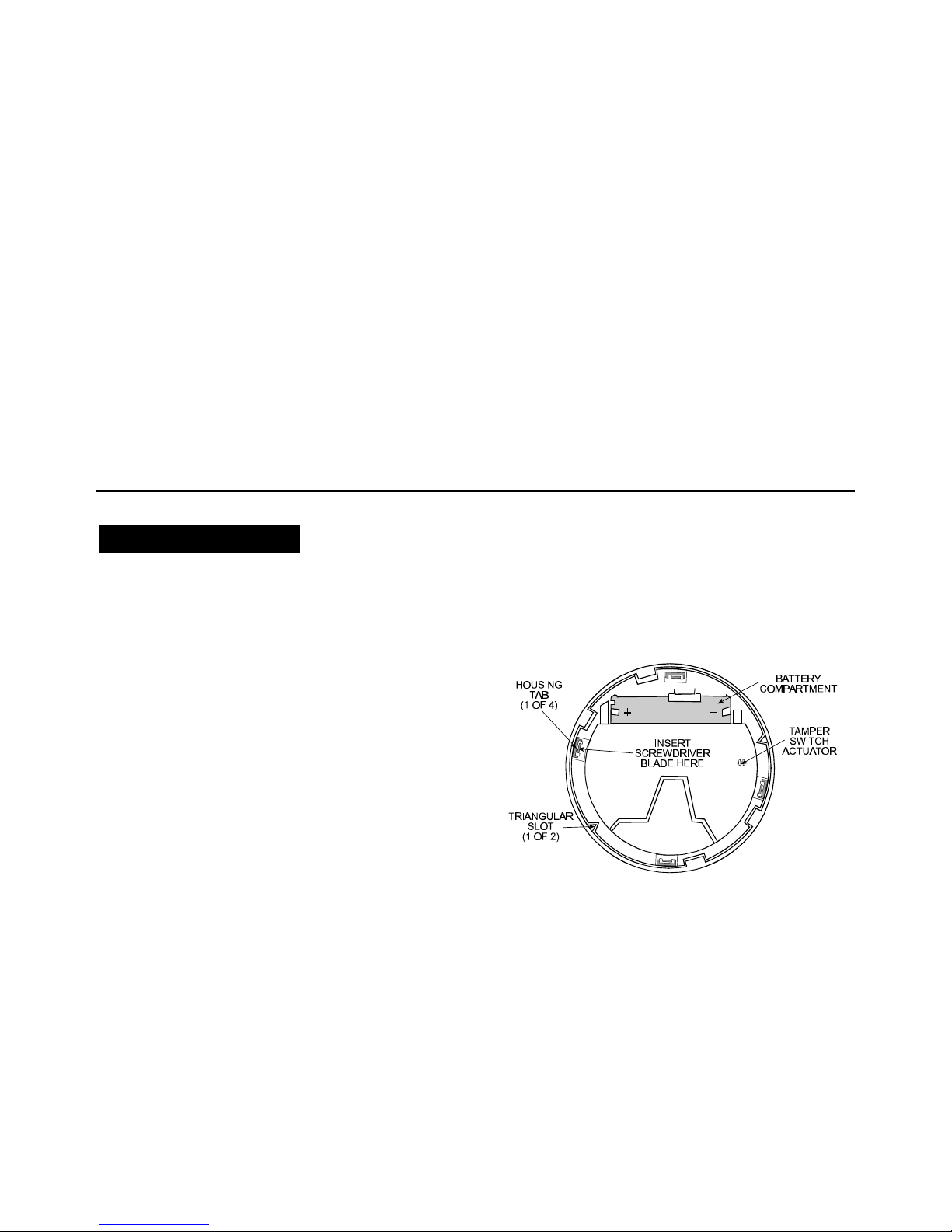
C. Remove the detector housing by gently prying the four
housing tabs on the bottom of the base with a small-bladed
screwdriver and pull the housing from the base. Use caution
to avoid damaging the thermistors.
D. Vacuum the screen carefully without removing it.
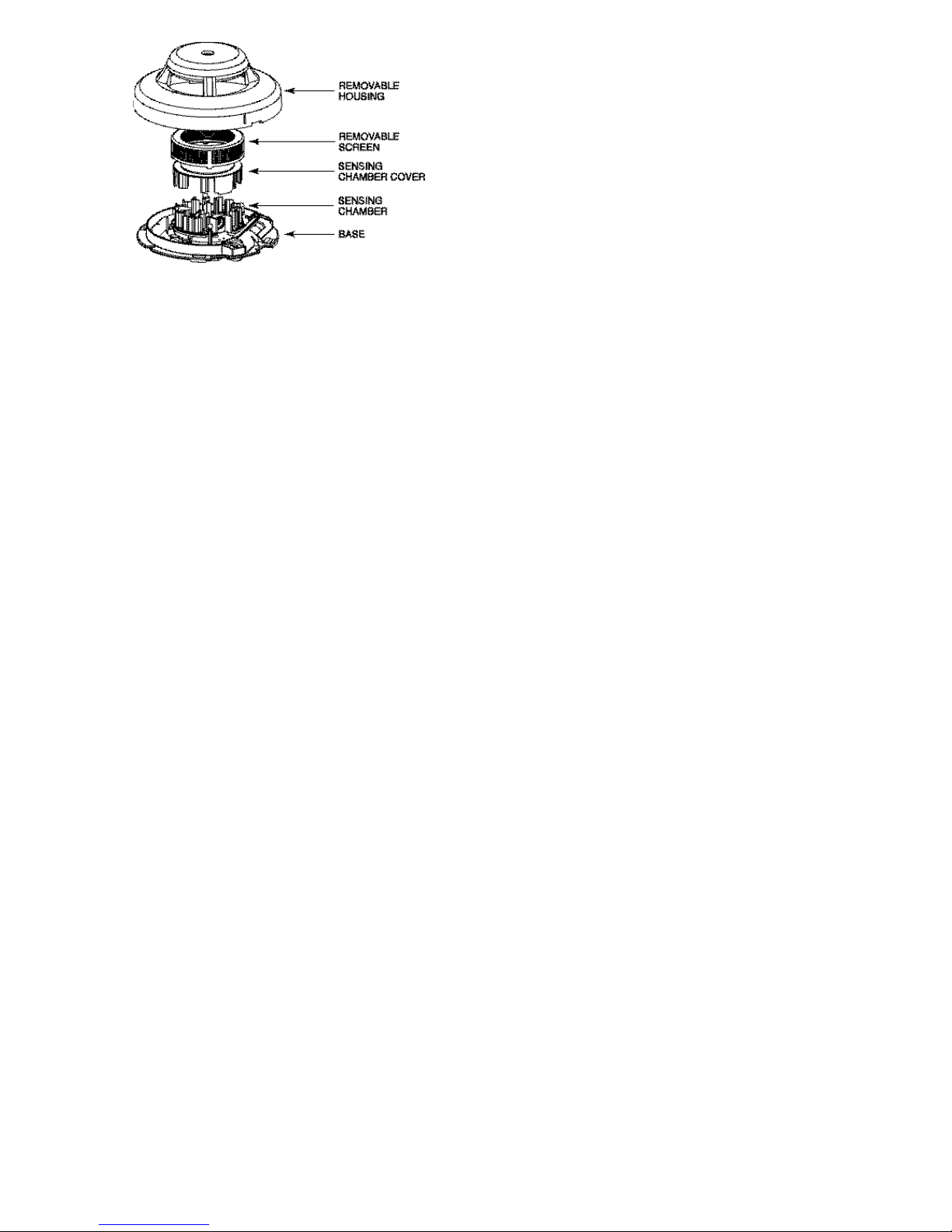
E. Remove the screen assembly, pulling straight out (see Fig.
10).
Figure 9. Housing Removal