1716
1500
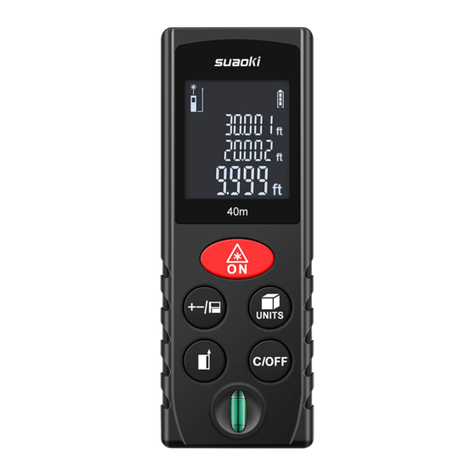
Rangefinder
rangeFinding tips
Laser rangefinders work by emitting a brief pulse of light
aimed at a target object. Distance is determined by the
amount of time taken for the light to emit and return to the
laser’s internal receiver. A laser’s ability to read range can
be affected by many things—mostly relating to the target
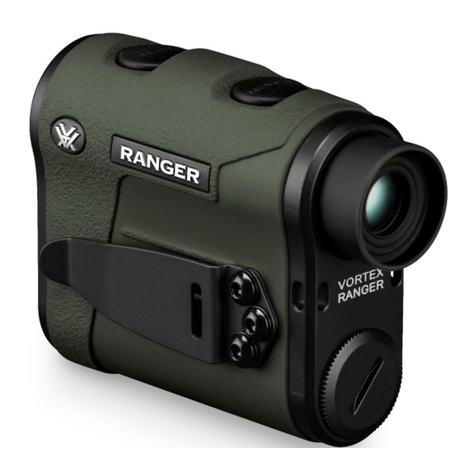
objects. Under ideal conditions, the Ranger can be expected
to range a large reflective object out to 1500 yards and deer-
sized game out to 750 yards.
Laser Performance Tips
•Light colors will usually reflect the laser pulse better than
dark ones. An exception would be snow, which can be
difficult to range.
•Shiny, reflective surfaces will usually reflect the laser
pulse better than dull, textured surfaces. Animal hair will
not reflect as well as a hard surface.
• Ranging while under cloud cover can improve laser
performance compared to ranging while under bright
sunny conditions.
•Solid objects, such as rock piles, will reflect the laser
pulse better than less dense items such as bushes.
•Flat surfaces perpendicular to the laser pulse will reflect
better than curved surfaces or surfaces angled in relation
to laser pulse.
•Ranging over water can sometimes cause false reflections
and readings.
•At longer distances, larger objects will be easier to range
than small objects.
• If you are having difficulty ranging an animal or object,
try ranging a different nearby object or use the Scan
feature to pan back and forth while watching for changes
in range number.