6
1 Basic Remarks
1.1 Purpose of the document
This operating manual is necessary for the safe and appropriate use of the
appliance, and as such must be read carefully by assembly and mainte-
nance staff before commissioning, and observed in all respects. This manual
must be kept read to hand in an easily accessible place.
1.2 Safety symbols
This symbol indicates a possibly dangerous situation.
The disregard of indicated hazards can result in serious harm to health or lead
to material damage.
2 Description
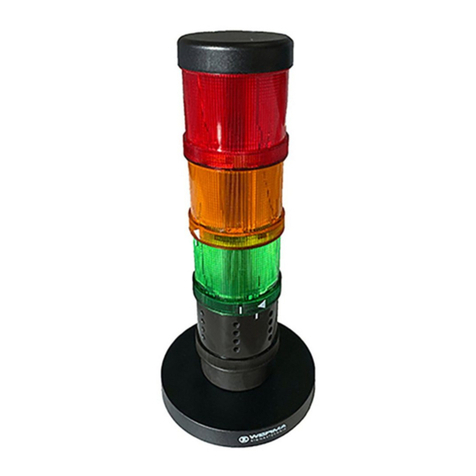
The signal tower consists of a duroplast connection box and a polycarbonate
signal tower unit. The individual signal tower tiers can be wired up in the con-
nection box. Please observe the correct polarity when connecting the prod-
uct.
3 Function
The appliance was developed as a signalling device for warning in hazardous
areas where flammable gas or vapours or dust are present. The device group
II category 2G, 2D permits use in potentially explosive atmospheres of zones 1
and 2, as well as 21 and 22.
The explosion protection for gas applications is achieved using the protection
types encapsulation "mb", intrinsic safety "ib", inherently safe optical radiation
„op is“ and increased safety "eb" (in the connection area); For dust applica-
tions additionally using the protection rating: protection via housing „tb“.
4 Conformity
The appliance meets the following standards and directives:
• Directives 2014/34/EU (ATEX), 2014/30/EU (EMC)
• EN 60079-0:2012 + A11:2013, EN 60079-7:2015,
• EN 60079-11:2012, EN 60079-18:2015,
• EN 60079-28:2015, EN 60079-31:2014,
• EN 60947-5-1:2004+Cor.:2005 + A1:2009
5 Safety instructions
• The appliance is exclusively intended for the designated use described in
article 2 “Function”. Other applications are prohibited, as inappropriate
use can result in dangerous situations.
• National safety and accident regulations must be observed.
• In case of equipment failure, additional safety precautions should be taken
to avoid possible danger to persons.
• It is critically important that processes which can generate a strong electri-
cal charge do not arise on the surface of the connection area housing.
Examples are fast-moving particles or hydraulically conveyed liquids and
drops or pneumatically conveyed dusts and loose parts or sprayed
charges in electrostatic coating processes.
310_741_003_0318_AB.fm Seite 6 Mittwoch, 28. März 2018 9:48 09