Installation, Operating & Setting Instructions.
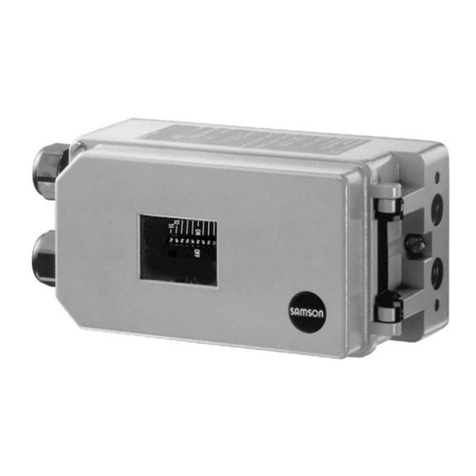
Westlock 793 Rotary Pneumatic Positioner
With SPDT V3 Microswitches OR V3 Inductive Proximity Sensors
WESTLOCK CONTROLS LTD
22 CHAPMAN WAY, TUNBRIDGE WELLS, KENT, TN2 3EF, ENGLAND. TEL: +44 (0)1892 516277. FAX: +44 (0)1892 516279
17/09/2012 TECHUK-55 REV 1 5 of 14
3.0 Setting Procedure
The positioner is pre-set for direct acting prior to leaving the factory. If re-adjustment
is necessary to suit a specific actuator, proceed using the following instructions.
With the positioner correctly mounted to the actuator, as per fig 1 or 2, and with cover
removed, connect the air supply, signal and actuator piping to the positioner as
shown in Figs 3 & 4.
3.1 Apply a signal pressure of approximately 9 psig and gradually reduce this to 3
psig. If the actuator just reaches the clockwise limit of rotation as the signal
reaches 3 psig, no adjustment is necessary.
3.2 If the actuator does not reach the clockwise limit of rotationat 3 psig, with
reference to Fig 5, loosen the locknut and turn the zero-adjusting nut 1/6 of a
turn clockwise, when viewed from above. Repeat until zero is correctly
achieved.
3.3 If the actuator reaches the clockwise limit of rotation before the signal reaches 3
psig, turn the zero-adjusting nut 1/6 of a turn anti-clockwise, when viewed from
above, and repeat until zero is correctly achieved.
3.4 Gradually increase the signal to 15 psig. If the actuator just reaches the
counter-clockwise limit of rotation as the signal reaches 15 psig, then no
adjustment is necessary.
3.5 If the actuator does not reach the counter-clockwise limit of rotation at 15 psig,
this indicates that the spring rate is too high. Loosen the hex socket set screw in
the range adjustment collar (see fig 5), hold the collar stationary using a hex
wrench (Allen key) and turn the spring slightly clockwise. The zero adjusting nut
must now be used to achieve full counter-clockwise rotation
3.6 Conversely, if the actuator reached the counter-clockwise limit of rotation before
15 psig, turn the spring slightly anti-clockwise with respect to the range
adjustment collar. Again, re-adjust the zero adjusting nut to achieve full counter-
clockwise limit of rotation. The zero and range settings are highly interactive
and steps 3.2 to 3.7 must be repeated until zero and span are acceptable.
Note; In steps 3.2to 3.7, clockwise and anti-clockwise rotations are viewed from
the adjusting nut end of the spring.