IN BRIEF:
• Some battery chargers perform erratically, or suffer damage, when run from portable petrol g enerators
• This is due to poor waveform quality from small port able generators, particu larly when lig htly loaded.
• Either apply an ad ditional load to the generators when running battery chargers, or get a bet ter generator set.
• The generator VA rating should be at least FOUR ti mes the battery voltage multiplied by the charger current .
THE PROBLEM - MORE DETAIL
In recent years, WOODS Battery Chargers have been seeing an increasing number of chargers which have been damaged by
poor power quality. In all cases, power has been supplied by portable generators (“Gen-sets”) of less than 5kVA rating .
Almost all of the damaged chargers have been Woods “Dialomatic” types, since these are the style most likely to be used with
small gen-sets.
Power from gen-sets of 7kVA and higher seems to be of good quality. No problems have been reported from using chargers
with these larg er gen-sets.
Similarly, few problems have been noted i n WOODS ELECTRIC “Automatic”, “BETAcharge” and “Neptune” chargers, simply
because these are not generally used with small gen-sets.
Although most appliances are not affected by the poor waveform quality from smaller gen-sets, those appliances which use
“Phase Power Control” are particularly affected. “Phase Power Control” is used in WOODS ELECTRIC battery chargers, in speed
controls for power tools, and in domestic lighting dimmers.
T HE CAUSE – MOR E DET AIL:
The generators in many small gen-s et s produce highly distorted waveforms.
Although meters are readil y available to measure generat or output voltage and frequency, it is rare to see meters for output
distortion measurement. The easiest way to view a generators’ output is to use an oscilloscope. This will not directly measure
distortion, but it will give a good visual indication of the degree of distortion.
Here is the (simulated) waveform of a typical “cheap and nasty”
generator, shown against a pure 240V 50Hz sinewave:
Thi s particular waveform exhi bits a distortion of around 25%.
Ideally, mains power (and gen-set output power) would be a pure
sine-wave. In fact, mains power may have up to 5% distortion.
Thi s level of distor tion does not create any misb ehaviour in
Dialomatic chargers.
Some gen-sets, however, produce power with more than 20%
di stortion (sometimes as high as 25%!).
The distortion is due to the design of the generat or. The engine
driving the generator is not responsible.
The phase-control circuit s in Woods Dialomatic chargers
manufactured before 200 1 cannot cope with more than 8%
di storti on. The cir cuits i n n ew Dialomatic char ger s can cope wit h
up to 15 % dis tortion.
Woods D ialomatic battery chargers are generally quite tolerant of
the variation s in frequency and voltage produced by gen-sets, but
they don’t cope with high distortion levels.
SOLUTIONS – MORE DETAIL:
We have found that the distortion produced by gen-sets may be
reduced to useable levels by loading the generator with a resistive
load, in addition to the battery charger.
Loads of between 5 00 watts and 15 00 watts will g ener al ly r educe
the generators’ distortion sufficiently. The load must be resistive,
and it must be constant. G ood examp les include 500W
incandes cent floodlights, and bar-element rad iat ors.
Fluores cent lighting, refrigerators and stoves are unsuitable –
either because they are not resistive, or because they are
t hermostatically controlled an d may cut out at any ti me.
Here is the (simulated) waveform of the same generator as before,
now loaded with a 1000 watt resistive load :
The degree of distortion reduction is immediately apparent – it is
now down to 12%.
Thi s “resistive loading” technique works well - but the operator must locate suitabl e loads (and remember to us e them each
time!), and the engines’ fuel consumpt ion will increase.
It may be viable to upgrade your generator set, instead.
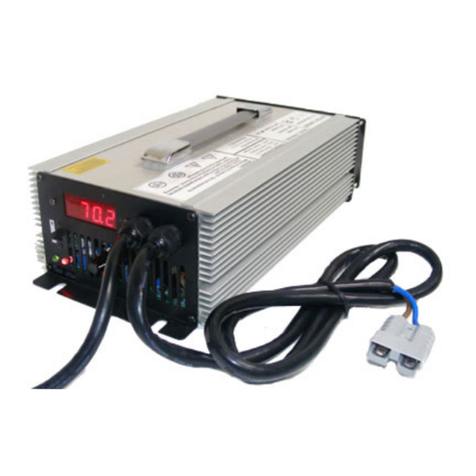
PORTABLE GENERATOR SETS: PORTABLE GENERATOR SETS:
0 8m 16m 24m 32m 40m 48m
-600
-400
-200
0
200
400
600
Xa: 48.00mXb: 0.000
Yc: 337.8 Yd:-340.0
a-b: 48.00m
c-d: 677.8
freq: 20.83
Ref=Ground X=8m/Div Y=voltage
d
c
b a
A
B
0 8m 16m 24m 32m 40m 48m
-400
-200
0
200
400
600
800
Xa: 48.00mXb: 0.000
Yc: 537.8 Yd: -140.0
a-b: 48.00m
c-d: 677.8
freq: 20.83
Ref=Ground X=8m/Div Y=voltage
d
c
b a
A
B
9