manuals.online logo
Brands
  1. Home
  2. •
  3. Brands
  4. •
  5. Xpelair
  6. •
  7. Fan
  8. •
  9. Xpelair Premier CF20 and User manual

Xpelair Premier CF20 and User manual

This manual suits for next models

3

Other Xpelair Fan manuals

Xpelair CMF171 User manual

Xpelair

Xpelair CMF171 User manual

Xpelair Natural Air 180 Vertical User manual

Xpelair

Xpelair Natural Air 180 Vertical User manual

Xpelair WX12 User manual

Xpelair

Xpelair WX12 User manual

Xpelair Ripple Standard 4" User manual

Xpelair

Xpelair Ripple Standard 4" User manual

Xpelair PX6 User manual

Xpelair

Xpelair PX6 User manual

Xpelair 100MM/4" RANGE DX100 User manual

Xpelair

Xpelair 100MM/4" RANGE DX100 User manual

Xpelair Xpelair SL150T User manual

Xpelair

Xpelair Xpelair SL150T User manual

Xpelair DX100B User manual

Xpelair

Xpelair DX100B User manual

Xpelair LV100 and User manual

Xpelair

Xpelair LV100 and User manual

Xpelair XPSS Quick reference guide

Xpelair

Xpelair XPSS Quick reference guide

Xpelair LVCF20TX User manual

Xpelair

Xpelair LVCF20TX User manual

Xpelair PX12 User manual

Xpelair

Xpelair PX12 User manual

Xpelair GX12 User manual

Xpelair

Xpelair GX12 User manual

Xpelair Simply Silent C4R User manual

Xpelair

Xpelair Simply Silent C4R User manual

Xpelair Simply Silent C4S User manual

Xpelair

Xpelair Simply Silent C4S User manual

Xpelair LVCF20 User manual

Xpelair

Xpelair LVCF20 User manual

Xpelair XIL100 User manual

Xpelair

Xpelair XIL100 User manual

Xpelair VX100 User manual

Xpelair

Xpelair VX100 User manual

Xpelair Simply Silent DX150 User manual

Xpelair

Xpelair Simply Silent DX150 User manual

Xpelair Premier DX180H User manual

Xpelair

Xpelair Premier DX180H User manual

Xpelair GX12 EC3 RF User manual

Xpelair

Xpelair GX12 EC3 RF User manual

Xpelair Simply Silent C4S User manual

Xpelair

Xpelair Simply Silent C4S User manual

Xpelair VX100 User manual

Xpelair

Xpelair VX100 User manual

Xpelair VX100 User manual

Xpelair

Xpelair VX100 User manual

Popular Fan manuals by other brands

Minka Group minkaAire Wave F843 instruction manual

Minka Group

Minka Group minkaAire Wave F843 instruction manual

Airflow Adroit DV50 instruction manual

Airflow

Airflow Adroit DV50 instruction manual

Vornado 270 Series owner's guide

Vornado

Vornado 270 Series owner's guide

comfort air TH-10D instruction manual

comfort air

comfort air TH-10D instruction manual

Livoo DOM386 instruction manual

Livoo

Livoo DOM386 instruction manual

Holmes BLIZZARD HAOF-90 owner's guide

Holmes

Holmes BLIZZARD HAOF-90 owner's guide

Taurus GRECO 16 ELEGANCE manual

Taurus

Taurus GRECO 16 ELEGANCE manual

Quorum PINNACLE installation instructions

Quorum

Quorum PINNACLE installation instructions

Monte Carlo Fan Company 3DIR58RBD-V1 Owner's guide and installation manual

Monte Carlo Fan Company

Monte Carlo Fan Company 3DIR58RBD-V1 Owner's guide and installation manual

Craftmade UH52 installation guide

Craftmade

Craftmade UH52 installation guide

Jocel JVA030658 instruction manual

Jocel

Jocel JVA030658 instruction manual

MIKA MFB1211/GR user manual

MIKA

MIKA MFB1211/GR user manual

Harbor Breeze RLG52NWZ5L manual

Harbor Breeze

Harbor Breeze RLG52NWZ5L manual

Allen + Roth L1405 instruction manual

Allen + Roth

Allen + Roth L1405 instruction manual

ViM KUBAIR F400 ECOWATT Technical manual

ViM

ViM KUBAIR F400 ECOWATT Technical manual

HIDRIA R10R-56LPS-ES50B-04C10 user guide

HIDRIA

HIDRIA R10R-56LPS-ES50B-04C10 user guide

BLAUBERG Ventilatoren CENTRO-M 100 L user manual

BLAUBERG Ventilatoren

BLAUBERG Ventilatoren CENTRO-M 100 L user manual

Triangle Engineering HEAT BUSTER SPL Series owner's manual

Triangle Engineering

Triangle Engineering HEAT BUSTER SPL Series owner's manual

manuals.online logo
manuals.online logoBrands
  • About & Mission
  • Contact us
  • Privacy Policy
  • Terms and Conditions

Copyright 2025 Manuals.Online. All Rights Reserved.

Guarantee
UK: This fan is guaranteed against defects for 3 years from the date of purchase.
Xpelair reserve the right to repair or replace the fan.
Keep your purchase receipt.
Any problems, contact the address below.
Outside UK: See International section below.
Technical Advice & Service
UK - Xpelair have a comprehensive range of services including:
Free technical advice Help-Desk from Engineers on all aspects of ventilation.
Free design service, quotations and site surveys.
Outside UK: See International section below.
Please ask for details on:
Tel +44 (0) 8709 000430
Fax +44 (0) 8709 000530
Also at the address below
Head Office – UK Sales Office and Spares
Applied Energy Products Ltd, Morley Way, Peterborough, PE2 9JJ, England
Tel: +44 (0) 1733 456789
Fax: +44 (0) 1733 310606
Sales/Spares Hotline: +44 (0) 8709 000420
Sales/Spares Faxline: +44 (0) 8709 000520
Web: http://www.xpelair.co.uk
International
Guarantee – Contact your local distributor or Xpelair direct
Technical advice and Service - Contact your local Xpelair distributor.
567-2066-02
Revision A
GB
F
D
NL
N
S
I
GR
a
Xpelair
Condensation Control Fans
♦CF20 Pull Cord
♦CF20T Pull Cord/Timer
Remote Switched Centrifugal Ducted Fans
♦DX200 Remote Switch
♦DX200T Remote Switch/Timer
Installation and operating instructions
Please retain for end user’s future reference
ES
Revision B
Redring Xpelair Group Ltd., Newcombe House, Newcombe Way,
Orton Southgate, Peterborough, PE2 6SE England
Redring Xpelair Group Ltd.
567-2066-02
(Revision C)
Guarantee
UK: This fan is guaranteed against defects for 3 years from the date of purchase.
Xpelair reserve the right to repair or replace the fan.
Keep your purchase receipt.
Any problems, contact the address below.
Outside UK: See International section below.
Technical Advice & Service
UK - Xpelair have a comprehensive range of services including:
Free technical advice Help-Desk from Engineers on all aspects of ventilation.
Free design service, quotations and site surveys.
Outside UK: See International section below.
Please ask for details on:
Tel +44 (0) 8709 000430
Fax +44 (0) 8709 000530
Also at the address below
Head Office – UK Sales Office and Spares
Applied Energy Products Ltd, Morley Way, Peterborough, PE2 9JJ, England
Tel: +44 (0) 1733 456789
Fax: +44 (0) 1733 310606
Sales/Spares Hotline: +44 (0) 8709 000420
Sales/Spares Faxline: +44 (0) 8709 000520
Web: http://www.xpelair.co.uk
International
Guarantee – Contact your local distributor or Xpelair direct
Technical advice and Service - Contact your local Xpelair distributor.
567-2066-02
Revision A
GB
F
D
NL
N
S
I
GR
a
Xpelair
Condensation Control Fans
♦CF20 Pull Cord
♦CF20T Pull Cord/Timer
Remote Switched Centrifugal Ducted Fans
♦DX200 Remote Switch
♦DX200T Remote Switch/Timer
Installation and operating instructions
Please retain for end user’s future reference
ES
Revision B
A
B
C
D
FIXING
HOLE
FIXING
HOLE
FRONT VIEW
FIXING
HOLE
!¡
66
222
93
66
94
20
213
252
20 182
40 62 56
Opciones auxiliares
Para realizar la instalación rápida y fácilmente,
puede necesitar algunos de los accesorios
siguientes:
WD100 Conducto para pared
CFWG100 Rejilla para pared
FDA Juego de adaptador para
conducto plano
XCT100 Retenedor de condensación
DGW/B Rejilla para la puerta de
intercambio del aire
SP100 Placa del tubo
XAA Adaptador para ladrillo ventilador
VC10 Portezuela de ventilación
WT10 Kit de terminación del conducto
XF/FM Conducto plano (Plástico/Metal)
(Plástico 234 x 29mm Metal 230 x
25mm)
VK10 Kit de ventilación para pared
FD100 Conducto flexible
WDC5 Sujetadores de tornillo sin fin
XCMK Kit de montaje en techo
XBP Obturador de contratiro
EFT Kit de terminación de fácil
instalación
GMK Kit de montaje de cristal
PDXGF Filtro de grasa
A continuación se listan algunos de los
recambios disponibles. Remítase a la última
página de este folleto para los detalles de
pedido:
41520SK Kit de reparación (kit completo)
41528SK Tubo circular (gama completa)
41731SK Motor (DX200)
41733SK Motor (CF20/CF20T/
DX200T)
41782SK Conjunto PCB (DX200T)
41735SK Conjunto PCB (CF20)
41736SK Conjunto PCB (CF20T)
41737SK Cubierta delantera / Deflector
(DX200)
41738SK
Cubierta delantera / Deflector
(DX200T)
41739SK
Cubierta delantera / Deflector
(CF20/CF20T)
41740SK Moldura borde (gama completa)
41741SK Conjunto de cordón (CF20/CF20T)
41742SK Rotor (gama completa)
ES
G
F
DX200
CF20
CF20T / DX200T
Tilbehør
For å forenkle installasjonen og
spare tid, kan det være at din
installasjon krever noe av
tilbehøret som er listet opp
nedenfor:
WD100 Vegg-gjennomføring
CFWG100 Vegg-gitter
FDA Utstyrspakke med
plant kanaladapter
XCT100 Kondensavskiller
DGW/B Gitterluke for
luftutskiftning
SP100 Muffeplate
XAA Luftadapter for mur
VC10 Avtrekksdeksel
WT10 Kanalavslutnings-sett
XF/FM Plan rørkanal
(plast/metall)
(plast 234 x 29 mm
metall 230 x 25 mm)
VK10 Veggventil-sett
FD100 Fleksibel rørkanal
WDC5 Snekkeskrue-klips
XCMK Sett for montering i
himling
XBP In-line
tilbakeslippsklaff
EFT Lettmontert
avslutnings-sett
GMK Sett for montering i
vindu
PDXGF Fettfilter
Nedenfor er det listet opp enkelte
reservedeler som er tilgjengelige.
Se baksiden på denne trykksaken
for bestillingsinformasjon:
41520SK Monterings-sett
(komplett)
41528SK Rund muffe (komplett)
41731SK Motor (DX200)
41733SK Motor (CF20/CF20T/
DX200T)
41782SK Kretskort-komponent
(DX200T)
41735SK Kretskort-komponent
(CF20)
41736SK Kretskort-komponent
(CF20T)
41737SK Frontdeksel kompl.
med mottrykksplate
(DX200)
41738SK
Frontdeksel kompl. med
mottrykksplate (DX200T)
41739SK
Frontdeksel kompl. med
mottrykksplate
(CF20/CF20T)
41740SK Innfatningsprofil
(komplett)
41741SK
Snorbryter-komponent
(CF20/CF20T)
41742SK Viftehjul (komplett)
Tillbehör
I listan nedan hittar du hjälpmedel
som kan vara av nytta under
installationen:
WD100 Väggtrumma
CFWG100 Väggaller
FDA Adaptorsats för
planmontering
XCT100 Kondensavledare
DGW/B Luftregleringsgaller
SP100 Mufförbindningsplatta
XAA Adapter
VC10 Ventilhuv
WT10 Avspänningssats
XF/FM Planmontering
(plast/metall)
(plast 234 x 29 mm)
(metall 230 x 25 mm)
VK10 Väggventilsats
FD100 Flexibel
ledningsdragning
WDC5 Skruvdriftsklämmor
XCMK Takmonteringssats
XBP Svart reglerventil
EFT Avspänningssats
GMK Glasmonteringssats
PDXGF Smörjningsfilter
I listan nedan hittar du
reservdelar. Du hittar
beställningsinformation på denna
bruksanvisnings baksida:
41520SK Fastsättningssats
(komplett)
41528SK Mufförbindning
(komplett sortiment)
41731SK Motor (DX200)
41733SK Motor (CF20/CF20T/
DX200T)
41782SK PCB-montering
(DX200T)
41735SK PCB-montering
(CF20)
41736SK PCB-montering
(CF20T)
41737SK Främre skydd med
skärm (DX200)
41738SK Främre skydd med
skärm (DX200T)
41739SK
Främre skydd med
skärm (CF20/CF20T)
41740SK Ramformning
(komplett sortiment)
41741SK Dragsnöresmontering
(CF20/CF20T)
41742SK Fläkthjul (komplett
sortiment)
Accessori opzionali
Per un’installazione più facile e
veloce, potrebbero essere
necessari alcuni degli accessori
sottoelencati:
WD100 Condotto per parete
CFWG100 Grata per parete
FDA Kit adattatore per
condotto piatto
XCT100
Pozzetto di
intercettazione della
condensa
DGW/B Grata dello sportello di
ricambio aria
SP100 Piastra di imbocco
XAA Adattatore per mattoni
traforati
VC10 Cappottatura di
ventilazione
WT10 Kit di terminazione
condotti
XF/FM Condotti piatti
(plastica/metallo)
(plastica 234 x 29mm,
metallo 230 x 25mm)
VK10 Kit di ventilazione per
parete
FD100 Condotti flessibili
WDC5 Fermagli a vite senza
fine
XCMK Kit di montaggio al
soffitto
XBP Otturatore in linea del
tiraggio di ritorno
EFT Kit di terminazione di
facile montaggio
GMK Kit per il montaggio su
vetro
PDXGF Filtro antigrasso
Qui di seguito sono elencati alcuni
dei ricambi disponibili. Per
informazioni su come ordinarli,
consultare la quarta di copertina:
41520SK Kit di fissaggio (kit
intero)
41528SK Imbocco a bicchiere
circolare (intera
gamma)
41731SK Motorino (DX200)
41733SK Motorino (CF20/
CF20T/DX200T)
41782SK Gruppo PCB
(DX200T)
41735SK Gruppo PCB (CF20)
41736SK Gruppo PCB (CF20T)
41737SK Coperchio anteriore
completo di
diaframma (DX200)
41738SK Coperchio anteriore
completo di
diaframma (DX200T)
41739SK Coperchio anteriore
completo di
diaframma
(CF20/CF20T)
41740SK
Modanatura della
cornice
(intera gamma)
41741SK
Gruppo cordicella
(CF20/CF20T)
41742SK
Girante (intera
gamma)
Συµπληρωµατικές Επιλ�γές
 
 



WD100 
CFWG100 
FDA 

XCT100 
DGW/B 

SP100 
XAA 

VC10

WT10 

XF/FM 



VK10 

FD100 
WDC5 

XCMK


XBP 


EFT 


GMK


PDXGF 





41520SK 

41528SK 
41731SK 
41733SK


41782SK

41735SK 
41736SK

41737SK



41738SK 



41739SK



41740SK 

41741SK 


41742SK 

N S I GR
For speed and ease of Installation, your installation may require some of the
Ancillaries indicated in “Ancillary Options”.
If installing on a wall (surface mounting)
1. Mark on the wall the centre of the duct hole A.
2. Use this centre to cut an opening through the wall 117mm dia, with a slight
fall to the exterior.
3. Fit the wall duct (WD100), not supplied, and mortar into place.
If installing on a wall (flush mounting)
1. Mark on the wall the centre of the duct hole A, and drill a pilot
hole through both walls at a slight downward angle.
2. Use the centre to mark a rectangular hole for the inner wall using the
dimensions A.
3. Cut the rectangular hole through the inner wall.
4. Go outside and cut a 117mm-diameter hole in the outer wall using the small
hole as the centre.
5. Measure the wall thickness.
Cut the wall duct (WD100), not supplied, so that it is 64mm less than the
wall thickness.
If installing in a ceiling (surface mounting)
This method requires a space above the ceiling, such as a loft or attic, to provide
access for 100mm internal diameter ducting.
1. Mark on the ceiling the centre of the duct hole A, avoiding ceiling joists and
buried cables etc.
2. Cut a 117mm-diameter hole using the marked centre.
If installing in a ceiling (flush mounting)
For 100mm diameter ducting:
1. Mark a rectangular hole using the dimensions B.
2. Cut the hole, avoiding ceiling joists and buried cables etc.
For flat ducting:
• This fan can be installed within a 47mm void without the circular spigot 7
(Fig.E). Flat ducting adapter kit (FDA) available.
Preparing the fan for installation
1. Remove the front cover 2(Fig.C)
2. Fit the foam tape !™ supplied around the circular spigot 7(Fig.E).
3. Remove the electrical cover 5(Fig.E). The impeller can be removed to
ease access (if required). This is a "push-on/pull-off" assembly.
Setting the fan speed
DX200T / CF20 / CF20T Only (Fig.D)
4. The correct condensation control speed (CF20/CF20T) or operating speed
(DX200T) should be selected to suit the room size in which the fan is to be
installed. Slide the switch Xto the required position. Please note that the
fan is factory set to “Position 2”.
5. Switch Position Size / Room Volume (m3)
1 Large (34 and above)
2 Medium (28 – 34)
3 Small (less than 28)
Setting the trickle speed
DX200T / CF20 / CF20T Only (Fig.D)
6. The fan can be set so that it provides constant trickle extraction. Slide the
switch Yto the required position. Please note that the fan is factory set to
“Position 0”.
7. Switch Position Setting
0Trickle extraction OFF
I Trickle extraction ON
Setting the time delay start
DX200T / CF20T Only (Fig.D)
8. The fan can be set so that there is a 2-minute delayed start to its
operation when used with an external on/off switch. Slide the
switch Zto the required position. Please note that the fan is
factory set to “Position 0”.
Switch Position Setting
0Time delay start OFF
ITime delay start ON
Mounting the fan on a wall or ceiling (surface mounting)
1. Place the ducting into the hole and align to the required position. If wall
mounting, ensure that the ducting slopes down and away from the fan
2. Mark the positions of the three fixing holes Ain Fan box 6(Fig.E).
3. If wall mounting, drill three holes 5.5mm diameter for wall plugs (supplied).
If ceiling mounting B, use appropriate fasteners (not supplied).
4. Cut out the cable inlet hole, if required, in the surround 0and slit the cable
grommet. Slide the surround 0over the fan box 6.
5. Pass the electrical cables into the fan box 6through the rear cable inlet
hole and surround, and re-fit the cable grommet.
Ensure that cable grommet is in place and a tight fit.
6. Offer the fan box 6up to the wall or ceiling. Ensure the circular spigot 7
enters the ducting.
7. Fix the fan box 6to the wall using screws 8or to the ceiling using
appropriate fasteners (not supplied).
If mounting in a wall (flush mounting)
The surround 0is not required. Fit the ducting to the circular spigot 7.
If the hole size is as recommended:
1. Assemble the three fan body clamps 9to the fan box 6using screws 8.
2. Slit the cable grommet. Pass the electrical cables into the fan box 6
through the cable inlet hole and cable grommet.
Ensure cable grommet is in place and a tight fit.
3. Offer the fan box 6up to the wall.
4. Tighten up the three screws 8until the fan is clamped to the inner wall.
The fan body clamps 9will rotate to an automatic stop position. DO NOT
OVERTIGHTEN.
If the hole size is larger than recommended i.e.: larger than the flange on the
fan box
6
(Mostly relating to “retro-fit” installations):
1. The fan body clamps ARE NOT suitable. Construct a wooden frame of
INTERNAL dimensions 203 x 233mm. Depth should be at least 50mm. Fit the
1. READ ALL THESE INSTRUCTIONS & WARNINGS FULLY BEFORE COMMENCING INSTALLATION.
2. INSTALLATIONS AND WIRING MUST CONFORM TO CURRENT IEE REGULATIONS (UK), LOCAL OR APPROPRIATE
REGULATIONS (OTHER COUNTRIES). IT IS THE INSTALLER’S RESPONSIBILITY TO ENSURE THAT THE APPROPRIATE
BUILDING CODES OF PRACTICE ARE ADHERED TO.
3. A QUALIFIED ELECTRICIAN MUST SUPERVISE ALL INSTALLATIONS.
4. THESE APPLIANCES ARE INTENDED FOR CONNECTION TO FIXED WIRING
5. CHECK THAT THE ELECTRICAL RATING SHOWN ON THE FAN MATCHES THE MAINS SUPPLY.
6. WARNING: THESE APPLIANCES MUST BE EARTHED.
7. SITE AWAY FROM DIRECT SOURCES OF HEAT (I.E.: GAS COOKERS OR EYE-LEVEL GRILLS) AND NOT WHERE
AMBIENT TEMPERATURES ARE LIKELY TO EXCEED 50˚C.
8. WHEN THE FAN IS INSTALLED IN A ROOM CONTAINING A FUEL BURNING APPLIANCE, PRECAUTIONS MUST BE TAKEN TO
AVOID THE BACKFLOW OF GASES INTO THE ROOM FROM THE OPEN FLUE OF THE FUEL BURNING APPLIANCE.
9. ENSURE THAT ALL RELEVANT SAFETY PRECAUTIONS (CORRECT EYE PROTECTION AND PROTECTIVE CLOTHING
ETC) ARE TAKEN WHEN INSTALLING AND MAINTAINING THIS FAN.
10. GENERAL GUIDANCE FOR SITING THE FAN SEE “FIG. G”. ALWAYS SITE FAN AS HIGH AS POSSIBLE
11. IF ANY SECTION OF THE DUCTWORK IS POSITIONED HIGHER THAN THE FAN A CONDENSATION TRAP (XCT100) MUST
BE FITTED AS CLOSE AS POSSIBLE TO THE FAN.
GB
IMPORTANT
IMPORTANT
1. READ ALL THESE INSTRUCTIONS & WARNINGS FULLY BEFORE COMMENCING INSTALLATION.
2. INSTALLATIONS AND WIRING MUST CONFORM TO CURRENT IEE REGULATIONS (UK), LOCAL OR APPROPRIATER REGULATIONS (OTHER
COUNTRIES). IT IS THE INSTALLER’S RESPONSIBILITY TO ENSURE THAT THE APPROPRIATE BUILDING CODES OF PRACTICE ARE
ADJERED TO.
3. A QUALIFIED ELECTRICIAN MUST SUPERVISE ALL INSTALLATIONS.
4. THESE APPLIANCES ARE INTENDED FOR CONNECTION TO FIXED WIRING.
5. CHECK THAT THE ELECTICAL RATING SHOWN ON THE FAN MATCHES THE MAINS SUPPLY.
6. WARNING: THESE APPLIANCES MUST BE EARTHED.
7. SITE AWAY FROM DIRECT SOURCES OF HEAT (I.E: GAS COOKERS OR EYE LEVEL GRILLS) AND NOT WHERE AMBIENT
TEMPERATURES ARE LIKELY TO EXCEED 50ºC.
8. WHEN THE FAN IS INSTALLED IN A ROOM CONTAINING A FUEL BURNING APPLIANCE, PRECAUTIONS MUST BE TAKEN TO AVOID THE
BACKFLOW OF GASES INTO THE ROOM FROM THE OPEN FLUE OF THE FUEL BURNING APPLIANCE.
9. ENSURE THAT ALL RELEVANT SAFETY PRECAUTIONS (CORRECT EYE PROTECTION AND PROTECTIVE CLOTHING ETC) ARE TAKEN
WHEN INSTALLING, OPERATING AND MAINTAINING THIS FAN.
10. GENERAL GUIDANCE FOR SITING THE FAN SEE “FIG G”. ALWAYS SITE THE FAN AS HIGH AS POSSIBLE.
11. IF ANY SECTION OF THE DUCTWORK IS POSITIONED HIGHER THAN THE FAN A CONDENSATION TRAP (XCT100) MUST BE FITTED AS
CLOSE AS POSSIBLE TO THE FAN.
12. THIS APPLIANCE IS NOT INTENDED FOR USE BY PERSONS (INCLUDING CHILDREN AND THE INFIRM) WITH REDUCED PHYSICAL,
SENSORY OR MENTAL CAPABILITIES, OR LACK OF EXPERIENCE AND KNOWLEDGE, UNLESS THEY HAVE BEEN GIVEN SUPERVISION
OR INSTRUCTION CONCERNING USE OF THE APPLIANCE BY A PERSON RESPONSIBLE FOR THEIR SAFETY. CHILDREN SHOULD BE
SUPERVISED TO ENSURE THAT THEY DO NOT PLAY WITH THE APPLIANCE.
Ancillary Options
For speed and ease of
Installation, your installation may
require some of the Ancillaries
listed below:
WD100 Wall Duct
CFWG100 Wall Grille
FDA Flat Duct Adaptor Kit
XCT100 Condensation Trap
DGW/B Air Replacement Door
Grille
SP100 Spigot Plate
XAA Air Brick Adaptor
VC10 Vent Cowl
WT10 Termination Ducting
Kit
XF/FM Flat Ducting
(Plastic/Metal)
(Plastic 234 x 29mm
Metal 230 x 25mm)
VK10 Wall Vent Kit
FD100 Flexible Ducting
WDC5 Worm Drive Clips
XCMK Ceiling Mounting Kit
XBP In-Line Back Draught
Shutter
EFT Easy Fit Termination
Kit
GMK Glass Mounting Kit
PDXGF Grease Filter
Listed below are some of the
spares available. See back page
of this booklet for ordering details:
41520SK Fixing kit (Entire kit)
41528SK Circular Spigot (Entire
Range)
41731SK Motor (DX200)
41733SK Motor (CF20/CF20T/
DX200T)
41782SK PCB Assy (DX200T)
41735SK PCB Assy (CF20)
41736SK PCB Assy (CF20T)
41737SK Front Cover c/w Baffle
(DX200)
41738SK Front Cover c/w Baffle
(DX200T)
41739SK Front Cover c/w Baffle
(CF20/CF20T)
41740SK Surround Moulding
(Entire Range)
41741SK Pull cord assembly
(CF20/CF20T)
41742SK Impeller (Entire
Range)
Accessoires en option
Pour une installation rapide et
facile, il est préconisé de se munir
des accessoires figurant sur la
liste ci-dessous :
WD100 Conduit mural
CFWG100 Grille murale
FDA Kit d'adapteur de
conduit plat
XCT100 Trappe de
condensation
DGW/B Grille de porte de
remplacement d’air
SP100 Plaquette pour ergot
XAA Adaptateur de brique
perforée
VC10 Capuchon d’évent
WT10 Kit de terminaison de
conduit
XF/FM Conduit plat
(Plastique/Métallique)
(Plastique 234 x 29 mm
Métallique 230 x 25 mm)
VK10 Kit pour évent mural
FD100 Conduit flexible
WDC5 Colliers à serrage par
vis sans fin
XCMK Kit pour montage au
plafond
XBP Obturateur de
refoulement en
ligne
EFT Kit de terminaisons à
encliqueter
GMK Kit de pose sur une
vitre
PDXGF Filtre de graisse
Liste de quelques pièces de
rechange : Pour la commande,
prière de se reporter à la dernière
page de cette notice :
41520SK Kit de fixation (Kit
complet)
41528SK Ergot circulaire
(gamme complète)
41731SK Moteur (DX200)
41733SK Moteur (CF20/CF20T/
DX200T)
41782SK Carte imprimée
(DX200T)
41735SK Carte imprimée
(CF20)
41736SK Carte imprimée
(CF20T)
41737SK Couvercle avant avec
chicane (DX200)
41738SK
Couvercle avant avec
chicane (DX200T)
41739SK
Couvercle avant avec
chicane (CF20/CF20T)
41740SK Moulure de cadre
(gamme complète)
41741SK
Ens. interrupteur à
cordon (CF20/CF20T)
41742SK Hélice (gamme
complète)
Zubehör
Die unten aufgeführten Produkte
unterstützen eine schnelle und
problemlose Installation:
WD100 Wandrohr
CFWG100 Wandgitter
FDA Flachrohr-Adapter
XCT100 Kondensationsfalle
DGW/B Luftaustauschtürgitter
SP100 Zapfenplatte
XAA Luftziegel-Adapter
VC10 Lüftungskappe
WT10 Bausatz für
Rohrabbruch/
Rohrabschluss
XF/FM Flachrohr
(Kunststoff/Metall)
Kunststoff 234 x 29 mm,
Metall 230 x 25 mm
VK10 Bausatz für
Wandlüftungs
FD100 Flexibles Rohr
WDC5 Schneckenantriebs-
klemmen
XCMK Bausatz für
Deckenmontage
XBP In-Line-
Durchzugsklappe für
die Rückseite
EFT „Easy Fit" Bausatz für
Rohrabbruch/
Rohrabschluss
GMK Bausatz für
Glasmontage
PDXGF Fettfilter
Unten aufgeführt sind einige
Ersatzteile. Auf der Rückseite
dieses Hefts finden Sie
Einzelheiten über die Bestellung:
41520SK
Befestigungsbausatz
(gesamter Bausatz)
41528SK Rundzapfen
(gesamtes Sortiment)
41731SK Motor (DX200)
41733SK Motor (CF20/CF20T/
DX200T)
41782SK Flachbaugruppe
(DX200T)
41735SK Flachbaugruppe
(CF20)
41736SK Flachbaugruppe
(CF20T)
41737SK Frontabdeckung C/W
Ablenkung (DX200)
41738SK Frontabdeckung C/W
Ablenkung (DX200T)
41739SK
Frontabdeckung C/W
Ablenkung (CF20/CF20T)
41740SK Einfassungsform
(gesamtes Sortiment)
41741SK Zugschnur
(CF20/CF20T)
41742SK Gebläserad
(gesamtes Sortiment)
Accessoireopties
Voor snelheid en gemak van
installatie is het mogelijk dat u
sommige van de onderstaande
accessoires nodig heeft.
WD100 Muurdoorvoer
CFWG100 Muurrooster
FDA Adapterkit voor plat
kanaal
XCT100 Condensaatvanger
DGW/B Deurrooster voor
luchtverversing
SP100 Luchtinlaatplaat
XAA Adapter voor
gaatsteen
VC10 Uitlaatkap
WT10 Muurdoorvoerset
XF/FM Plat kanaal
(plastic/metaal)
(Plastic 234 x 29mm
Metaal 230 x 25mm)
VK10 Muuruitlaatset
FD100 Flexibele slang
WDC5 Schroefdraadklemmen
XCMK Plafondmontagekit
XBP Gealigneerde
achterste tochtklep
EFT
Gemakkelijk te
monteren aansluitingset
GMK Glasmontagekit
PDXGF Oliefilter
Hieronder vindt u een lijst van
verkrijgbare reserveonderdelen.
Verwijs naar de achterste pagina
voor het bestellen ervan.
41520SK Montageset (volledig
set)
41528SK Ronde luchtinlaat
(volledige reeks)
41731SK Motor (DX200) **
41732SK Motor (DX200T) **
41733SK Motor (CF20/CF20T/
DX200T)
41734SK PCB montage
(DX200T)
41735SK PCB montage (CF20)
41736SK PCB montage
(CF20T)
41737SK Bovendeel
ventilatorhuis met
schermplaat (DX200)
41738SK Bovendeel
ventilatorhuis met
schermplaat (DX200T)
41739SK Bovendeel
ventilatorhuis met
schermplaat
(CF20/CF20T)
41740SK Lijstwerk voor
montageplaat
(volledige reeks)
41741SK Trekkoordmontage
(CF20/CF20T)
41742SK Rotor (volledige
reeks)
GB F D NL
wooden frame into the internal wall and make good the hole.
2. Offer the fan box 6up to the wall.
3. Screw the fan box 6to the wooden frame using the slots in the flange
(screws not supplied).
If mounting in a ceiling (flush mounting)
1. The surround 0is not required.
2. Insert the fan box 6into the hole and mark four positions using the slots in
the flange B.
3. Remove the fan box 6from ceiling and fit the four ceiling clips (supplied)
over the edge of the hole, so that the clips align with the marks on the ceiling B.
4. Drill 4 pilot holes into the ceiling through the hole of each clip, ensuring not to
damage the clip.
5. Fit the ducting to the circular spigot 7.
6. Offer the fan box 6up to the ceiling.
7. Slit the cable grommet. Pass the electrical cable into the fan box 6through
the front cable inlet hole.
Ensure cable grommet is in place and a tight fit.
8. Using the screws !¡ (Fig.B), fix the fan box flange to the ceiling clips.
Terminating the ducting
Fit an outer grille (such as CFWG100, not supplied in the DX200/DX200T)
to the outer wall. For ceiling mounting, use appropriate ancillaries (not
supplied).
Wire the electrical connections
WARNING! THIS APPLIANCE MUST BE EARTHED
1. Isolate the electricity supply and remove all fuses.
The terminal block will accept cable up to 1.5mm2
2. Use a double-pole isolating switch with a minimum contact gap of 3mm in
both poles.
3. Use suitably rated 3-core or 4-core cable dependant on application.
4. Remove the retaining screws of the terminal cover, if still in position.
5. Wire the fan as shown in Fusing the cable clamp provided. Check fan
model to diagram.
DX200: “LH” =Live (High Speed)/ “LL” = Live(Low Speed)
6. Replace the terminal cover 5and fasten the retaining screws.
7. See section on “User adjustments” if you wish to use settings other than
those that have been factory set.
8. Refit the front cover(Fig.C).
Connect the cable from the isolating switch to electrical supply wiring, and
re-check installation.
10. Refit fuses before turning on electricity supply.
11. For fixed wiring circuits, the protective fuse for the appliance must not
exceed 5A.
For Australia Only
CF20 – Connection to the supply - flexible 3-core cable with 3 pin plug top for
insertion into an approved 10A wall mounted surface switch with at least 3mm
clearance between contacts.
ALL OTHERS – Permanently connected to the supply and a remote switch controls
operation. They should be directly wired to the supply through an approved 10A wall
mounted surface switch with at least 3mm clearance between contacts.
User adjustments
Before making any adjustments, isolate the fan completely from the mains
supply, check specification below to see which features apply to your fan.
1. Remove the front cover and replace after adjustment (Fig. C)
DX200
There are no user adjustments for this fan.
DX200T
1. The timer over-run period can be adjusted between approximately 30
seconds and 20 minutes. Use an electrician’s screwdriver and turn screw “T”
(Fig.D), clockwise to increase time, anti-clockwise to decrease. (Factory
preset to approximately 10 minutes)
CF20
1. The humidity setting is adjustable between approximately 50% and 90%
relative humidity. Use an electrician’s screwdriver, and turn screw “RH”
(Fig.D), clockwise to increase the relative humidity setting and anti-clockwise
to decrease. (Note: the fan is more sensitive at 50% RH than at 90% and is
factory preset to approximately 70%).
CF20T
1. The timer over-run period can be adjusted between approximately 30
seconds and 20 minutes. Use an electrician’s screwdriver and turn screw “T”
(Fig.D), clockwise to increase time, anti-clockwise to decrease.
2. The humidity setting is adjustable between approximately 50% and 90%
relative humidity. Use an electrician’s screwdriver, and turn screw “RH”
(Fig.D), clockwise to increase the relative humidity setting and anti-clockwise
to decrease. (Note: the fan is more sensitive at 50% RH than at 90%).
Using the fan
DX200
Operate the fan using the external on/off switch. Repeat to switch off.
The fan speed is pre-set by the installer to either high or low speed. (If a change
over switch has been installed then the user can switch between high speed and
low speed.)
DX200T
Operate the fan using the external on/off switch. Repeat to switch off.
When the switch is turned off, the fan continues to operate for the selected over-
run timer period. Top Light “I” is lit when the external on/off switch is switched on.
The fan speed is pre-set by the installer to either high, medium or low speed.
Time delay start feature on or off
This is set by the installer to provide a 2-minute time delay start when the fan is
switched on using the external on/off switch.
CF20 / CF20T
Switched Operation
The fan can be wired with a separate on/off switch. Fan operates at condensation
speed when switched on. Top “Light I” is lit when the separate on/off switch is
switched on. When switched off, the fan will continue to operate if the humidity level
exceeds the set level. CF20T only: When switched off, the fan continues to operate
at condensation speed for the adjustable timer over-run period.
Condensation Operation
The fan operates at condensation control speed, when the relative humidity
exceeds the set level, and turns off when the humidity drops.
Boost Operation
The integral pull cord switch switches the fan to run at high speed. Bottom “Light
II” is lit when the fan is operating at high speed.
Note: If the separate on/off switch and integral pull cord are both on, then Lights “I”
and “II” will both be lit and the fan will run at high speed.
CF20T only
Time delay start feature on or off
This is set by the installer to provide a 2-minute time delay start when the fan is
switched on using a separate on/off switch.
Cleaning
Before cleaning, isolate the fan completely from the mains supply
Only clean the external surface of the fan, using a damp lint free cloth.
Do not use strong detergents, solvents or chemical cleaners
Allow fan to dry thoroughly before use.
Apart from cleaning, no other maintenance is required.
Key See Diagram E
1. Baffle Plate
2. Front Cover
3. Impeller
4. Fixing Screws
5. Terminal Cover
6. Fan Box
PLEASE LEAVE THIS LEAFLET WITH THE FAN FOR THE BENEFIT OF THE
USER
7. Circular Spigot
8. Clamp screws and wall plugs - 3 off
9. Fan Body Clamps – 3 off
10. Surround
11. Ceiling Screws 25mm long 4 off (Diagram B)
12. Foam Tape
2. A means for disconnection in all poles must be incorporated in the
fixed wiring in accordance with the wiring regulations.
8. Tornillos de abrazadera y tacos para la pared -
3 unidades
9. Abrazaderas del cuerpo del ventilador – 3 unidades
10. Borde
11. Tornillos para el techo de 25 mm de longitud -
4 unidades (Diagrama B)
12. Cinta de espuma
La profundidad deber ser de por lo menos 50 mm. Monte el marco de madera
en la pared interna y ajústelo en el agujero.
2. Sitúe la caja del ventilador 6contra la pared.
3. Atornille la caja del ventilador 6en el marco de madera usando las ranuras del
saliente (los tornillos no se suministran).
Si se monta en el techo (montaje embutido)
1. No hace falta el borde 0.
2. Introduzca la caja del ventilador 6en el agujero y marque las cuatro posiciones
con las ranuras en el saliente B.
3. Quite la caja del ventilador 6del techo y ponga los cuatro sujetadores del techo
(suministrados) por encima del borde del agujero, de forma que los sujetadores
queden alineados con las marcas del techo B.
4. Taladre 4agujeros de referencia en el techo por el agujero de cada sujetador,
teniendo cuidado de no dañar el sujetador.
5. Monte el conducto en el tubo circular 7.
6. Sitúe la caja del ventilador 6contra el techo.
7. Corte el ojal del cable. Pase el cable eléctrico hasta el interior de la caja del
ventilador 6por el agujero de entrada del cable delantero.
Asegúrese de que el ojal del cable esté en su sitio y bien ajustado.
8. Con los tornillos !¡ (Fig. B), sujete el saliente de la caja del ventilador en los
sujetadores del techo.
Acabado del conducto
Monte la rejilla exterior (por ejemplo la CFWG100, no suministrada de los modelos
DX200/DX200T), en la pared exterior. Utilice los accesorios adecuados para el
montaje en el techo (no suministrados).
Conexiones eléctricas
¡ADVERTENCIA! ESTE APARATO NECESITA TOMA DE TIERRA
1. Aísle la toma de corriente y quite todos los fusibles. El bloque de
terminales acepta cable de hasta 1,5mm2.
2. Use un interruptor bipolar aislante con una separación de contacto mínima de
3mm en ambos polos.
3. Use un cable adecuado de 3 almas o 4 almas, según la aplicación.
4. Quite los tornillos de retención de la cubierta de terminales, si está todavía en
su sitio.
5. Ponga los cables del ventilador tal y como se indica en la figura F, usando la
abrazadera del cable que se suministra. Compruebe el modelo del ventilador en
el diagrama.
DX200: "LH" =Activo (Alta velocidad)/ "LL" = Activo (Baja velocidad)
6. Vuelva a poner la cubierta de terminales 5y apriete los tornillos de retención.
7. Vea la sección sobre "Ajustes del usuario" si quiere utilizar ajustes distintos a los
que vienen de fábrica.
8. Vuelva a poner la cubierta delantera (Fig. C).
9. Conecte el cable que va del interruptor aislante hasta el cable de alimentación,
y vuelva a comprobar la instalación.
10. Vuelva a poner los fusibles antes de conectar la alimentación eléctrica.
11. Para los circuitos de cableado fijo, el fusible protector del aparato no debe
superar los 5A.
Sólo para Australia
CF20 – Conexión a la alimentación eléctrica – cable flexible de 3 almas con clavija de
3 pines para enchufe homologado de pared de 10A y por lo menos 3mm de
separación entre los contactos.
OTROS – Conexión permanente a la alimentación eléctrica y funcionamiento con
control remoto por conmutador. Conexión directa a la toma de corriente mediante
enchufe homologado de pared de 10A y por lo menos 3mm de separación entre los
contactos.
Ajustes del usuario
Antes de realizar cualquier ajuste, aíslese totalmente el ventilador de la toma de
corriente, comprobando las especificaciones que se indican más abajo para ver
las características del ventilador.
1. Quite la cubierta delantera y vuélvala a poner después de realizar el ajuste
(Fig. C).
DX200
Este ventilador no admite ajustes.
DX200T
1. El periodo de rebase del temporizador se puede ajustar entre aproximadamente
30 segundos y 20 minutos. Use un destornillador de electricista para girar el
tornillo "T" (Fig. D) hacia la derecha para aumentar el tiempo, o hacia la izquierda
para disminuirlo. (Viene ajustado de fábrica en aproximadamente 10 minutos).
CF20
1. El nivel de la humedad es ajustable entre aproximadamente 50% y 90% de
humedad relativa. Use un destornillador de electricista para girar el tornillo "RH"
(Fig. D) hacia la derecha para aumentar la humedad relativa y hacia la
izquierda para disminuirla. (Nota: el ventilador es más sensible a 50% HR que a
90%, viniendo de fábrica ajustado a aproximadamente 70%).
CF20T
1. El periodo de rebase del temporizador se puede ajustar entre aproximadamente
30 segundos y 20 minutos. Use un destornillador de electricista para girar el
tornillo "T" (Fig. D) hacia la derecha para aumentar el tiempo, o hacia la
izquierda para disminuirlo.
2. El nivel de la humedad es ajustable entre aproximadamente 50% y 90% de
humedad relativa. Use un destornillador de electricista para girar el tornillo "RH"
(Fig. D) hacia la derecha para aumentar la humedad relativa y hacia la
izquierda para disminuirla. (Nota: el ventilador es más sensible a 50% HR que a
90%).
Uso del ventilador
DX200
El ventilador se apaga y enciende con el interruptor externo. La velocidad del
ventilador es preajustada por el instalador en alta o baja. (El usuario puede cambiar
la velocidad si se ha instalado un interruptor a tal efecto).
DX200T
El ventilador se apaga y enciende con el interruptor externo. Cuando el interruptor se
apaga, el ventilador continúa funcionando durante el periodo de rebase
preseleccionado. El testigo superior Luz "I" se ilumina al encender el interruptor
externo correspondiente.
La velocidad del ventilador está preajustada por el instalador, bien a velocidad alta,
media o lenta.
Activación o desactivación del arrancador diferido
La función de arrancador diferido es ajustada por el instalador y retrasa en 2 minutos
el arranque del ventilador cuando se enciende con el interruptor externo.
CF20 / CF20T
Operación mediante conmutador
El ventilador se puede dotar de un interruptor aparte de encendido y apagado. El
ventilador funciona a la velocidad de condensación al encenderse. El testigo superior
"Luz I" se ilumina cuando se enciende el interruptor aparte. Cuando se apaga, el
ventilador continúa funcionando si el nivel de humedad supera el nivel previsto. Sólo
para el modelo CF20T: Cuando se apaga, el ventilador continúa funcionando a la
velocidad de condensación durante el durante el periodo de rebase preseleccionado.
Funcionamiento por condensación
El ventilador funciona a la velocidad de control de condensación cuando la humedad
relativa supera el nivel previsto, apagándose cuando baja el nivel de humedad.
Funcionamiento de sobreempuje
El interruptor con cordón integrado permite el funcionamiento del ventilador a alta
velocidad. El testigo inferior "Luz II" se ilumina cuando se el ventilador funciona a alta
velocidad.
Nota: Si están encendidos el interruptor aparte de encendido / apagado y el
interruptor con cordón integrado, los testigos Luces "I" y "II" se encienden y el
ventilador funciona a alta velocidad.
Sólo para el modelo CF20T
Activación o desactivación del arrancador diferido
La función de arrancador diferido es ajustada por el instalador y retrasa en 2 minutos
el arranque del ventilador cuando se enciende con el interruptor aparte.
Limpieza
Antes de limpiarlo, es necesario aislar completamente el ventilador de la fuente
de alimentación.
Límpiese sólo la superficie exterior del ventilador con un paño húmedo sin pelusa.
No utilice detergentes fuertes, disolventes ni productos de limpieza química.
Deje que el ventilador se seque completamente antes de utilizarlo.
Aparte de la limpieza, el ventilador no necesita ningún tipo de mantenimiento.
Llave Remítase al Diagrama E
1. Placa deflectora
2. Cubierta delantera
3. Rotor
4. Tornillos de sujeción
5. Cubierta de terminales
6. Caja del ventilador
7. Tubo circular
POR FAVOR DEJE ESTE FOLLETO JUNTO AL VENTILADOR PARA
INFORMACIÓN DEL USUARIO
Pour une installation rapide et facile, il est préconisé de se munir des accessoires
mentionnés au paragraphe "Accessoires en option".
Pour un montage mural (en surface)
1. Marquer sur le mur le milieu de l’orifice Adu conduit.
2. Utiliser ce milieu pour découper un orifice dans le mur de 117 mm de
diamètre, avec une légère inclinaison vers l’extérieur.
3. Poser le conduit mural (WD100) (non fourni), et le fixer en place au mortier.
Pour un montage mural (encastré)
1. Marquer sur le mur le milieu de l’orifice Adu conduit, et percer un avant-
trou dans les deux murs.
2. Utiliser le milieu pour marquer un trou rectangulaire dans le mur interne,
selon les dimensions A.
3. Découper le trou rectangulaire dans le mur interne.
4. Passer à l’extérieur, et découper un trou de 117 mm de diamètre dans le
mur extérieur, en se servant du petit trou comme milieu.
5. Mesurer l’épaisseur du mur.
Couper le conduit du mur (WD100) (non fourni) afin qu’il ait une longueur
de 64 mm de moins que l’épaisseur du mur.
Pour un montage au plafond (en surface)
Pour cette méthode, il faut disposer d’un espace au-dessus du plafond (ex. comble
ou grenier), afin de prévoir l’accès du conduit de 100 mm de diamètre interne.
1. Marquer le milieu du trou du conduit Adans le plafond, en évitant les
solives de plafond et les câbles dissimulés, etc.
2. Découper un trou de 117 mm de diamètre autour du milieu marqué.
Pour un montage au plafond (encastré)
Pour un conduit de 100 mm de diamètre :
1. Marquer un trou rectangulaire selon les dimensions B.
2. Découper le trou en évitant les solives du plafond et les câbles enterrés, etc.
Pour un conduit plat :
• Ce ventilateur peut être installé dans un vide de 47 mm sans l’ergot circulaire
7(Fig.E). Kit adaptateur pour conduit plat (FDA) disponible.
Préparation du ventilateur pour l’installation
1. Retirer le couvercle avant
2
(Fig.C)
2. Enrouler l’isolant adhésif !™ fournie autour de l’ergot circulaire 7(Fig.E).
3. Retirer le couvercle électrique 5(Fig.E). Pour faciliter l’accès (si
requis), on peut retirer l’hélice. Cet ensemble se met en place par
enfoncement et se retire par traction.
Règlage de la vitesse du ventilateur
DX200T / CF20 / CF20T seulement (Fig.D)
4. Il faut sélectionner la vitesse du régulateur de condensation (CF20/CF20T)
ou la vitesse de fonctionnement (DX200T) en tenant compte des dimensions
de la pièce où est installé le ventilateur. Glisser le curseur Xà la position
requise. À noter que le ventilateur est réglé en usine sur la "Position 2".
5. Position du curseur Dimensions / Volume de la pièce (m3)
1 Grande (34 et plus)
2 Moyenne (28 – 34)
3 Petite (moins de 28)
Réglage de vitesse d’extraction de maintien
DX200T / CF20 / CF20T seulement (Fig.D)
6. On peut régler le ventilateur de manière à ce qu’il assure une extraction de
maintien constante. Glisser le curseur Yà la position requise. À noter que
le ventilateur est réglé en usine sur la "Position 0".
7. Position du curseur Réglage
0 Extraction de maintien Arrêt
I Extraction de maintien Marche
Réglage du début du temporisateur
DX200T / CF20T seulement (Fig.D)
8. On peut régler le ventilateur de manière à obtenir un délai de 2 minutes
avant sa mise en route lorsqu’il est utilisé avec un commutateur
Marche/Arrêt externe. Glisser le curseur Zà la position requise. À noter
que le ventilateur est réglé en usine sur la "Position 0".
Position du curseur Réglage
0 Début du temporisateur Arrêt
I Début du temporisateur Marche
Pour un montage du ventilateur sur un mur ou un plafond (en surface)
1. Placer le conduit dans le trou et l’aligner à la position requise. Pour un
montage sur un mur, vérifier que le conduit est incliné vers le bas et à l’écart
du ventilateur.
2. Marquer les positions des trois trous de fixation Adans le boîtier 6du
ventilateur (Fig.E).
3. Pour un montage sur un mur, percer trois trous de 5,5 mm de diamètre pour
les chevilles (fournies). Pour un montage au plafond B, utiliser des fixations
appropriées (non fournies).
4. Découper le trou d’admission du câble, si requis, dans l’encadrement 0et
fendre le passe-fils. Glisser l’encadrement 0sur le boîtier 6du ventilateur.
5. Faire passer le câble électrique dans le boîtier 6du ventilateur, à travers le
trou d’admission arrière pour câble et à travers l’encadrement, puis remettre
le passe-fils en place.
Vérifier que le passe-fils est en place et bien ajusté serré.
6. Présenter le boîtier 6du ventilateur dans le mur ou le plafond. Vérifier que
l’ergot circulaire 7pénètre dans le conduit.
7. Fixer le boîtier 6du ventilateur dans le mur à l’aide des vis 8ou dans le
plafond à l’aide de fixations appropriées (non fournies).
Pour un montage dans un mur (encastré)
L’encadrement 0n’est pas requis. Monter le conduit jusqu’à l’ergot circulaire 7.
Si les dimensions du trou sont celles recommandées :
1. À l’aide des vis 8, assembler les trois brides 9de la carène dans le boîtier
6du ventilateur.
2. Fendre le passe-fils. Faire passer le câble électrique dans le boîtier 6du
ventilateur à travers le trou d’admission de câble par le passe-fils.
Vérifier que le passe-fils est en place et bien ajusté serré.
3. Présenter le boîtier 6du ventilateur dans le mur.
4. Serrer les trois vis 8jusqu’à ce que le ventilateur soit plaqué sur le mur
interne. Les brides 9de la carène du ventilateur pivoteront jusqu’à une
position de butée automatique. NE PAS TROP SERRER.
Si les dimensions du trou sont supérieures à celles recommandées, ex. :
supérieures à la bride sur le boîtier
6
du ventilateur (ceci se rapporte
généralement aux installations "de rattrapage") :
1. Les brides de la carène du ventilateur NE conviennent PAS. Fabriquer un
cadre en bois de dimensions INTERNES de 203 mm x 233 mm.
1. AVANT DE COMMENCER L’INSTALLATION, IL FAUT LIRE ATTENTIVEMENT ET JUSQU’À LA FIN CETTE NOTICE ET LES AVERTISSEMENTS.
2. L’INSTALLATION ET LE CBLAGE ÉLECTRIQUE DOIVENT ÊTRE CONFORMES AUX RÈGLEMENTS IEE (R.U.), AUX RÈGLEMENTS MUNICIPAUX OU AUTRES
RÈGLEMENTS APPLICABLES (AUTRES PAYS) EN VIGUEUR. - IL INCOMBE À L’INSTALLATION DE S’ASSURER QUE LES RÈGLES DE DÉONTOLOGIE
APPLICABLE À LA CONSTRUCTION SONT RESPECTÉES.
3. TOUTES LES INSTALLATIONS DOIVENT ÊTRE EFFECTUÉES SOUS LA SUPERVISION D’UN ÉLECTRICIEN QUALIFIÉ.
4. CES APPAREILS SONT CONÇUS POUR ÊTRE RACCORDÉS PAR CBLAGE FIXE.
5. VÉRIFIER QUE LA TENSION NOMINALE INDIQUÉE SUR L’APPAREIL CORRESPOND À CELLE DE L’ALIMENTATION SECTEUR.
6. AVERTISSEMENT : CES APPAREILS DOIVENT ÊTRE RACCORDÉS À LA TERRE.
7. LES PLACER À L’ÉCART DE TOUTE SOURCE DIRECTE DE CHALEUR (EX : CUISINIÈRES À GAZ OU GRILS À HAUTEUR DES YEUX). NE PAS LES INSTALLER SI
LA TEMPÉRATURE AMBIANTE EST SUSCEPTIBLE DE DÉPASSER 50°C.
8. SI LE VENTILATEUR EST INSTALLÉ DANS UNE PIÈCE CONTENANT UN APPAREIL DE CHAUFFAGE AU MAZOUT, IL FAUT PRENDRE LES PRÉCAUTIONS
NÉCESSAIRES POUR ÉVITER L’ASPIRATION DES GAZ PROVENANT DU CONDUIT OUVERT DE L’APPAREIL DE CHAUFFAGE AU MAZOUT DANS LA PIÈCE.
9. LORS DE L’INSTALLATION ET DE L’ENTRETIEN DU VENTILATEUR, VÉRIFIER QUE TOUTES LES CONSIGNES DE SÉCURITÉ APPROPRIÉES (LUNETTES ET
VÊTEMENTS DE PROTECTION APPROPRIÉS, ETC.) SONT RESPECTÉES.
10. DIRECTIVES GÉN’ERALES POUR LE CHOIX DE L’EMPLACEMENT DU VENTILATEUR, VOIR "FIG. G". PLACER LE VENTILATEUR AUSSI HAUT QUE POSSIBLE
11. SI UNE SECTION DU CONDUIT EST PLACÉE À UNE HAUTEUR SUPÉRIEURE AU VENTILATEUR, IL FAUT MONTER UNE TRAPPE DE CONDENSATION (XCT100)
AUSSI PRÈS QUE POSSIBLE DU VENTILATEUR.
F
IMPORTANT
IMPORTANT
1. LISEZ ATTENTIVEMENT TOUTES LES INSTRUCTIONS ET AVERTISSEMENTS AVANT DE COMMENCER L’INSTALLATION.
2. L’INSTALLATION ET LE CABLAGE DOIVENT ETRE CONFORMES A LA REGLEMENTATION ACTUELLE IEE (UK), AUX REGLEMENTATIONS
REGIONALES OU AUX AUTRES REGLEMENTATIONS APPROPRIEES (AUTRES PAYS). IL APPARTIENT A L’INSTALLATEUR DE RESPECTER
LES CODES APPROPRIES DE PRATIQUE DU BATIMENT.
3. UN ELECTRICIEN QUALIFIE DOIT SUPERVISER TOUTE L’INSTALLATION.
4. CES APPAREILS SONT DESTINES A ETRE RACCORDES A DES CABLES FIXES.
5. VERIFIEZ QUE LES SPECIFICATIONS ELECTRIQUES INDIQUEES SUR LE VENTILATEUR CORRESPONDENT A CELLES DE L’ALIMENTATION
SECTEUR.
6. ATTENTION-DANGER : CES APPAREILS DOIVENT ETRE RACCORDES A LA TERRE.
7. PLACEZ LOIN DES SOURCES DIRECTES DE CHALEUR (PAR EXEMPLE, GAZINIERES OU GRILLES AU NIVEAU DE L’OEIL) ET JAMAIS DANS
UNE PIECE OU LA TEMPERATURE AMBIANTE RISQUE DE DEPASSER 50°C.
8. LORS DE L’INSTALLATION DU VENTILATEUR DANS UNE PIECE CONTENANT UN APPAREIL A GAZ, L’INSTALLATEUR DOIT S’ASSURER QUE
LE TAUX DE RENOUVELLEMENT DE L’AIR EST SUFFISANT A LA FOIS POUR LE VENTILATEUR ET L’APPAREIL A GAZ.
9. VERIFIEZ QUE TOUTES LES PRECAUTIONS DE SECURITE (PROTECTIONS OCULAIRES CORRECTES ET VETEMENTS DE PROTECTION,
ETC) ONT ETE PRISES POUR L’INSTALLATION, LE FONCTIONNEMENT ET L’ENTRETIEN DE CE VENTILATEUR.
10. POUR DES CONSEILS GENERAUX CONCERNANT L’IMPLANTATION DU VENTILATEUR, VOIR LA “FIGURE G.”. PLACEZ TOUJOURS LE
VENTILATEUR LE PLUS HAUT POSSIBLE.
11. SI UNE PARTIE DE LA GAINE EST PLACEE PLUS HAUT QUE LE VENTILATEUR, ON DOIT INSTALLER UN COLLECTEUR DE CONDENSATION
(XCT100) LE PLUS PRES POSSIBLE DU VENTILATEUR
12. CET APPAREIL NE DOIT PAS ETRE UTILISE PAR DES PERSONNES (Y COMPRIS LES ENFANTS ET LES PERSONNES HANDICAPEES) DONT
LES CAPACITES PHYSIQUES, SENSORIELLES OU MENTALES SONT REDUITES, OU QUI N’ONT PAS L’EXPERIENCE ET LES COMPETENCES
NECESSAIRES, A MOINS D’ETRE SUPERVISEES OU QUE LES INSTRUCTIONS CONCERNANT L’UTILISATION DE L’APPAREIL SOIT DONNEES
PAR UNE PERSONNE RESPONSABLE. LES ENFANTS DOIVENT ETRE SURVEILLES POUR LES EMPECHER DE JOUER AVEC L’APPAREIL.
Se debe incorporar un medio de desconexión en todos los polos en el
cableado fijo según las regulaciones de cableado.
Para rapidez y facilidad de instalación, puede necesitar algunos de los accesorios
auxiliares que se listan en "Opciones Auxiliares".
Si se instala en una pared (montaje de superficie)
1. Marque en la pared el centro del agujero del conducto
A
.
2. Use este centro para cortar una apertura en la pared de 117mm de
diámetro, con una ligera pendiente hacia el exterior.
3. Monte el conducto para la pared (WD100), que no se suministra, y la
argamasa.
Si se instala en una pared (montaje embutido)
1. Marque en la pared el centro del agujero del conducto
A
, y taladre un
agujero guía que atraviese las dos paredes.
2. Use el centro para marcar un agujero rectangular para la pared interior
usando las dimensiones
A
.
3. Corte el agujero rectangular en la pared interior.
4. Salga al exterior y corte un agujero de 117mm de diámetro en la pared
exterior usando el agujero pequeño como centro.
5. Mida el grosor de la pared.
Corte el conducto de la pared (WD100), que no se suministra, de forma
que tenga una longitud 64mm inferior al grosor de la pared.
Si se monta en el techo (montaje de superficie)
Este método requiere un espacio por encima del techo, como por ejemplo un altillo o
un ático, con el fin de permitir el acceso al conducto interior de 100mm de diámetro.
1. Marque en el techo el centro del agujero del conducto
A
, evitando las
vigas y cables, etc.
2. Corte un agujero de 117mm de diámetro usando el centro marcado.
Si se monta en el techo (montaje embutido)
Para el conducto de 100mm de diámetro:
1. Marque un agujero rectangular usando las dimensiones
B
.
2. Corte el agujero, evitando las vigas y los cables, etc.
Para el conducto plano:
•Este ventilador se puede instalar dentro de un espacio de 47mm sin el tubo
circular
7
(Fig.
E
). Juego de adaptador del conducto plano (FDA) disponible..
Preparación del ventilador para la instalación
1. Quite la cubierta delantera
2
(Fig.
C
)
2.
Ponga la cinta de espuma !™ que se suministra alrededor del tubo circular 7(Fig. E).
3. Quite la cubierta eléctrica
5
(Fig.
E
). Se puede quitar el rotor facilitar el
acceso (si hace falta). Este es un conjunto de presión/estirar.
Ajuste de la velocidad del ventilador.
DX200T / CF20 / CF20T sólo (Fig.
D
)
4. La velocidad correcta de control de la condensación (CF20/CF20T) o la
velocidad de funcionamiento (DX200T) se debe seleccionar según el
tamaño de la habitación en la que se vaya a instalar el ventilador. Deslice el
interruptor
X
hasta la posición requerida. Por favor observe que el
ventilador viene de fábrica ajustado en la "Posición 2".
5. Tamaño del interruptor – Posición / Volumen de la habitación (m3)
1 Grande (34 y superior)
2 Media (28 – 34)
3 Pequeño (menos de 28)
Ajuste de la velocidad lenta
DX200T / CF20 / CF20T Sólo (Fig.
D)
6. El ventilador se puede ajustar para que realice una extracción lenta y
constante. Deslice el interruptor
Y
hasta la posición requerida. Por favor
observe que el ventilador viene de fábrica ajustado a la "Posición 0".
7. Ajuste de la posición del interruptor
0 Extracción lenta desactivada
I Extracción lenta activada
Ajuste del arrancador diferido
DX200T / CF20T Sólo (Fig.
D
)
8. El ventilador se puede ajustar de forma que arranque con un retraso de 2
minutos cuando se utilice con un interruptor externo. Deslice el interruptor
Z
hasta la posición requerida. Por favor observe que el ventilador viene de
fábrica ajustado a la "Posición 0".
Ajuste de la posición del interruptor
0 Arrancador diferido desactivado
I Arrancador diferido activado
Montaje del ventilador en pared o techo (montaje de superficie)
1. Ponga el conducto en el agujero y alinéelo hasta la posición requerida. Si lo
va a montar en la pared, asegúrese de que el conducto se incline hacia
abajo alejándose del ventilador.
2. Marque las posiciones de los tres agujeros de sujeción
A
en la caja del
ventilador
6
(Fig.
E
).
3. Si lo va a montar en la pared, taladre tres agujeros de 5,5mm de diámetro
para los tacos de la pared (suministrados).
Si lo va a montar en el techo
B
, use los sujetadores apropiados (no
suministrados).
4. Corte el agujero de entrada del cable, si hace falta, en el
0
borde y corte
el ojal del cable. Deslice el
0
borde por la caja del ventilador
6
.
5. Pase los cables eléctricos hasta el interior de la caja del ventilador
6
por la
entrada posterior de cables y borde, y vuelva a poner el ojal de los cables.
Asegúrese de que el ojal del cable esté en su sitio y que quede ajustado.
6. Suba la caja del ventilador
6
hasta la pared o techo. Asegúrese de que el
tubo circular
7
entre en el conducto.
7. Sujete la caja del ventilador
6
en la pared con los tornillos
8
o en el techo
con los sujetadores correspondientes (no suministrados).
Si se monta en pared (montaje embutido)
El borde
0
no hace falta. Ponga el conducto en el tubo circular
7
.
Si el tamaño del agujero es como se recomienda:
1. Monte las tres abrazaderas del cuerpo del ventilador
9
en la caja del
ventilador
6
con los tornillos
8
.
2. Corte el ojal del cable. Pase los cables eléctricos a la caja del ventilador 6
por el agujero de entrada de cables y el ojal del cable.
Asegúrese de que el ojal del cable esté en su sitio y bien ajustado.
3. Sitúe la caja del ventilador
6
contra la pared.
4. Apriete los tres tornillos
8
hasta que el ventilador quede sujeto a la pared
interior.
Las abrazaderas del cuerpo del ventilador
9
giran hasta la posición de
parada automática. NO LAS APRIETE DEMASIADO.
Si el tamaño del agujero es mayor de lo recomendado, por ejemplo mayor
que el saliente de la caja del ventilador
6
(sobre todo para los montajes
que no necesitan instalación especial):
1. Las abrazaderas del cuerpo del ventilador NO SON adecuadas. Construya
un marco de madera de dimensiones INTERNAS 203 x 233 mm.
1. LEA TODAS LAS INSTRUCCIONES Y AVISOS ANTES DE EMPEZAR LA INSTALACIÓN.
2. LA INSTALACIÓN Y EL CABLEADO TIENEN QUE CUMPLIR LAS NORMAS ACTUALES IEE (UK), O LAS NORMAS LOCALES O APROPIADAS (OTROS PAÍSES).
LA PERSONA QUE REALIZA LA INSTALACIÓN ES RESPONSIBLE DE ASEGURARSE DE QUE SE RESPETEN LOS CÓDIGOS DE PRÁCTICA APROPIADOS.
3. LA INSTALACIÓN DEBE SER SUPERVISADA POR UN ELECTRICISTA CUALIFICADO.
4. ESTOS APARATOS HAN SIDO DISEÑADOS PARA SU CONEXIÓN A CABLEADO FIJO.
5. COMPRUEBE QUE LA CAPACIDAD ELÉCTRICA QUE SE INDICA EN EL VENTILADOR SEA LA MISMA QUE LA DE LA RED.
6. ADVERTENCIA: ESTOS APARATOS NECESITAN TOMA DE TIERRA.
7. NO REALIZAR LA INSTALACIÓN CERCA DE FUENTES DIRECTAS DE CALOR (POR EJEMPLO COCINAS DE GAS O PARRILLAS A NIVEL DE LOS OJOS),
ESPECIALMENTE DONDE LA TEMPERATURA SUPERE LOS 50°C.
8. SI EL VENTILADOR SE INSTALA EN UNA HABITACIÓN EN LA QUE HAYA UN APARATO QUE QUEME COMBUSTIBLE, SE DEBEN TOMAR PRECAUCIONES
PARA EVITAR EL RETORNO DE LOS GASES A LA HABITACIÓN DESDE POR EL CONDUCTO DE HUMOS DEL APARATO.
9. ASEGÚRESE DE QUE SE TOMEN TODAS LAS PRECAUCIONES DE SEGURIDAD RELEVANTES (PROTECCIÓN OCULAR Y ROPA CORRECTOS
ETC.). AL INSTALAR Y MANTENER ESTE VENTILADOR.
10. REMÍTASE A LA FIGURA "G" PARA INSTRUCCIONES GENERALES SOBRE LA SITUACIÓN DEL VENTILADOR. SITÚELO SIEMPRE A LA MAYOR ALTURA
POSIBLE.
11. SI CUALQUIER PARTE DE LOS CONDUCTOS SE SITÚA A MAYOR ALTURA QUE EL VENTILADOR, ES NECESARIO MONTAR DISPOSITIVO DE RETENCIÓN
DE CONDENSACIÓN (XCT100) LO MÁS CERCA POSIBLE DEL VENTILADOR.
ES
IMPORTANTE
7. Ergot circulaire
8. 3 Vis de serrage et chevilles murales
9. 3 Brides de carène de ventilateur
10. Cadre
11. 4 Vis de plafond 25 mm de long (Schéma B)
12. Isolant adhésif
Il doit avoir une profondeur d’au moins 50 mm. Poser le cadre en bois dans le
mur interne, et reboucher la partie autour du trou.
2. Présenter le boîtier 6du ventilateur dans le mur.
3. En utilisant les fentes prévues dans la bride, visser (vis non fournies) le boîtier
6du ventilateur dans le cadre en bois.
Pour un montage dans un plafond (encastré)
1. L’encadrement 0n’est pas requis.
2. Introduire le boîtier 6du ventilateur dans le trou et marquer les quatre positions
en utilisant les fentes de la bride B.
3. Retirer le boîtier 6du plafond, et poser les quatre colliers de plafond (fournis)
par-dessus le bord du trou de manière à aligner les colliers avec les repères
marqués dans le plafond B.
4. Percer 4 avant-trous dans le plafond à travers le trou de chaque collier, en
veillant à ne pas endommager le collier.
5. Monter le conduit jusqu’à l’ergot circulaire 7.
6. Présenter le boîtier 6du ventilateur dans le plafond.
7. Fendre le passe-fils. Faire passer le câble électrique dans le boîtier 6du
ventilateur à travers le trou d’admission de câble par le passe-fils.
Vérifier que le passe-fils est en place et bien ajusté serré.
8. À l’aide des vis !¡ (Fig. B), fixer la bride du boîtier de ventilateur dans les
colliers de plafond.
Terminaison du conduit
Monter une grille extérieure (de type CFWG100, par exemple, non fournie dans le
DX200/DX200T) sur le mur extérieur. Pour un montage au plafond, utiliser les
accessoires appropriés (non fournis).
Raccorder les câbles électriques
AVERTISSEMENT : CET APPAREIL DOIT ÊTRE RACCORDÉ À LA TERRE
1. Isoler l’alimentation électrique et retirer tous les fusibles.
La plaque à bornes peut recevoir un câble ayant un diamètre maximum de 1,5 mm2
2. Utiliser un sectionneur bipolaire présentant un entrefer de contact minimum de
3 mm dans les deux pôles.
3. Utiliser un câble de tension nominale appropriée à 3 ou à 4 conducteurs selon
l’utilisation.
4. Si elles sont toujours en place, retirer les vis de retenue du couvercle du cache-
bornes.
5. Faire le raccordement du câble du ventilateur comme indiqué à la Fig. Fet
utiliser le pince-câble fourni. Vérifier le modèle du ventilateur sur le schéma.
DX200: "LH" = Sous tension (Grande vitesse)/ "LL" = Sous tension
(Petite vitesse)
6. Remettre en place le cache-bornes 5et fixer les vis de retenue.
7. Pour utiliser des réglages autres que ceux fixés en usine, se reporter au
paragraphe "Réglages effectués par l’utilisateur".
8. Remettre le couvercle avant (Fig. C).
Raccorder le câble entre le sectionneur et le câble d’alimentation électrique, puis
vérifier à nouveau l’installation.
10. Avant de mettre l’ensemble sous tension, remettre les fusibles.
11. En ce qui concerne les circuits de câblage fixe, le pouvoir de coupure du fusible
de protection de l’appareil ne doit pas être supérieur à 5 A.
Pour l’Australie seulement
CF20 : Raccordement à l’alimentation électrique : utiliser un câble souple à 3
conducteurs avec une prise à 3 broches pour la brancher dans une douille murale
homologuée de 10 A présentant un entrefer d’au moins 3 mm entre les contacts.
TOUS LES AUTRES VENTILATEURS : un câble relié en permanence à l’alimentation
électrique et un commutateur à distance contrôlent le fonctionnement Ils doivent être
raccordés directement par un commutateur homologué 10 A monté en surface sur le
mur et présentant un entrefer d’au moins 3 mm entre les contacts.
Réglages effectués par l’utilisateur
Avant d’effectuer tout réglage, isoler complètement le ventilateur de l’alimentation
électrique. Vérifier les caractéristiques techniques indiquées ci-dessous pour
savoir quelles fonctions s’appliquent à ce ventilateur.
1. Retirer le couvercle avant, puis le remettre en place après le réglage (Fig. C).
DX200
Il n’y a pas de réglages utilisateur correspondant à ce ventilateur.
DX200T
1. L’utilisateur peut régler le délai de dépassement de fonctionnement du
temporisateur entre 30 secondes et 20 minutes environ. Utiliser un tournevis
d’électricien et tourner la vis "T" (Fig. D) en sens horaire pour augmenter la durée,
et en sens antihoraire pour la diminuer. (Préréglé en usine à 10 minutes environ)
CF20
1. Le réglage de l’humidité varie d’environ 50 à 90% d’humidité relative. Utiliser un
tournevis d’électricien et tourner la vis "RH" (Fig. D) en sens horaire pour
augmenter le réglage de l’humidité relative, et en sens antihoraire pour le diminuer.
(Nota : le ventilateur est plus sensible à 50% HR qu’à 90%. Il est préréglé en usine
sur une HR d’environ 70%).
CF20T
1. L’utilisateur peut régler le délai de dépassement de fonctionnement du
temporisateur entre 30 secondes et 20 minutes environ. Utiliser un tournevis
d’électricien et tourner la vis "T" (Fig. D) en sens horaire pour augmenter la
durée, et en sens antihoraire pour la diminuer.
2. Le réglage de l’humidité varie d’environ 50 à 90% d’humidité relative. Utiliser un
tournevis d’électricien et tourner la vis "RH" (Fig. D) en sens horaire pour
augmenter le réglage de l’humidité relative, et en sens antihoraire pour le
diminuer. (Nota : le ventilateur est plus sensible à une HR de 50% qu’à 90%).
Utilisation du ventilateur
DX200
Pour faire fonctionner le ventilateur, utiliser le commutateur Marche/Arrêt externe.
L’utiliser à nouveau pour couper le ventilateur.
La vitesse du ventilateur est préréglée par l’installateur, soit sur grande vitesse, soit
sur petite vitesse. (Si un commutateur est installé, l’utilisateur peut basculer entre
grande et petite vitesse.)
DX200T
Pour faire fonctionner le ventilateur, utiliser le commutateur Marche/Arrêt externe.
L’utiliser à nouveau pour couper le ventilateur.
Lorsque le commutateur est sur arrêt, le ventilateur continue de fonctionner pendant
le délai de dépassement de fonctionnement préréglé. Le témoin supérieur "I" s’allume
lorsque le commutateur Marche/Arrêt externe est mis sur Marche.
La vitesse du ventilateur est prérèglée par l'installateur, soit sur grande vitesse, soit
sur vitesse moyenne, soit sur petite vitesse.
Marche/Arrêt du temporisateur
Ce dispositif est réglé par l’installateur afin d’assurer un délai de 2 minutes avant le
fonctionnement du ventilateur lorsque celui-ci est mis en marche à l’aide du
commutateur Marche/Arrêt externe.
CF20 / CF20T
Fonctionnement commuté
On peut raccorder le ventilateur à un commutateur Marche/Arrêt séparé. Lorsque le
commutateur est mis sur Marche, le ventilateur fonctionne à la vitesse de
condensation. Le témoin supérieur "I" s’allume lorsque le commutateur Marche/Arrêt
séparé est mis sur Marche. Lorsque le commutateur est mis sur Arrêt, le ventilateur
continue de fonctionner si le niveau d’humidité dépasse le niveau préréglé. CF20T
seulement : Lorsque le commutateur est mis sur Arrêt, le ventilateur continue de
fonctionner à la vitesse de condensation pendant la durée réglable du temporisateur.
Fonctionnement du régulateur de condensation
Le ventilateur fonctionne à la vitesse du régulateur de condensation lorsque l’humidité
relative dépasse le niveau préréglé. Il s’arrête lorsque le niveau d’humidité diminue.
Fonctionnement à grande vitesse
L’interrupteur à cordon incorporé met le ventilateur en marche à grande vitesse. Le
témoin inférieur "II" s’allume lorsque le ventilateur fonctionne à grande vitesse.
(Nota : Si le commutateur Marche/Arrêt séparé et l’interrupteur à cordon sont tous les
deux sur Marche, les deux témoins "I" et "II" sont tous deux allumés, et le ventilateur
fonctionne à grande vitesse.
CF20T seulement :
Marche ou Arrêt du temporisateur
Ce dispositif est réglé par l’installateur afin d’assurer un délai de 2 minutes avant le
fonctionnement du ventilateur lorsque celui-ci est mis en marche à l’aide du
commutateur Marche/Arrêt séparé.
Nettoyage
Avant de nettoyer le ventilateur, il faut l’isoler complètement de l’alimentation secteur
Ne nettoyer que la surface externe du ventilateur à l’aide d’un chiffon non pelucheux
humide.
Ne pas utiliser de détergents, solvants forts ou produits de nettoyage chimiques.
Attendre que le ventilateur soit complètement sec avant de l’utiliser.
À part le nettoyage, le ventilateur n’exige aucun autre entretien.
Légende Voir schéma E
1. Séparateur à chicane
2. Couvercle avant
3. Hélice
4. Vis de fixation
5. Cache-bornes
6. Boîtier du ventilateur
PRIÈRE DE LAISSER CET IMPRIMÉ AVEC LE VENTILATEUR, À PORTÉE DE
L’UTILISATEUR

IMPORTANTE
1. LEA TODAS LAS INSTRUCCIONES Y ADVERTENCIAS COMPLETAMENTE ANTES DE INICIAR LA INSTALACIÓN.
2. LA INSTALACIÓN Y CABLEADO DEBERÁ REALIZARSE SEGÚN LAS REGULACIONES DE CORRIENTE DE LA IEE (RU), LOCAL O LAS
REGULACIONES PERTINENTES (OTROS PAÍSES). SERÁ RESPONSABILIDAD DEL INSTALADOR GARANTIZAR QUE SE SIGUEN LOS
CÓDIGOS DE PRÁCTICA APROPIADOS PARA EL EDIFICIO.
3. TODAS LAS INSTALACIONES DEBERÁN SER SUPERVISADAS POR UN ELECTRICISTA CALIFICADO.
4. ESTE DISPOSITIVO HA SIDO PREVISTO PARA UNA CONEXIÓN EN CABLEADO FIJO.
5. COMPRUEBE QUE LA TASA ELÉCTRICA MOSTRADA EN EL VENTILADOR CONCUERDA CON EL SUMINISTRO.
6. ADVERTENCIA: ESTE DISPOSTIVO DEBE SER PUESTO A TIERRA.
7. SITUAR LEJOS DE FUENTES DE CALOR DIRECTAS (P.EJ. COCINAS DE GAS O GRILLS A NIVEL DE LA VISTA) NI DONDE LA TEMPERATURA
AMBIENTAL SUPERE LOS 50º C.
8. CUANDO EL VENTILADOR SEA INSTALADO EN UNA HABITACIÓN QUE CONTENGA UN DISPOSITIVO QUE QUEME COMBUSTIBLE,
DEBERÁN TOMARSE LAS PRECAUCIONES ADECUADAS PARA EVITAR FLUJOS DE RETORNO DE GASES EN LA HABITACIÓN DESDE LA
SALIDA DEL DISPOSITIVO QUE QUEMA COMUSTIBLE.
9. ASEGÚRESE QUE SE TOMAN TODAS LAS PRECAUCIONES DE SEGURIDAD RELEVANTES (PROTECCIÓN ADECUADA DE LOS OJOS Y
ROPA PROTECTORA ETC) CUANDO SE REALICE LA INSTALACIÓN, EL MANEJO Y EL MANTENIMIENTO DEL VENTILADOR.
10. PARA OBTENER UNA GUÍA GENERAL SOBRE LA INSTALACIÓN DEL VENTILADOR CONSULTE LA “FIG G”. SIEMPRE SITUE EL VENTILADOR
TAN ALTO COMO SEA POSIBLE.
11. SI SE SITUA CUALQUIER SECCIÓN DE TUBERÍA MÁS ALTA QUE EL VENTILADOR, SE DEBERÁ INSTALAR UNA VÁLVULA DE CONDENSACIÓN
(XCT100) TAN CERCA COMO SEA POSIBLE DEL VENTILADOR.
12. NO SE HA PREVISTO EL USO DE ESTE DISPOSITIVO POR PERSONAS (INCLUIDOS NIÑOS Y ENFERMOS) CON CAPACIDADES FÍSICAS,
SENSORIALES O MENTALES REDUCIDAS, O FALTA DE EXPERIENCIA O CONOCIMIENTO, A MENOS QUE ESTÉN SUPERVISADOS O BAJO
LA DIRECCIÓN SOBRE EL USO DEL DISPOSITIVO POR UNA PERSONA RESPONSABLE DE SU SEGURIDAD. LOS NIÑOS DEBERÁN SER
SUPERVISADOS PARA GARANTIZAR QUE NO JUEGAN CON EL DISPOSITIVO.
2. Un moyen de déconnexion de tous les pôles doit être incorporé dans le
câblage fixe conformément à la réglementation concernant le câblage.
Die unter „Zubehör" aufgeführten Produkte unterstützen eine schnelle und
problemlose Installation.
Wandmontage (Aufsatz)
1. Markieren Sie die Mitte des Rohrloches
A
an der Wand.
2. Schneiden Sie um diese Mitte ein Loch mit einem Durchmesser von
117 cm, dass sich nach außen leicht neigt.
3. Setzen Sie das nicht mitgelieferte Wandrohr (WD100) ein und befestigen
Sie es mit Mörtel.
Wandmontage (Einsatz)
1. Markieren Sie die Mitte des Rohrloches
A
an der Wand und bohren Sie
ein Führungsloch durch beide Wände.
2. Markieren Sie mit Hilfe der markierten Mitte ein rechteckiges Loch mit den
Abmessungen
A
für die Innenwand.
3. Schneiden Sie das rechteckige Loch durch die Innenwand.
4. Schneiden Sie von außen ein Loch mit einem Durchmesser von 117 cm in
die Außenwand; das kleine Loch dient als Mitte.
5. Messen Sie die Wandstärke. Schneiden Sie das nicht mitgelieferte
Wandrohr so zurecht, dass es 64 mm kürzer ist als die Wandstärke.
Deckenmontage (Aufsatz)
Für diese Methode braucht man einen Raum oberhalb der Decke, wie zum
Beispiel einen Dachboden, um das Rohr mit 100 mm Innendurchmesser
montieren zu können.
1. Markieren Sie die Mitte des Rohrloches
A
an der Decke, achten Sie
darauf, dass Sie keine Deckenbalken oder verlegte Leitungen beschädigen.
2. Schneiden Sie um diese Mitte ein Loch mit einem Durchmesser von 117 cm.
Deckenmontage (Einsatz)
Für das Rohr mit 100 mm Durchmesser:
1. Markieren Sie ein rechteckiges Loch mit den Abmessungen
B
.
2. Schneiden Sie das Loch; achten Sie darauf, dass Sie keine Deckenbalken
oder verlegte Leitungen beschädigen.
Für das Flachrohr:
• Dieser Abzug kann in einer Öffnung mit 47 mm Durchmesser ohne
Rundzapfen
7
installiert werden (Abb.
E
). Ein Flachrohr-Adapter (FDA) ist
erhältlich.
Vorbereitung der Abzugsinstallation
1. Nehmen Sie die Frontabdeckung
2
ab (Abb.
C
).
2. Montieren Sie das mitgelieferte Schaumband !™ um den Rundzapfen
7
.
(Abb.
E
).
3. Nehmen Sie die Elektroabdeckung 5ab. (Abb. E). Das Gebläserad lässt
sich (falls nötig) entfernen, um den Zugang zu erleichtern. Dies ist eine
Druck-Ein/Zug-Aus-Montage.
Einstellung der Abzugsgeschwindigkeit
Nur für DX200T/CF20/CF20T (Abb.
D
)
4. Wählen Sie anhand der Zimmergröße die korrekte Geschwindigkeit zur
Regelung der Kondensation (CF20/CF20T) oder die Betriebsgesch-
windigkeit (DX200T). Schieben Sie den Schalter
X
in die gewünschte
Stellung. Bitte beachten Sie, dass der Abzug im Werk auf „Stellung 2"
eingestellt wird.
5. Schalterstellung Größe / Zimmervolumen (m3)
1 groß (34 und mehr)
2 mittelgroß (28-34)
3 klein (weniger als 28)
Einstellung der Tropfextraktion
Nur für DX200T/CF20/CF20T (Abb.
D
)
6. Der Abzug lässt sich so einstellen, dass er ständig extrahiert. Schieben Sie
den Schalter
Y
in die gewünschte Stellung. Bitte beachten Sie, dass der
Abzug im Werk auf „Stellung 0" eingestellt wird.
7. Schalterstellung Einstellung
0 Tropfenextraktion AUS
1 Tropfenextraktion EIN
Einstellung der Startverzögerung
Nur für DX200T/CF20T (Abb.
D
)
8. Der Abzug lässt sich so einstellen, dass er erst mit zweiminütiger
Verzögerung einsetzt, beispielsweise wenn der EIN/AUS-Schalter außen
montiert ist. Schieben Sie den Schalter
Z
in die gewünschte Stellung. Bitte
beachten Sie, dass der Abzug im Werk auf „Stellung 0"
eingestellt wird.
Schalterstellung Einstellung
0 Verzögerung AUS
1Verzögerung EIN
Montage des Abzugs an der Wand oder an der Decke (Aufsatz)
1. Schieben Sie das Rohr in das Loch und passen Sie es entsprechend an.
Bei der Wandmontage müssen Sie darauf achten, dass das Rohr sich nach
unten und weg vom Abzug neigt.
2. Markieren Sie die Stellen für die drei Befestigungslöcher
A
im
Abzugskasten
6
(Abb.
E
).
3. Bei der Wandmontage bohren Sie drei Löcher mit jeweils 5,5 mm
Durchmesser für die Dübel (mitgeliefert). Bei der Deckenmontage
B
verwenden Sie bitte die entsprechende Befestigung (nicht mitgeliefert).
4. Schneiden Sie, falls nötig, das Loch für das Kabel in die Einfassung
0
und schlitzen Sie die Durchgangstülle auf. Schieben Sie die Einfassung
0
über den Abzugskasten
6
.
5. Schieben Sie nun die Elektrokabel in den Abzugskasten
6
durch das
hintere Kabelloch und die Einfassung und machen Sie die Durchgangstülle
wieder fest.
Achten Sie darauf, das die Durchgangstülle richtig sitzt und gut befestigt ist.
6. Halten Sie den Abzugskasten
6
an die Wand bzw. Decke. Achten Sie
darauf, dass der Rundzapfen
7
in das Rohr passt.
7. Befestigen Sie den Abzugskasten mit Schrauben
8
an der Wand bzw. mit
der entsprechenden, nicht mitgelieferten Befestigung an der Decke.
Wandmontage (Einsatz)
Die Einfassung
0
ist nicht erforderlich. Montieren Sie das Rohr am Rundzapfen
7
.
Wenn die Größe des Loches den Empfehlungen entspricht:
1. Befestigen Sie die drei Abzugskörperklemmen
9
am Abzugskasten
6
mit
Hilfe von Schrauben
8
.
2. Schlitzen Sie die Durchgangstülle auf. Schieben Sie nun die Kabel in den
Abzugskasten
6
durch das Kabelloch und die Durchgangstülle. Achten Sie
darauf, das die Durchgangstülle richtig sitzt und gut befestigt ist.
3. Halten Sie den Abzugskasten
6
an die Wand.
4. Ziehen Sie die drei Schrauben
8
fest an, bis der Abzug auf der Innenwand
festgeklemmt ist. Die Abzugskörperschrauben
9
rotieren bis zur
automatischen Stop-Position. NICHT ZU FEST ANZIEHEN!
Wenn das Loch größer als empfohlen ist, d.h. größer als der Flansch am
Abzugskasten
6
(das ist meistens bei „Retro-Fit" Installationen der Fall):
1. LESEN SIE DIESE ANWEISUNGEN UND WARNUNGEN SORGFÄLTIG DURCH, BEVOR SIE MIT DER INSTALLATION BEGINNEN.
2. ALLE INSTALLATIONEN UND ELEKTRISCHEN ARBEITEN MÜSSEN DEN GEGENWÄRTIGEN IEE-BESTIMMUNGEN IN GROSSBRITANNIEN BZW. DEN
ENTSPRECHENDEN BESTIMMUNGEN IN ANDEREN LÄNDERN ENTSPRECHEN. DER INSTALLATEUR IST FÜR DIE EINHALTUNG ALLER BAU- UND SONSTIGEN
VORSCHRIFTEN VERANTWORTLICH.
3. ALLE INSTALLATIONSARBEITEN SIND VON EINEM QUALIFIZIERTEN ELEKTRIKER ZU BEAUFSICHTIGEN.
4. DIESE GERÄTE SIND FÜR DEN ANSCHLUSS AN EIN FEST VERKABELTES NETZ VORGESEHEN.
5. PRÜFEN SIE, DASS ALLE ELEKTRISCHEN WERTE AM ABZUG MIT DEM STROMNETZ KOMPATIBEL SIND.
6. WARNUNG: DIESE GERÄTE MÜSSEN GEERDET WERDEN.
7. WEDER IN DIREKTER UMGEBUNG VON HITZEQUELLEN (Z.B. GASHERDEN ODER GRILLÖFEN AUF AUGENHÖHE) NOCH IN EINER UMGEBUNG ANBRINGEN,
IN DER DIE RAUMTEMPERATUR 50°C ÜBERSTEIGT.
8. WENN DER ABZUG IN EINEM RAUM INSTALLIERT WERDEN SOLL, IN DEM BRENNSTOFF VERBRANNT WIRD, SIND BESONDERE VORSICHTSMASSNAHMEN
ERFORDERLICH, DAMIT GASE NICHT VON DER OFFENEN FLAMME DES BRENNERS IN DEN RAUM ZURÜCKFLIESSEN KÖNNEN.
9. ACHTEN SIE DARAUF, DASS ALLE ENTSPRECHENDEN SICHERHEITSMASSNAHMEN (DER RICHTIGE AUGENSCHUTZ SOWIE SCHUTZKLEIDUNG USW.) BEI
DER INSTALLATION UND WARTUNG DIESES ABZUGS GETROFFEN WERDEN.
10. ALLGEMEINE RICHTLINIEN FÜR GEEIGNETE STANDORTE ENTNEHMEN SIE BITTE DER „ABB.G". MONTIEREN SIE DEN ABZUG IMMER MÖGLICHST HOCH.
11. FALLS EIN TEIL DES ROHRWERKS HÖHER ALS DER ABZUG MONTIERT WIRD, IST DIE MONTAGE EINER KONDENSATIONSFALLE (XCT100) MÖGLICHST NAH
AM ABZUG ERFORDERLICH.
D
WICHTIG



IEE







  






(XCT100)




٢
WICHTIG
1. BITTE LESEN SIE DIESE GESAMTE GEBRAUCHSANWEISUNG UND ALLE WARNHINWEISE VOR BEGINN DER INSTALLATION DURCH.
2. DIE INSTALLATION UND VERKABELUNG MUSS DEN AKTUELLEN IEE-VORSCHRIFTEN (GB), ÖRTLICHEN ODER SONSTIGEN ZUTREFFENDEN
VORSCHRIFTEN (ANDERER LÄNDER) ENTSPRECHEN. DER INSTALLATEUR TRÄGT DIE VERANTWORTUNG FÜR DIE EINHALTUNG ALLER
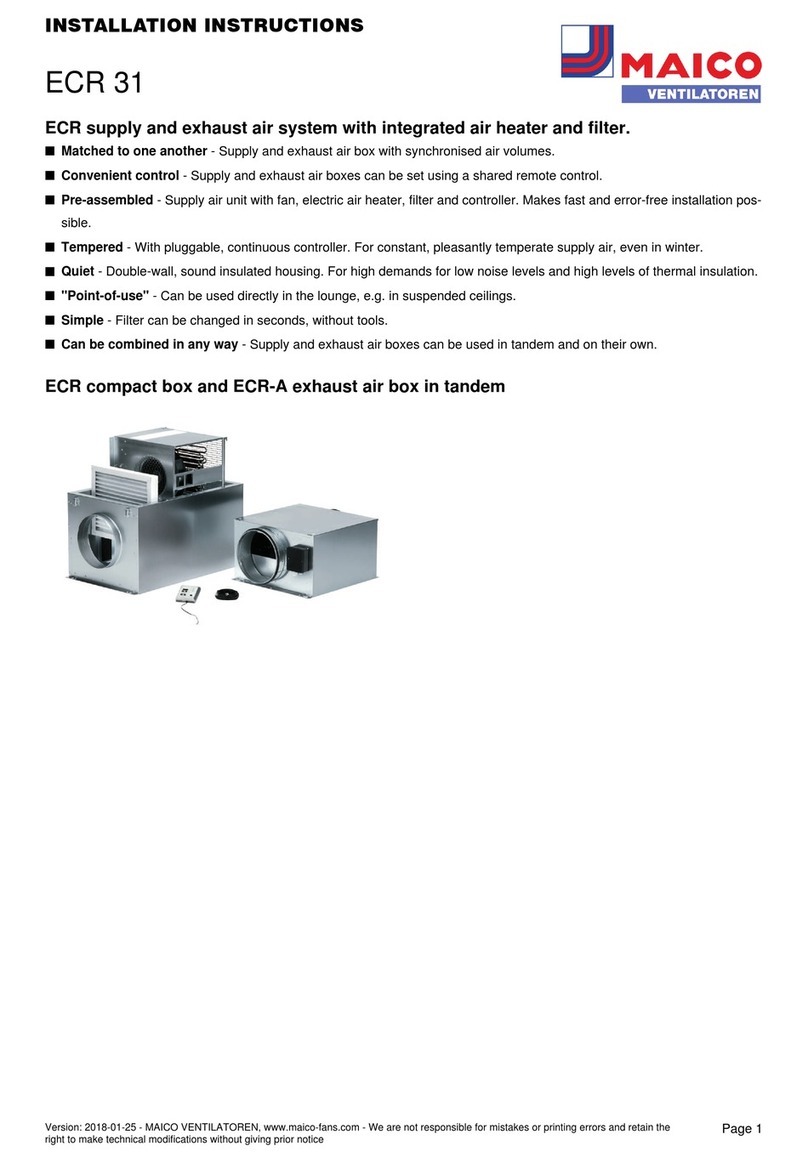
GELTENDEN BAUVORSCHRIFTEN.
3. SÄMTLICHE INSTALLATIONSARBEITEN MÜSSEN VON EINEM QUALIFIZIERTEN ELEKTRIKER ÜBERWACHT WERDEN.
4. DIESE GERÄTE SIND FÜR DIE FESTVERDRAHTUNG AUSGELEGT.
5. ÜBERPRÜFEN SIE, DASS DIE AUF DEM VENTILATOR ANGEGEBENEN ELEKTRISCHEN BETRIEBSWERTE MIT DER NETZVERSORGUNG
ÜBEREINSTIMMEN.
6. WARNUNG: DIESE GERÄTE MÜSSEN GEERDET WERDEN.
7. NICHT IN DER NÄHE VON DIREKTEN WÄRMEQUELLEN AUFSTELLEN (Z. B. GASHERD ODER EINEM AUF AUGENHÖHE INSTALLIERTEN GRILL)
UND NICHT AN ORTEN, AN DENEN DIE UMGEBUNGSTEMPERATUR 50°C ÜBERSCHREITEN KANN.
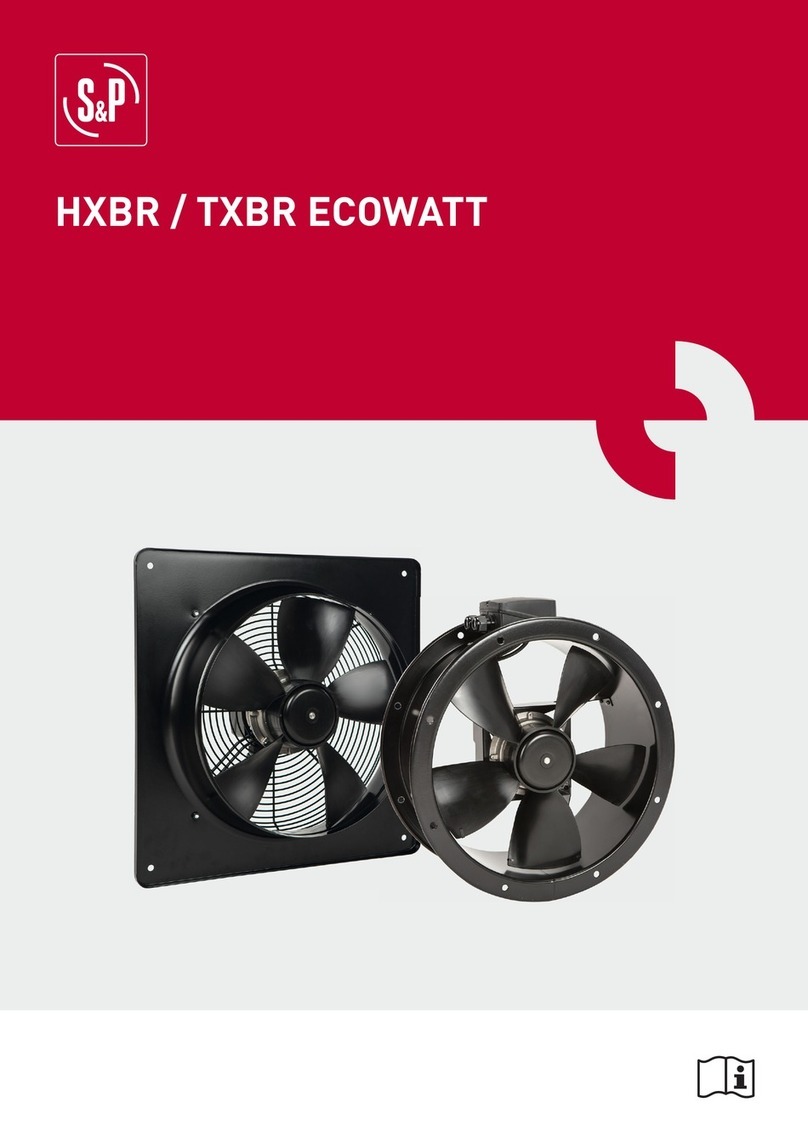
8. WIRDDERVENTILATORINEINEMRAUMINSTALLIERT,INDEMSICHEIN BRENNSTOFFBRENNERBEFINDET,MÜSSENVORSICHTSMASSNAHMEN
GETROFFEN WERDEN UM ZU VERHINDERN, DASS GASE AUS DEM OFFENEN ABZUG DES BRENNERS IN DEN RAUM ZURÜCKSTRÖMEN.
9. BEI INSTALLATION, BETRIEB UND WARTUNG DIESES VENTILATORS MÜSSEN ALLE ENTSPRECHENDEN SICHERHEITSVORKEHRUNGEN
(KORREKTER AUGENSCHUTZ UND SCHUTZKLEIDUNG USW.) GETROFFEN WERDEN.
10. ALLGEMEINE RICHTLINIEN FÜR DIE MONTAGEPOSITION DES VENTILATORS SIND ABB. G ZU ENTNEHMEN. DEN VENTILATOR
GRUNDSÄTZLICH SO HOCH WIE MÖGLICH MONTIEREN.
11. WENN EIN TEIL DER LÜFTUNGSROHRLEITUNG HÖHER ALS DER VENTILATOR GEFÜHRT WIRD, MUSS EIN KONDENSATABLAUF (XCT100)
MÖGLICHST NAHE AM VENTILATOR BEFESTIGT WERDEN.
12. DIESES GERÄT IST NICHT ZUR BENUTZUNG DURCH PERSONEN (EINSCHLIESSLICH KINDER, ALTER UND SCHWACHER MENSCHEN)
MIT EINGESCHRÄNKTEN KÖRPERLICHEN, SENSORISCHEN ODER GEISTIGEN FÄHIGKEITEN ODER MIT MANGELNDER ERFAHRUNG UND
KENNTNIS VORGESEHEN, ES SEI DENN, DIESE PERSONEN STEHEN UNTER AUFSICHT ODER HABEN VON EINER FÜR IHRE SICHERHEIT
VERANTWORTLICHE PERSON EINE ANLEITUNG ZUR BENUTZUNG DES GERÄTS ERHALTEN. KINDER MÜSSEN BEAUFSICHTIGT WERDEN,
DAMIT SICHERGESTELLT IST, DASS SIE NICHT MIT DEM GERÄT SPIELEN.
7. Rundzapfen
8. Klemmschrauben und Dübel, 3 Stck.
9. Abzugskörperklemmen, 3 Stck.
10. Einfassung
11. Deckenschrauben, 25 mm lang, 4 Stck. (Abb. B)
12. Schaumband
1. Die Abzugskörperklemmen SIND NICHT geeignet. Fertigen Sie einen
Holzrahmen mit den Innenmaßen 203 x 233 mm. Die Tiefe muss mindestens
50 mm betragen. Befestigen Sie den Holzrahmen in der Innenwand und
reparieren Sie das Loch.
2. Halten Sie den Abzugskasten 6an die Wand.
3. Schrauben Sie den Abzugskasten 6am Holzrahmen mit Hilfe der Schlitze im
Flansch fest (Schrauben sind nicht mitgeliefert).
Deckenmontage (Einsatz)
1. Die Einfassung 0ist nicht erforderlich.
2. Setzen Sie den Abzugskasten 6in das Loch und markieren Sie die vier Stellen
mit Hilfe der Schlitze im Flansch B.
3. Nehmen Sie den Abzugskasten 6von der Decke ab und befestigen Sie die vier
Deckenklammern (mitgeliefert) über dem Lochrand, so dass die Klammern der
Markierung an der Decke Bentsprechen.
4. Bohren Sie vier Führungslöcher in die Decke durch das Loch in jeder Klammer.
Achten Sie darauf, dass Sie die Klammer nicht beschädigen.
5. Befestigen Sie das Rohr am Rundzapfen 7.
6. Halten Sie den Abzugskasten 6an die Decke.
7. Schlitzen Sie die Durchgangstülle auf. Schieben Sie nun die Kabel in den
Abzugskasten 6durch das vordere Kabelloch. Achten Sie darauf, das die
Durchgangstülle richtig sitzt und gut befestigt ist.
8. Befestigen Sie mit Hilfe der Schrauben
!¡
(Abb. B) den Abzugskastenflansch
an den Deckenklammern.
Rohrabbruch/Rohrabschluss
Befestigen Sie ein Außengitter (z.B. CFWG100, bei DX200/DX200T nicht mitgeliefert)
an der Außenwand. Bei Deckenmontage verwenden Sie bitte das entsprechende
Zubehör (nicht mitgeliefert).
Elektrische Installation
WARNUNG! DIESES GERÄT MUSS GEERDET WERDEN
1. Unterbrechen Sie die Stromzufuhr und entfernen Sie alle Sicherungen. Der
Anschlussblock ist für Kabel bis zu 1,5 mm2geeignet.
2. Verwenden Sie einen zweipoligen Isolierschalter mit einem
Mindest kontakt abstand von 3 mm an beiden Polen.
3. Verwenden Sie je nach Anwendung das entsprechende Dreiader- bzw.
Vieraderkabel.
4. Entfernen Sie die Befestigungsschrauben an der Anschlussblockabdeckung,
falls noch in Position.
5. Verdrahten Sie den Abzug mit Hilfe der Kabelklemme wie in Fgezeigt. Prüfen
Sie das Abzugsmodell und die Zeichnung.
DX200: „LH" = Live / stromführend (hohe Geschwindigkeit) / „LL" = Live/
stromführend (niedrige Geschwindigkeit).
6. Setzen Sie die Anschlussblockabdeckung 5wieder auf und ziehen Sie die
Schrauben an.
7. Falls Sie die im Werk vorgenommenen Einstellungen ändern möchten, lesen Sie
bitte den Abschnitt „Einstellung durch den Benutzer".
8. Setzen Sie die vordere Abdeckung wieder auf (Abb. C).
9. Schließen Sie das Kabel vom Isolierschalter an die elektrischen Stromkabel an
und prüfen Sie die Installation.
10. Setzen Sie die Sicherungen wieder ein, bevor Sie die Stromzufuhr einschalten.
11. Bei festen Kreisen darf die Schutzsicherung nicht über 5A liegen.
Nur für Australien
CF20 – Der Anschluss an die Stromzufuhr erfolgt über flexible Dreiaderkabel mit
dreipoligem Stecker zum Einschub in zulässige Wandschalter mit 10A und
mindestens 3 mm Zwischenraum zwischen den Kontakten.
Alle anderen Länder – Permanenter Anschluss an das Netz und fernbedienter
Schalter. Die Verdrahtung zum Netz erfolgt über zulässige Wandschalter mit 10 A und
mindestens 3 mm Zwischenraum zwischen den Kontakten.
Einstellungen durch den Benutzer
Bevor Sie irgend etwas verstellen, trennen Sie bitte den Abzug komplett von der
Stromzufuhr und prüfen Sie die nachstehenden Angaben, um zu sehen, was für
Sie zutrifft.
1. Nehmen Sie die Frontabdeckung ab und setzen Sie diese nach dem Verstellen
wieder auf (Abb. C).
DX200
Für diesen Abzug gibt es keine Verstellmöglichkeiten.
DX200T
1. Die Überlaufzeit für den Timer lässt sich etwa von 30 Sekunden bis 20 Minuten
verstellen. Verwenden Sie einen Elektrikerschraubenzieher und drehen Sie die
Schraube „T" (Abb.D) im Uhrzeigersinn, wenn Sie die Dauer erhöhen und
gegen den Uhrzeigersinn, wenn Sie diese senken möchten. (Werkseinstellung:
etwa 10 Minuten).
CF20
2. Die Einstellung der Feuchtigkeit variiert etwa zwischen 50% und 90% relativer
Feuchtigkeit. Verwenden Sie einen Elektrikerschraubenzieher und drehen Sie die
Schraube „RH" (Abb. D) im Uhrzeigersinn, wenn Sie die relative Feuchtigkeit
erhöhen und gegen den Uhrzeigersinn, wenn Sie diese senken möchten. (Bitte
beachten Sie: der Abzug reagiert bei 50% relativer Feuchtigkeit empfindlicher als
bei 90%. Werkseinstellung: etwa 70%).
CF20T
1. Die Überlaufzeit für den Timer lässt sich etwa von 30 Sekunden bis 20 Minuten
verstellen. Verwenden Sie einen Elektrikerschraubenzieher und drehen Sie die
Schraube „T" (Abb. D) im Uhrzeigersinn, wenn Sie die Dauer erhöhen und
gegen den Uhrzeigersinn, wenn Sie diese senken möchten.
2. Die Einstellung der Feuchtigkeit variiert etwa zwischen 50% und 90% relativer
Feuchtigkeit. Verwenden Sie einen Elektrikerschraubenzieher und drehen Sie
die Schraube „RH" (Abb. D) im Uhrzeigersinn, wenn Sie die relative
Feuchtigkeit erhöhen und gegen den Uhrzeigersinn, wenn Sie diese senken
möchten. (Bitte beachten Sie: der Abzug reagiert bei 50% relativer Feuchtigkeit
empfindlicher als bei 90%).
Betätigung des Abzugs
DX200
Den Abzug betätigen Sie mit dem EIN/AUS-Schalter. Wiederholen und ausschalten.
Die Geschwindigkeit wird vom Installateur entweder auf hoch oder niedrig eingestellt.
(Falls ein Schalter zum Wechseln installiert ist, kann der Benutzer selbst von hoch
nach niedrig und umgekehrt schalten).
DX200T
Den Abzug betätigen Sie mit dem EIN/AUS-Schalter. Wiederholen und ausschalten.
Wenn der Schalter ausgeschaltet ist, läuft der Abzug noch während der eingestellten
Überlaufzeit weiter. Die obere Lampe „I" ist eingeschaltet, wenn der externe EIN/AUS-
Schalter eingeschaltet ist. Die Geschwindigkeit wird vom Installateur auf hoch, mittel
oder niedrig eingestellt.
Startverzögerung ein oder aus
Diese Einstellung erfolgt durch den Installateur auf 2 Minuten Verzögerung beim
Einschalten, sofern ein externer EIN/AUS-Schalter verwendet wird.
CF20/CF20T
Schalterbetrieb
Der Abzug kann mit einem separaten EIN/AUS-Schalter versehen werden. Der Abzug
läuft auf Kondensationsgeschwindigkeit, wenn er eingeschaltet ist. Die obere Lampe
„I" ist eingeschaltet, wenn der separate EIN/AUS-Schalter eingeschaltet ist. Der
Abzug läuft nach dem Ausschalten weiter, wenn der Feuchtigkeitspegel den
eingestellten Wert übersteigt. Nur für CF20T. Der Abzug läuft nach dem Ausschalten
auf Kondensationsgeschwindigkeit während der Überlaufzeit des Timers weiter.
Kondensationsbetrieb
Der Abzug läuft auf Kondensationskontrollgeschwindigkeit, wenn die relative
Feuchtigkeit den eingestellten Wert übersteigt, und er schaltet sich ab, wenn der
Feuchtigkeitspegel sinkt.
Verstärkter Betrieb
Der integrierte Schalter mit Zugschnur schaltet den Abzug auf die richtige
Geschwindigkeit ein. Die untere Lampe „II" ist eingeschaltet, wenn der Abzug mit
hoher Geschwindigkeit läuft. Bitte beachten: Wenn sowohl der separate EIN/AUS-
Schalter als auch der integrierte Zugschalter eingeschaltet sind, so sind auch die
beiden Lampen „I" und „II" eingeschaltet und der Abzug läuft auf hoher
Geschwindigkeit.
Nur CF20T
Verzögerung ein oder aus
Der Installateur stellt eine Verzögerung von 2 Minuten ein, wenn der Abzug mit dem
separaten EIN/AUS-Schalter gestartet wird.
Reinigung
Vor dem Reinigen stets die Stromzufuhr komplett ausschalten!
Reinigen Sie die Außenfläche des Abzugs nur mit einem feuchten, lintfreien Tuch.
Verwenden Sie keine scharfen Reinigungs- oder Lösungsmittel bzw. chemische Mittel.
Lassen Sie den Abzug gut abtrocknen, bevor Sie ihn einschalten. Außer der
Reinigung ist keine ständige Wartung erforderlich.
Schlüssel Siehe Abbildung E
1. Ablenkplatte
2. Frontabdeckung
3. Gebläserad
4. Befestigungsschrauben
5. Anschlussabdeckung
6. Abzugskasten
BITTE BEWAHREN SIE DIESES HEFT FÜR DEN BENUTZER IN DER NÄHE DES
ABZUGS AUF.
2. Eine Vorrichtung zur Trennung aller Pole muss gemäß den
Verdrahtungsvorschriften in die Festverdrahtung integriert werden.
!"#$%&'($)*%+,-./*%012$3452.678+6$9:;0<=>$3&?@+AB$3C0D&-*=E0F3,?$1GH?@+2$9%AI .