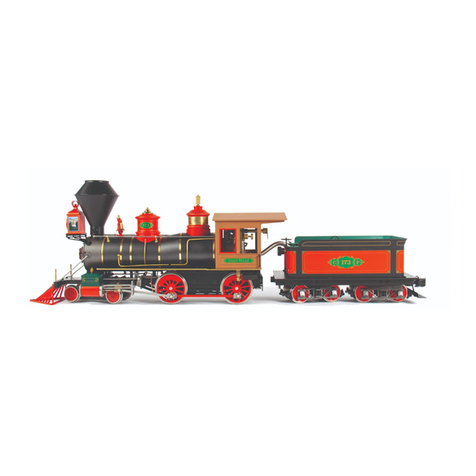
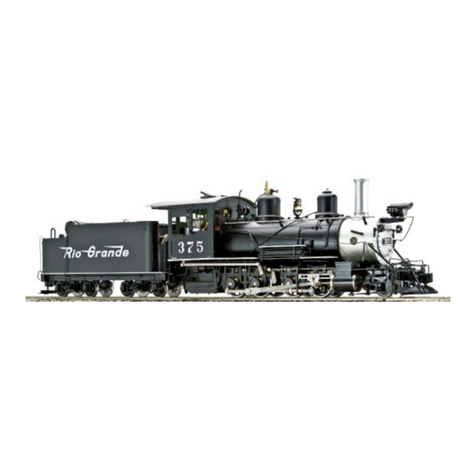
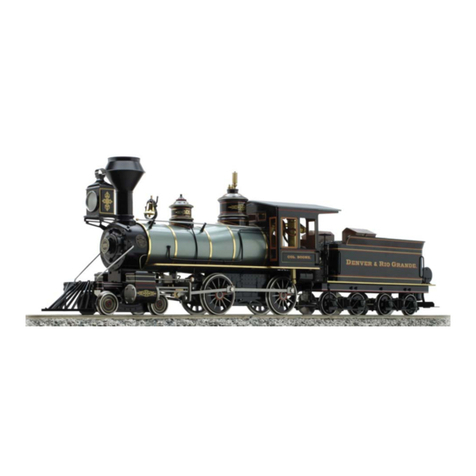
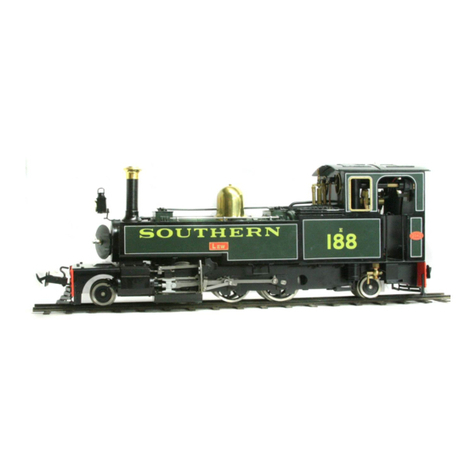
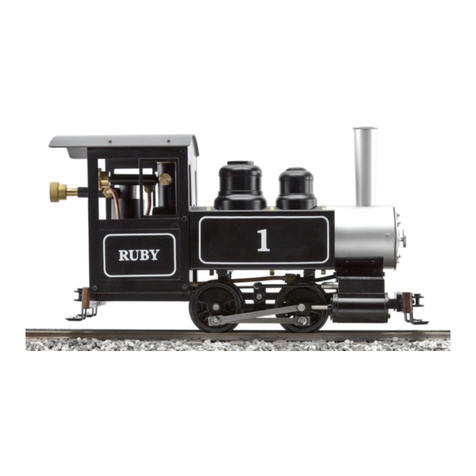
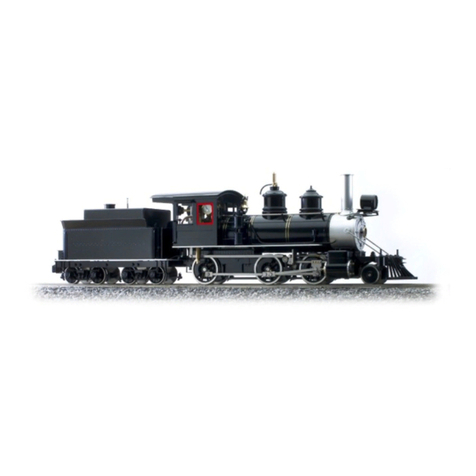
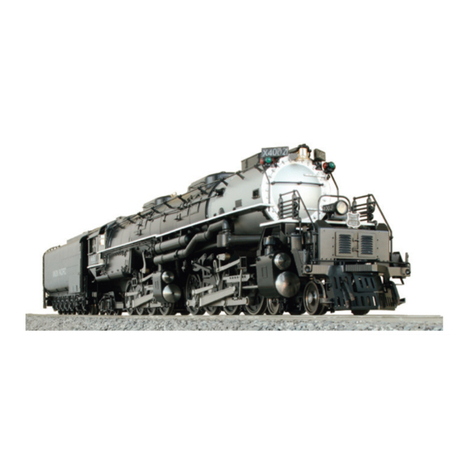
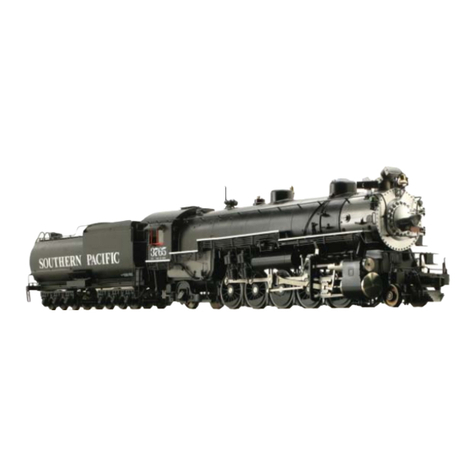
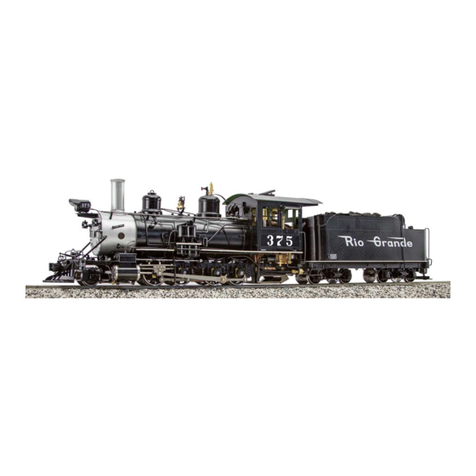
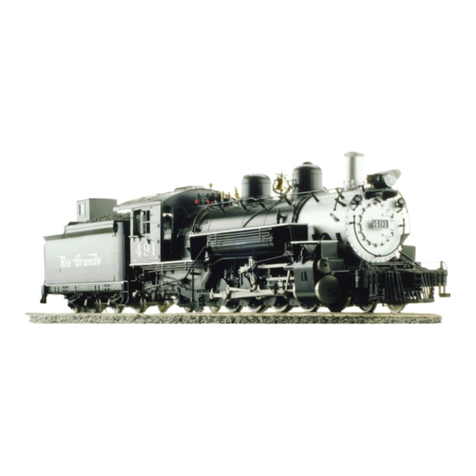
D&RGW K-28 COAL FIRED MANUAL
5
Included with these instructions, as an addendum, are several published articles that have appeared in various
magazines and elsewhere. They are included with permission from their respective authors, and we thoroughly
suggest that you read them as well as these instructions.
Introduction To Coal Firing
Coal ring a locomotive is a dynamic, interactive, process; quite unlike ring with butane. The best way to ap-
proach it is to envision yourself as both reman and engineer in the cab of a steam locomotive at the turn of the
century. The engineer’s duty can be likened to that of an orchestra conductor, coordinating the many elements
necessary to create harmony from what would otherwise be chaos. The reman, on the other hand, is like the rst
chair violin position, or concertmaster, setting the tone, style and rhythmic reliability of the production. While the
engineer was in charge of the throttle, Johnston bar, brakes and progress of the locomotive, the reman held it all
together; tending to the needs of the locomotive’s heart and soul, the boiler. The reman was always alert to the
processes taking place and the need to address continuously changing situations.
The following statement is taken from the “Handbook For Railway Steam Locomotive Enginemen.”
“The duty of the locomotive reman is to provide an adequate supply of steam at all times, and to match these
requirements to the needs of the road and the engineer, so as to maintain the required timetable . This must be
done in such a way that the safety of the locomotive, its crew and passengers is maintained at all times.”
Failing to anticipate the needs for changes in power, as the train sped up, climbed hills, slowed down, or stopped
at stations, could result in delays and boiler damage, wrecks and explosions.
To this end, maintaining a proper level of combustion in the re box and adequate water over the crown sheet
were paramount on the reman’s mind.
About Your Boiler
A good place to begin the ring process is to have a thorough understanding of your locomotives boiler and how it
behaves. The boiler in your locomotive duplicates a full size boiler in all aspects, including signicant areas of at
surface. Construction includes 8 re tubes and 1 ue, a water legged rebox, a anged steam dome, 5 bushings
for mounting various ttings and a pass through for the blower pipe.
The major at surfaces are the rebox front, sides and top, the boiler front sheet and the at outside portions of
the boiler wrapper surrounding the rebox. The rebox is surrounded by water legs on 3 sides, the back being
dry. These at surface water legs are supported against the internal pressures by copper rods or stays tying them
to each other. The top of the rebox, or crown sheet, also basically at, is supported from collapsing by vertical
plates that connect it to the outer shell, or wrapper. The front of the rebox, or rear ue sheet, and the front of the
boiler, or front ue sheet, are supported against boiler pressure by being connected to each other with the tubes
and ue. The barrel of the boiler, being spherical, is self supporting within the limits of its design strength.
Several of these boiler plates are anged and all are assembled using a high strength, high temperature, silver
bearing brazing compound. To maintain joint strength, those boiler plates exposed to the combustion process,
and more particularly the crown sheet, must be in direct contact with and covered at all times by the water in the
boiler. This means WATER LEVEL IS CRITICAL. To this end , the locomotive is equipped with an axle pump ,
hand pump and Goodall valve, and can also be optionally tted with an injector. It should be noted that injectors
in smaller sizes are notoriously nicky devices, not generally reliable, and should NEVER BE RELIED ON for criti-
cal boiler feed .
The K-28 conversion boiler is designed to function at a working pressure between 60 and 75 pounds per square
inch. This pressure is continuously trying to collapse the crown sheet and inner rebox sides. The water level
must be maintained above a point equivalent to the bottom edge of the blower pass through pipe at all times. The
lower working limit for water level is the TOP OF THE RED LINE scribed on the water gauge. The installed axle