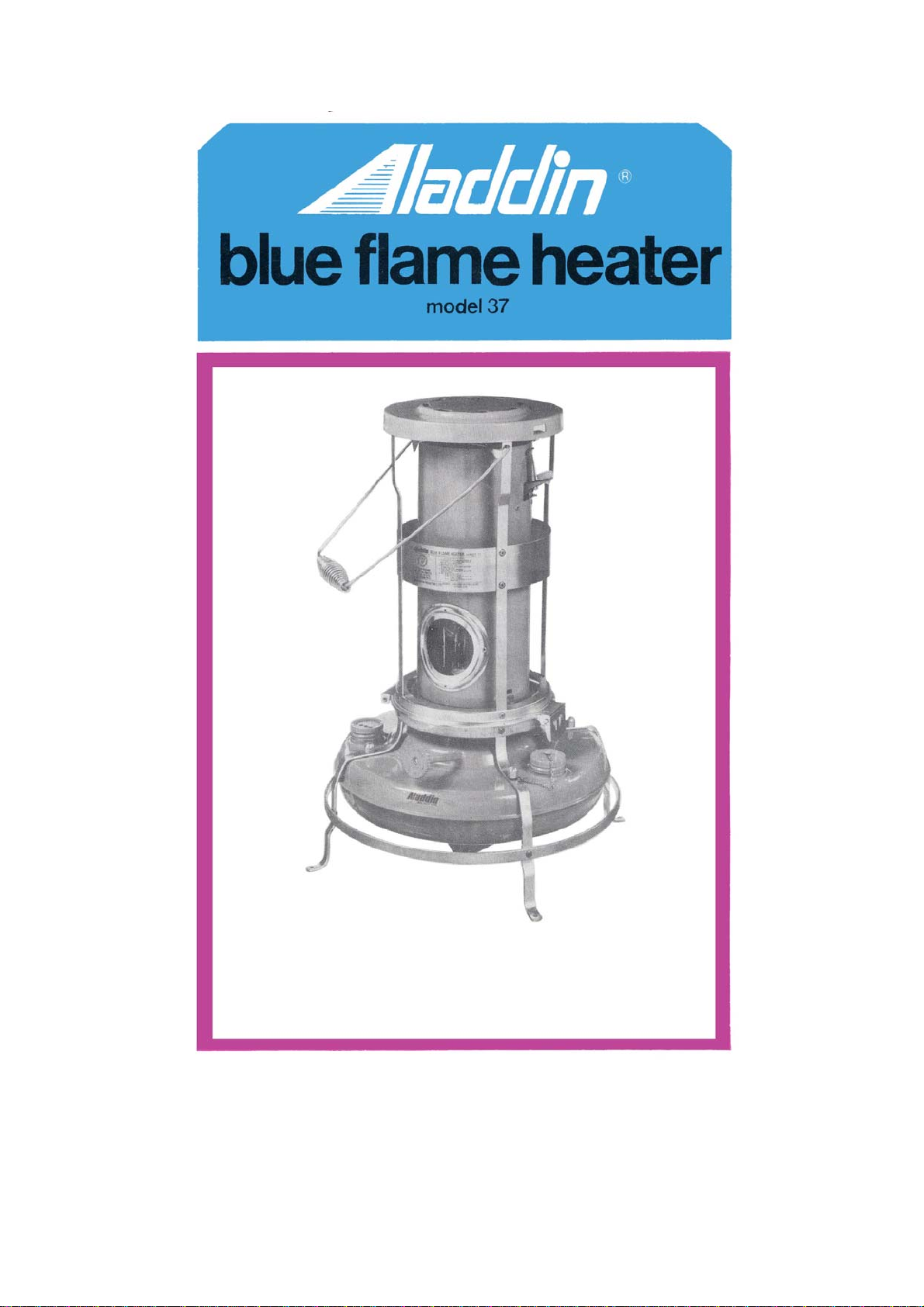
gauge after the needle has reached the full symbol “W” and fill the tank to its
maximum capacity. This must be done carefully to avoid over-filling--the level
of paraffin must not rise above the bottom of the filler neck.
The oil gauge also indicates when the heater needs refilling. Do not allow the
heater to burn dry thus causing the wick to smoulder which will shorten the life
of the wick and lessen performance.
LIGHTING
When you use the heater for the first time, or have fitted a new wick, do not
light it for at least an hour so that the wick has a chance to soak up enough
paraffin. Release the clip and swing open the chimney. Check that the flame
spreader (P.329900), which has a large number of small holes in it, is fitted in
the centre tube of the tank. If it has fallen out or is not seated properly it must
be replaced and pushed fully home before the heater is lit. Make sure the
burner basket (P.151000) is locked fully into the tank. The wick winder “W”
turns clockwise to raise the wick (P.169901). With just enough wick showing
(you should still see five rows of holes on the flame spreader), light the wick
all the way around and then press the extinguisher resetting lever down and
hold it down whilst closing the heater, checking carefully that the spring clip is
properly fastened. Release the resetting lever, leaving it in the down position.
If the lever is not left in the down position the heater will be extinguished as
soon as the lever is released. The burner reaches working temperature very
quickly, so you should Immediately adjust the wick to give you the required
heat within the limits of the SAFE BLUE FLAME.
THE SAFE BLUE FLAME
Remember that your safety indicator is the colour of the flame. When the
flame is a clear blue all over you have got the SAFE BLUE FLAME. When the
flame shows any yellow the wick is too high or too low or something is wrong
with the heater never letthe heater burn like this—it could cause smoking.
This visual safety indicator is so important and so simple to use that a little
practice at first will amply repay you. Short periods of yellow flame are not
dangerous so you can safely try the settings for yourself.
Turn the wick winder anti-clockwise CN until the heater is almost out and you
will get aflickering yellow edge to the flame; this is too low. Raise the wick until
a completely blue flame is obtained and then raise a little more so that it
cannot revert to yellow; this is the lowest setting for the SAFE BLUE FLAME.
As you turn the wick up more the blue flame will grow and you may notice a
reddish glow above the flame and possibly intermittent red flecks of burning
dust. This is quite normal. Eventually yellow spikes will appear at the top edge
of the flame to warn you that you have gone too far. Lower the wick until you
get rid of the yellow spikes and you now have the highest setting for the SAFE
BLUE FLAME.
LEAVING THE HEATER
As long as you have the SAFE BLUE FLAME you can confidently leave your
heater unattended, but do take a few simple precautions against accidents.
Place the heater on a level surface out of draughts and where it can’t be
knocked over. Make sure that children cannot play with it. You and the heater