EVAL-ADAU1466Z User Guide
One Technology Way •P. O . Box 9106 •Norwood, MA 02062-9106, U.S.A. •Tel: 781.329.4700 •Fax: 781.461.3113 •www.analog.com
Evaluating the ADAU1466 SigmaDSP Audio Processor
PLEASE SEE THE LAST PAGE FOR AN IMPORTANT
WARNING AND LEGAL TERMS AND CONDITIONS.Rev. 0 | Page 1 of 45
FEATURES
4 analog inputs
8 analog outputs
Stereo S/PDIF input and output
Self boot EEPROM memory
EVALUATION KIT CONTENTS
EVAL-ADAU1466Z evaluation board
EVAL-ADUSB2EBZ (USBi) communications adapter
USB cable with Mini-B plug
6 V ac to dc power supply
HARDWARE REQUIRED
PC running Windows XP, Windows Vista, or Windows 7
Analog, stereo audio source with an output cable terminated
with a 3.5 mm (1/8 inch) plug (for analog input)
Headphones, desktop speakers, or audio input with a cable
terminated with a 3.5 mm (1/8 inch) plug (for analog
output)
S/PDIF audio source and receiver, each with optical cables
terminated with TOSLINK connectors (for digital
input/output)
SOFTWARE REQUIRED
SigmaStudio software, available for download from the
SigmaStudio product page
DOCUMENTS NEEDED
ADAU1466 data sheet
AD1938 data sheet
AN-1006 Application Note
GENERAL DESCRIPTION
This user guide details the design, setup, and operation of the
EVAL -ADAU1466Z evaluation board. This device is suitable for
evaluation of, and software development for, the ADAU1466
and ADAU1462 SigmaDSP processors. Note that the ADAU1466
and the ADAU1462 are functionally identical, except that the
ADAU1466 has more program and data memory than the
ADAU1462. When using this evaluation board to evaluate the
ADAU1462, in the Setting Up Communications in SigmaStudio
section, select the ADAU1462 block rather than the ADAU1466
as shown in Figure 15. Performing this action informs the compiler
to limit the amount of memory allocated to match the ADAU1462.
All other procedures and instructions in this user guide are
identical for the ADAU1462 and ADAU1466.
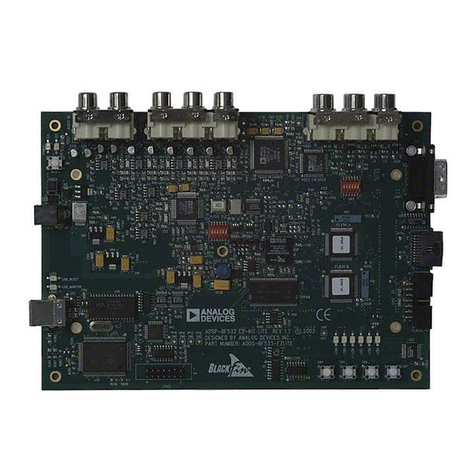
This evaluation board provides access to the digital serial audio
ports of the ADAU1466, as well as some of its general-purpose
input/outputs (GPIOs). An analog input and output is provided
by the AD1938 codec that is included in the evaluation kit. The
ADAU1466 core is programmed using Analog Devices, Inc.,
SigmaStudio® software, which interfaces to the evaluation board
via a USB interface (USBi). The on-board EEPROM can be
programmed for self boot mode. The evaluation board is powered
by a 6 V dc supply, which is regulated to the voltages required
on the board. The printed circuit board (PCB) is a 4-layer design,
with a ground plane and a power plane on the inner layers. The
evaluation board includes connectors for external analog inputs
and outputs, and optical Sony/Philips Digital Interface (S/PDIF)
interfaces. The master clock is provided by the integrated oscillator
circuit and the on-board 12.288 MHz passive crystal.
For full details, see the ADAU1466 and AD1938 data sheets,
which must be used in conjunction with this user guide when
using the evaluation board.