
Axiris Marcel User manual

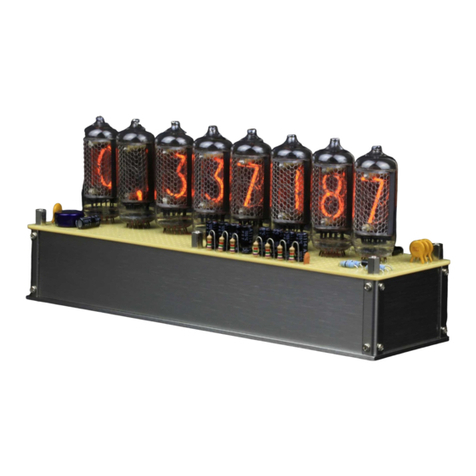
Nixie Clock Marcel
User Manual
May 2011

Safety Precautions
Do not power on the clock when tubes are damaged or missing.
Use the power supply that came with the clock, or use a power supply that's compliant
with the technical specifications of the clock.
Do not expose the clock to rain or moisture. Do not put the clock in sunlight for a long
time. Do not expose the clock to high temperatures. Do not co er the clock.
Always clean the clock with a dry or ery slighty damp cloth. Do not use any detergents.
Be careful while touching the tubes, esp. the nozzle at the top. Power off the clock before
cleaning. The clock must be completely dry when it's powered on.
Do not subject the clock to mechanical shocks. A oid any mechanical shocks to the tubes
and to the top of the tubes in particular.
Keep out of reach of children.
Technical Information
Power supply 12 VDC, 500 mA
Power consumption 3 W max.
DC-connector
Dimensions 138 mm x 63 mm x 68 mm (W x D x H)
Nixie Tubes IN-16
Background light Depends on the clock's configuration:
▪Cyan LEDs
▪Ocean green LEDs
▪RGB LEDs with automatically changing colors
Time format ▪12 hour format
▪24 hour format
Date format ▪DD-MM-YY (day-month-year)
▪MM-DD-YY (month-day-year)
Alarm snoo e time 1..9 minutes
Backup power 30 minutes
Durability Tubes ▪Tube life sa ing mode with adjustable brightness (to pre ent wearing
out)
▪Periodical animations (to pre ent cathode poisioning)
2 User Manual
Adjusting the Clock's Precision
Option 10 in the option mode allows you to adjust the clock's precision. If you decrease
the alue by one, the clock runs approx. 1.3 s slower per month. If you increase the
alue by one, the clock runs approx. 1.3 s faster per month.
In order to adjust the clock's precision you ha e to determine how much time the clock
de iates o er a period of time. Use a reference clock to this purpose. Examples of a
reference clock include a GPS clock and the clock on the Teletext pages.
Measure the period in hours and the de iation in seconds. The de iation is positi e when
the clock runs too fast, it is negati e when the clock runs too slow. When you determine
the de iation, you must only take whole seconds into account disregarding any fractional
part.
Once you' e determined the alues for the period and the de iation, use the following
formula to calculate the adjustment:
adjustment = − (de iation × 550 ÷ period)
Example
Suppose the clock runs 2 seconds behind o er a period of 72 hours. Hence the de iation
is -2 s. According to the formula, the adjustment is −(−2 × 550 ÷ 72) = ~15. In order
to adjust the clock's precision, you'll ha e to add 15 to the alue of option 10 in the
option mode.
Contact Information
Official website: http://www.axiris.be/
User Manual 7

Tubes Animation Method
option
▪0: No animation
▪1: Cycling digits e ery minute
▪2: Wa ing digits e ery minute
▪3: Cycling digits e ery 10 min.
▪4: Cycling digits e ery hour
▪5: Cycling digits at midnight
Cycling Digits
option
▪1: Left to right
▪2: Right to left
▪3: All tubes at once
▪4: Random
Brightness
option
▪1..10: Minimal to maximal
Clock's Precision
option
Press SET/ALARM to increment
the alue by one.
Press ADJ/SNOOZE to decrement
the alue by one.
Alarm Tone
option
▪1..9: Fast to slow pace
▪10: No alarm tone
Brightness of Tube Saving Mode
option
▪0: Off
▪1..10: Minimal to maximal
Start of Tube Saving Mode
option
▪00..23: Midnight to 23 hours
Duration of Tube Saving Mode
option
▪00: No sa ing mode
▪01..23: Acti e hours
▪24: Sa ing mode always acti e
6 User Manual
Installation
Connect the DC plug of the power supply to the DC connector on the back of the clock.
Plug the power supply into a power socket. The clock is now powered on.
Please note there's no ON/OFF switch. To power off the clock remo e the power supply
from the power socket and/or disconnect the DC connector from the clock.
After you' e powered on the clock, the clock will show the display mode.
When you power off the clock, the clock will remember all settings for approximately 30
minutes. All settings will be lost thereafter, meaning you'll ha e to set up again after
powering on the clock.
Control Panel
Turn the knob LED to control the brightness of the background lightning. The brightness
aries from no light at all to maximal intensity.
The meaning of the buttons MODE/OPTION, SET/ALARM and ADJ/SNOOZE depends
on the clock's current mode.
You can operate the buttons MODE/OPTION and SET/ALARM in two ways:
▪Push briefly: Push the button and release immediately. This operation is called
pushing the button.
▪Hold: Push the button for at least one second and release afterwards. This operation
is called holding the button.
User Manual 3

Display Mode
Push MODE/OPTION to show time, alarm and date.
Push SET/ALARM to turn on or off the alarm. An orange dot in the right tube indicates
whether the alarm is turned on. When the alarm goes off push SET/ALARM to stop the
alarm.
Push ADJ/SNOOZE to show the current date for a number of seconds. When the alarm
goes off push ADJ/SNOOZE to snooze. The alarm will go off again after the snooze time
has expired.
Hold MODE/OPTION to acti ate the option mode.
Hold SET/ALARM to acti ate the setup mode.
Setup Mode
Setup mode allows you to set the time, the alarm and the date.
Push MODE/OPTION to cycle through the arious settings:
time ► alarm ► date ► back to display mode
Push SET/ALARM to step through the arious alues of a setting. The currently selected
alue flashes. Push ADJ/SNOOZE to change the alue.
Time
hours minutes seconds
Alarm
hours minutes snooze
Snooze time is expressed in minutes
Date
Date format DD-MM-YY
day month year
Date format MM-DD-YY
month day year
4 User Manual
Option Mode
Option mode allows you to change arious settings of the clock. Press MODE/OPTION
to step through the a ailable options. The alue of the currently selected option flashes.
Push ADJ/SNOOZE to change the alue.
The clock will re ert to display mode when you don't push any button for at least fifteen
seconds.
Time Format
option alue
▪12: 12 hour format
▪24: 24 hour format
eading Zero
option
▪0: Disabled
▪1: Enabled
Digit Cross Fading
option
Digit cross fading in the tubes:
▪0: Disabled
▪1..9: Fast (1) to slow (9)
Date Format
option
▪1: DD-MM-YY (day-month-year)
▪2: MM-DD-YY (month-day-year)
Display Date
option
Automatically show date:
▪0: Disabled
▪1: At 00/10/20/30/40/50 sec.
▪2: At 00/20/40 seconds
▪3: At 00/30 seconds
▪4: At 40 seconds
▪5: At 50 seconds
▪6: At the top of the hour
▪7: At midnight
Date Scrolling Speed
option
▪1..4: Fast (1) to slow (4)
User Manual 5
Table of contents
Other Axiris Clock manuals
Popular Clock manuals by other brands

Silicon Laboratories
Silicon Laboratories SI5324 manual
Heathkit
Heathkit GC-1005 Assembly manual
Oregon Scientific
Oregon Scientific PRYSMA RMR221P manual
Andrew O'Malley
Andrew O'Malley DOTKLOK Assembly instructions
ALGE-Timing
ALGE-Timing ASC3 manual
Bodet
Bodet Profil 960 Installation and operating instructions


Progetti
Progetti KALIMERO Directions
La Crosse Technology
La Crosse Technology WT-3141b Quick setup instructions
La Crosse Technology
La Crosse Technology W86531 owner's manual
Sharp
Sharp SPC900 instruction manual
La Crosse Technology
La Crosse Technology 404-50447 quick start guide
Datexx
Datexx DF0063 quick guide