14 | TRIKE USER GUIDE AZUB RECUMBENTS® | www.azub.eu 15 | TRIKE USER GUIDE AZUB RECUMBENTS® | www.azub.eu
Most people new to recumbents go through three periods:
1st period – Passion: You can easily ride around the house and a few kilometers without any hills.
You feel that the recumbent is very good bike, and you wonder, “How could I ride a regular bike
so long?”
2nd period – Deep Depression: Your first trip with some hills and some more kilometers will
completely change your mind. You will have problems pedaling half of your standard distance
and the pain in your legs will be terrible, but you have to train!
3rd period – Trained: Now you are definitely a recumbent rider. You can easily cycle long
distances. Hills are no problem for you, and you again feel that recumbents are very good, fast
and comfortable bikes with many advantages and some disadvantages.
So what is the problem?
It’s simple. When riding recumbents you use some other muscles than on an upright bike, and
these muscles are not trained. It‘s the same as starting a new sport. You have to train, that‘s it.
Also you have to get used to a new style of pedaling and a new bike. That means that if you
would like to go for a long trip soon after buying your first recumbent, then we recommend that
you use your upright bike and try your recumbent for long distance after some time and training.
Also you have to notice, that you cannot use your body weight when pedaling, so you must
have well trained legs, but on the other hand, your legs will be trained much sooner and will be
stronger.
5.1.7 Riding with Cargo
With the rack and bag options that we offer, you can comfortably carry a significant load on
your trike. It’s important to keep your heavy cargo as low, forward, and centered as possible.
Remember to allow for longer stopping distances with cargo and slower cornering.
5.1.8 Riding O-Road
Your trike may not be intended for big drops or harsh descents, but depending on your tires,
it is suitable for riding many dirt or gravel roads. Be aware that with a trike you must lean into
cambered trails. On a bicycle you would do this naturally, and you can ride at an angle to the
road surface, but trikes can be unstable at high cambers before bikes would have a problem.
5.2 Living with Your Recumbent
Unfortunately not all life with your new recumbent will be spent in the driver’s seat, so this
section of the manual goes over some other aspects of owning your new trike.
Living with
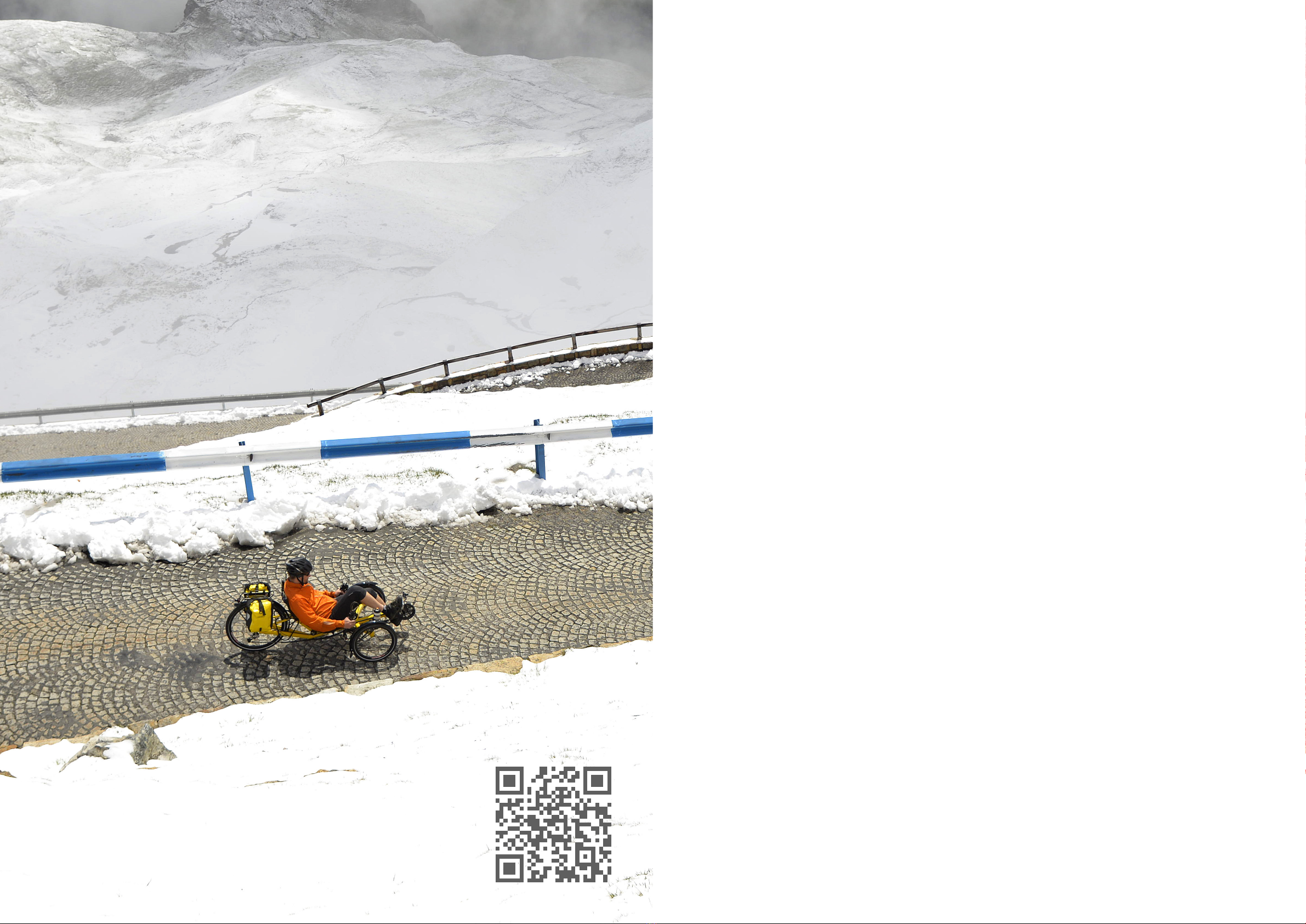
You may find it very fun to ride your trike on slippery surfaces such as ice and
snow. Trikes give you maximum stability, but remember that your stopping
distance will be much longer, and you can’t steer when your front wheels are
skidding.
Brake drums, calipers and rotors will heat up when they are used. Do not touch
them while riding or immediately after riding.
5.1.4 Shifting
It’s a good habit with every type of a bicycle to shift to a low gear before
stopping. You can then pull away easily when you start again. While riding it’s
recommended to keep your pedaling cadence between 80-100 rpm. Try to look
forward and shift before hills to avoid changing gears under pressure.
Standard shifting systems can only shift when the bike is being pedaled, but
hub gear systems can be shifted while stopped, pedaling, or coasting.
Azub trikes can be equipped with many different gearing systems. For further
information, read the manuals from their manufacturers.
5.1.5 Riding Downhill
Use caution on downhill rides. It is not unusual to reach speeds of over 70 km/h
on steep descents. You will find that you can go faster with much more
confidence once you become acclimated to the way the machine handles.
Because there is less air resistance in the recumbent position, you will go faster
than an upright bike.
5.1.6 Beginning with Recumbents
Now, everything is going well, and you can easily ride around your house or
block of flats. Perfect. You plan your first trip. Plan it carefully because you will
likely have some problems with long distances or steep hills. Riding too far
before your body is trained can result in temporary joint and muscle pain.
CAUTION!
Drum brakes can overheat on long, steep descents. If you feel the brakes
start to weaken on a descent, then stop and allow the brakes to cool
before continuing.