BNC 106H User manual


2
WARRANTY
Berkeley Nucleonics Corporation warrants all instruments, including
component parts, to be free from defects in material and workmanship,
under normal use and service for a period of one year. If repairs are
required during the warranty period, contact the factory for component
replacement or shipping instructions. Include serial number of the
instrument. This warranty is void if the unit is repaired or altered by others
than those authorized by Berkeley Nucleonics Corporation.

3
CONTENTS
Page
SECTION 1 SPECIFICATIONS 6
Model 106H Characteristics
6
SECTION 2 OPERATING INFORMATION 8
Features
8
General
8
Power Up 8
Module Installation 8
Safety Precautions 9
Warm Up Requirements 9
Troubleshooting 9
Front Panel Description 9
LED Indicator 9
Connectors 9
Rear Panel Description 10
Mainframe Operation 11
Front Panel Programming 11
Remote Programming 13
SECTION 3 THEORY OF OPERATION 14
General
14
Circuit Description
14
Module Interface 14
Laser Drivers 15
SECTION 4 MAINTENANCE AND CALIBRATION 17
Maintenance
17
Light Output Connector 17
Calibration
17
General 17
Equipment Required 17
Procedure 17

4
CONTENTS
ILLUSTRATIONS
Figure No.
Page
Frontispiece Model 106H 1064 nm Optical Module 5
1-1 Trigger and Output Pulse Timing
2-1 Safety Labels
3-1 Module Interface Block Diagram
TABLES
Table No.
Page
2-1 106H Module Default Settings 10
2-2 Menu Keys for the 106H Module 12
3-1 P8, Module Interface Signals 14
3-2 Plug-In Module Memory Map 16

5
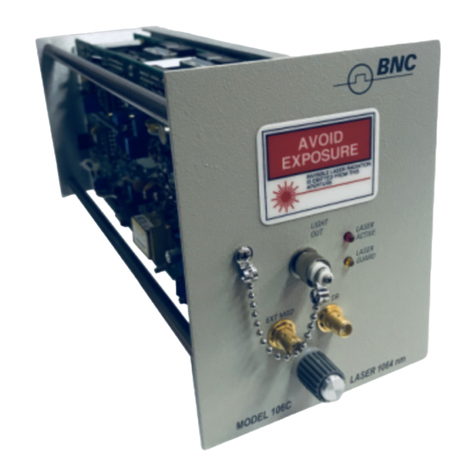
1064 NM OPTICAL MODULE
MODEL 106H
Graphic (Model 106H)
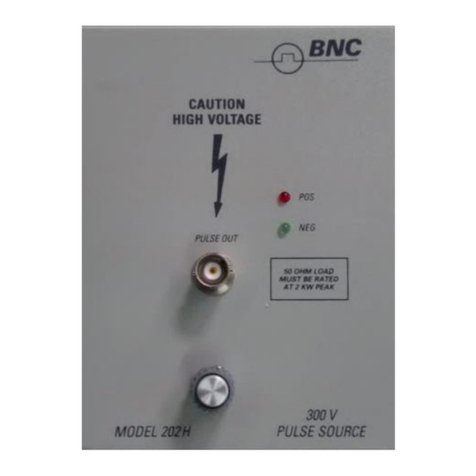
The Model 106H is one of a series of output plug-in modules that provide electrical and optical pulses
when installed in the Model 6040 mainframe.
This particular module provides optical pulses of 1064 nm wavelength at peak levels to 50 mW at rates
to 2 kHz.

6
SECTION 1
SPECIFICATIONS
MODEL 106H CHARACTERISTICS
Timing Characteristics
Rep Rate: 0.01 Hz - 2 kHz.
Delay: 0 - 640 s (Single Pulse operation),
500 s - 640 s (Double Pulse operation).
Width: Four fixed output widths, 10 ns, 15 ns, 20 ns and 25 ns
(contact factory for custom widths).
Output Characteristics
LIGHT OUT
Source: Laser diode.
Wavelength: 1064 nm.
Spectral Width: 4 nm typical, 10 nm max.
Power Level: 50 mW max., 5 mW min. (Peak level). Baseline level is
fixed at zero.
Power Level Resolution: 0.2 mW.
Extinction Ratio:
Pulse Adjustment Range: (Max. pulse size: min. pulse size) 10 dB,
Rise Time: 3ns.
Fall Time: 5ns.
Insertion Delay: 20 ns typical (between mainframe TRIG OUT and LIGHT
OUT; see Figure 1-1).
Jitter: 100 ps rms (between mainframe TRIG OUT and LIGHT
OUT).
Connector: SMA 100/140 um glass fiber.
PULSE OUT
Amplitude: +5 V into 50 ohms.
Transition Times: 1.5 ns.
Insertion Delay: 10 ns typical (between mainframe TRIG OUT and
module PULSE OUT; see Figure 1-1).

7
SPECIFICATIONS
Modes
The Model 106H can operate under the following mainframe Mode.
PULSE Conventional pulse generator operation with rate,
delay, width (four width selections) and single/double pulse
operation controlled by the 6040 mainframe.
Module Memory Control
Nonvolatile memory (RAM and ROM) stores front panel settings and determines the allowable signals,
modes and units.
STORAGE: Ten complete settings can be saved in module memory
and retrieved by the mainframe. The setting in memory 0 is
automatically transferred into the mainframe upon insertion
of the module,
General
DIMENSIONS: 3.75" W
4.9" H
10" D (95 mm
124 mm
254 mm).
WEIGHT: 2 lbs, net (0.9 kg); 7 lbs, shipping (3.2 kg).
AMBIENT TEMPERATURE: 0° - 50° C operating temperature (32° -112° F).
Specifications apply 10° - 40° C (50° -104° F).

8
SECTION 2
OPERATING INFORMATION
FEATURES
The Model 106H plug-in module provides a 1064 nm laser diode optical output source for the Model
6040 Universal Pulse Generator, The 106H operates only in the Pulse Mode of the 6040 mainframe. It
supplies flat-topped pulses with fast rise and fall times and adjustable Peak level. Baseline level is fixed
at zero (no light output).
Pulse timing is generated by the mainframe. The pulse width may be chosen from four fixed selections:
10 ns, 15 ns, 20 ns, or 25 ns (contact the factory for alternate width choices). A delay can be specified
with respect to an internal trigger occurring at a selected repetition rate or with respect to an externally
supplied trigger signal (TRIG IN). In addition. Single Cycle operation allows the user to trigger the
instrument manually, using a pushbutton (or using remote programming). In each case a trigger out
signal (TRIG OUT) is provided by the 6040 for reference (see Figure 1-1). Double Pulse operation,
producing both an initial and delayed pulse out of the same jack, may be selected for any trigger choice.
For all of these timing options both optical and electrical outputs are provided. The module PULSE OUT
jack provides electrical pulses coincident with the optical output (LIGHT OUT). These +5 V (into 50 ohm)
pulses have the same width as the optical pulses produced (even when the module is provided with
alternate width options). The mainframe PULSE OUT jack also supplies +5 V electrical pulses that
correspond to the optical output pulses, provided the standard width selections (10 ns, 15 ns, 20 ns, or
25 ns) are being used. Refer to Figure 1-1 for timing diagrams of these outputs.
For more detailed information on the characteristics of the Pulse Mode and hov to control the module
from the mainframe, see the Specifications section and the 6040 manual.
General
POWER UP
When power is applied to the 6040 mainframe with a 106H module installed, the instrument settings from
the module's memory 0 are activated. The mainframe automatically checks what type of plug-in module
is in place and loads the appropriate parameters. The LCD, after shoving the mainframe's software
version number and performing a memory check, will display "106H Ver. x.x" where "x.x" is the version
number of the module.
Module Installation
The module must be installed with mainframe power off.
A module can be damaged or have its
memory corrupted if inserted or removed from the mainframe with the power on. To install the module,
simply slide it in and tighten the mount screw knob.

9
OPERATING INFORMATION
Safety Precautions
Laser light emitted from the end of a connected light fiber is invisible. Fibers should be terminated in a
system which will not allow human exposure to this radiation. Do not stare into the beam or into a beam
from a reflecting surface. Use of controls or adjustments or performance procedures other than those
specified herein may result in hazardous exposure. Safety labels attached to the module are shown in
Figure 2-1.
Always keep the LIGHT OUT connector covered with the dust cap when a fiber is not attached in order to
avoid hazardous exposure and to keep the connector as clean as possible.
Warm Up Requirements
No warm up period, other than that necessary for the mainframe itself, is required.
TROUBLESHOOTING
Follow the procedure in the Troubleshooting section of the 6040 manual. Make sure that the module is
seated correctly in the mainframe. If the module's memory has been corrupted, a cold boot will put the
module's default settings into effect (as described in the Cold Boot paragraph in the 6040 manual). Table
2-1 gives the default settings for the 106H module.
The Quick Test procedure for the mainframe may be applied to the 106H by selecting the Pulse Mode
and following the test sequence using the module's LIGHT OUT connector and an optical detector in
place of the mainframe's PULSE OUT.
Front Panel Descriptions
LED INDICATOR
The front panel LASER ACTIVE LED turns on when the instrument is in a state that can produce a light
output.
CONNECTORS
Two connectors appear on the 106H module front panel.
LIGHT OUT provides the optical output from the module. A100/140 m fiber with an SMA connector is
required (the unit can be configured for other connectors; consult the factory for details). To keep dust
out of the connector when a fiber is not attached, a dust cap is provided.

10
OPERATING INFORMATION
Table 2-1. 106H Module Default Settings.
PULSE OUT provides an electrical output from the module corresponding to the optical output from
LIGHT OUT.
When LIGHT OUT is active, PULSE OUT goes to +5 V (into 50 ohm); when LIGHT OUT is off, PULSE
OUT is at zero volts (see Figure 1-1).
Rear Panel Description
The rear panel of the 106H module has a mounting screw (for installation into the mainframe), one 40-pin
edge connector, and one SMA connector.
The 40-pin connector allows the 6040 mainframe to control and communicate with the module and also
supplies the power to the module.
The SMA (snap-on type) connector receives the high speed pulse generator DRIVE signal from the
mainframe, This signal is an ECL version of the mainframe's front panel PULSE OUT.
MODE: Pulse
TRIG: Single Cycle
(with other values set as follows)
Internal Trigger Rate = 1 kHz.
External Trigger Threshold = 0.00 V
Trigger Slope +
TIMING: Delay = 1 s
Width = "1"
Single Pulse
LEVEL: Peak = 50.0mW
GPIB/RS232: GPIB Address = 6
Baud Rate = 1200
Full Duplex
Remote Enabled
This manual suits for next models
2
Table of contents
Other BNC Control Unit manuals

Popular Control Unit manuals by other brands
Festo
Festo Compact Performance CP-FB6-E Brief description
Elo TouchSystems
Elo TouchSystems DMS-SA19P-EXTME Quick installation guide

JS Automation
JS Automation MPC3034A user manual
JAUDT
JAUDT SW GII 6406 Series Translation of the original operating instructions
Spektrum
Spektrum Air Module System manual
BOC Edwards
BOC Edwards Q Series instruction manual

KHADAS
KHADAS BT Magic quick start
Etherma
Etherma eNEXHO-IL Assembly and operating instructions
PMFoundations
PMFoundations Attenuverter Assembly guide
GEA
GEA VARIVENT Operating instruction
Walther Systemtechnik
Walther Systemtechnik VMS-05 Assembly instructions
Altronix
Altronix LINQ8PD Installation and programming manual