1.
INTRODUCTION
.Noise
is
now
recognized
as
a pollutant. The noise levels in
our
present
day jndustrial society
are
constantly increasing. High noise levels
can
result
at worst in irreparable hearing
loss,
and at best in annoyance
or
interruption
of
work,
leisure activities
and
sleep and interference
with
conversation. A
large research
effort
has
been
brought
to
bear on the problem
of
noise
pollution
to
discover the relevant parameters
for
noise measurement.
It
has
been
found
that
the human ear
has
a reduced response
to
low
and
very high
frequencies. This effect
is
produced in noise measurement
by
using a fre-
quency weighting
network
of
similar frequency response
to
the human
ear.
There
are
several
such weightings,
but
the A weighting
is
in most common
use.
A second result
has
been
that
hearing
loss
and annoyance
are
a
function
not
only
of
the noise level,
but
also the
duration
of
the exposure, thus
introducing the concept
of
Noise Dose.
For
asteady continuous noise
it
is
a
simple matter
to
define the Noise
Dose
as
being the sound level
for
the
specified duration.
Time
varying sound levels are, however, more
difficult
to
define, and
some
trading relationship between level
and
duration
must
be
specified. Such a relationship
would
allow the reduction
of
a randomly
varying sound level
to
an
equivalent continuous sound level
for
the measure-
ment duration. The
commonly
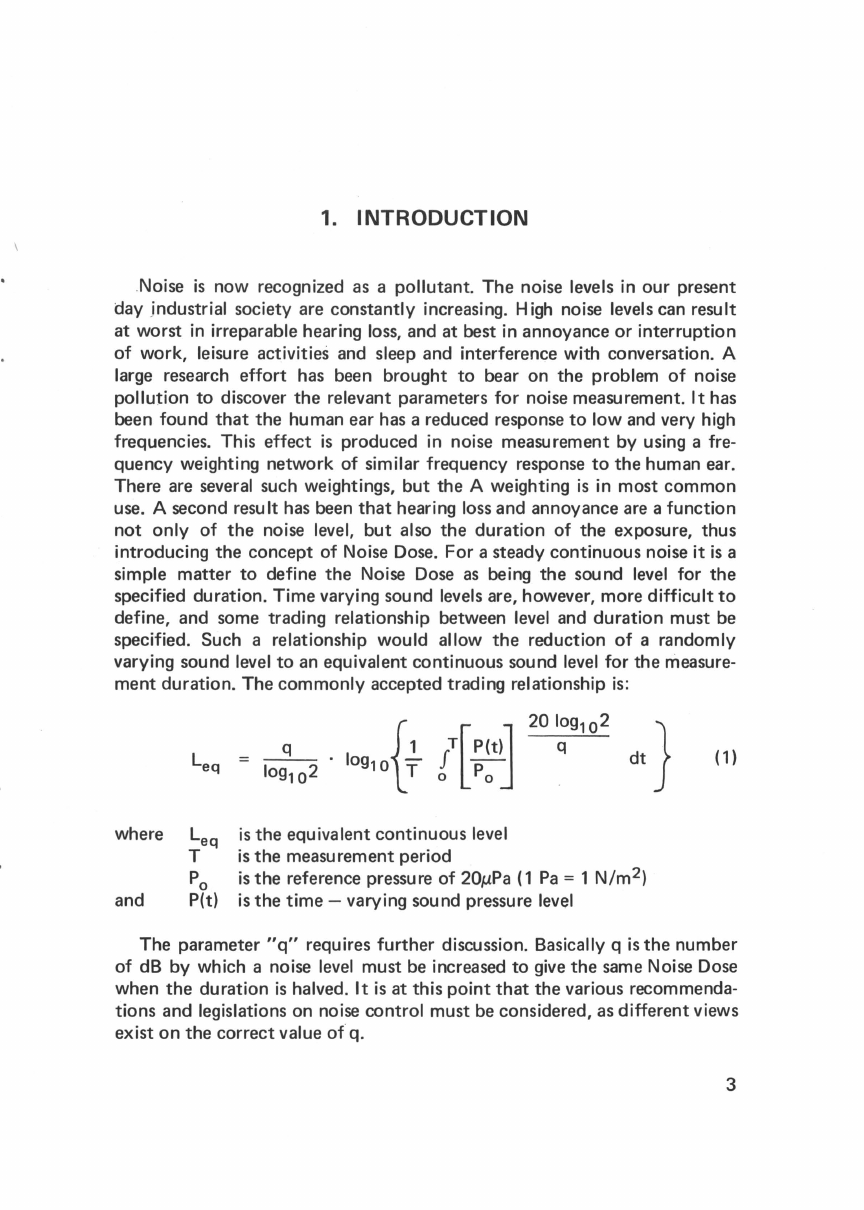
accepted trading relationship is:
(1)
where
Leq
is
the equivalent continuous level
T
is
the measurement period
P
0
is
the reference pressure
of
20MPa
(1
Pa
=1
N/m
2)
and P(t)
is
the
time-
varying sound pressure level
The parameter
"q"
requires
further
discussion. Basically q
is
the number
of
dB
by
which a noise level must
be
increased
to
give the
same
Noise Dose
when the duration
is
halved.
It
is
at this
point
that
the various recommenda-
tions and legislations on noise control must
be
considered,
as
different
views
exist on the correct value
of
q.
3