OvaEasy HATCHER Advance Series 2_V01_GB_NL
10
9 Troubleshooting
9.1 Poor hatching results are frustrating and can be caused by a large number of factors. The most
common are given below. Brinsea Products will not be held responsible for loss of eggs or chicks
under any circumstances. A wealth of advice and information is available on our website:-
www.brinsea.co.uk
9.2 Gather as much information from the hatching results as possible to enable the problem to be
analysed in detail. Record dates that eggs are set, incubator settings, dates of hatches, weight losses
and the number and condition of hatchlings. Candle or break open unhatched eggs to estimate the
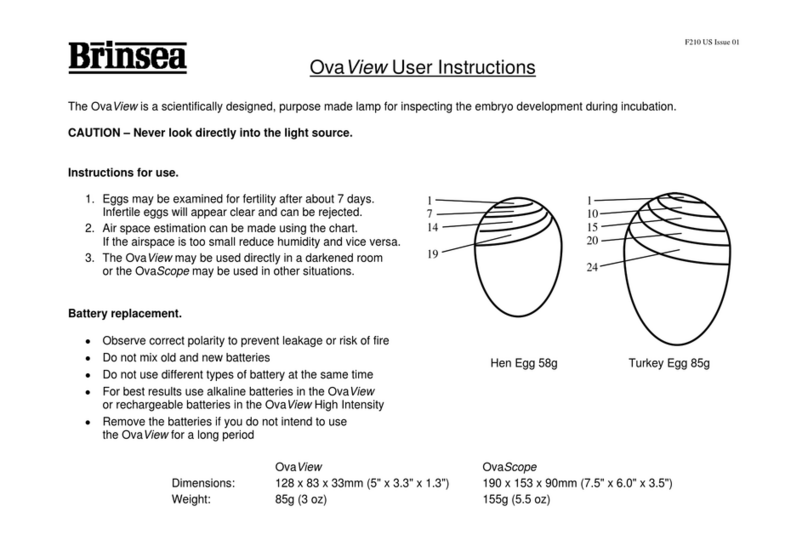
extent of embryo development. The Brinsea OvaView and High Intensity OvaView candling lamps are
available from your dealer.
9.3 Many hatching problems are associated with incorrect humidity during incubation. Consider upgrading
to EX specification to give better control of humidity. Go to www.brinsea.co.uk for details.
1) Clear when candled -
probably infertile (or very
early death) when candled at
8 days
2) Fertile with red blood
vessels - after 8 days
3) Red or black staining -
early death when candled at 8
days
4) Embryo with red blood
‘ring’ - early death when
candled at 8 days
5) Dark outline with ill defined
detail - late death (10-16days)
6) Live embryo with bill in air
sack - due to hatch in 24-48
hours
7) Normal development of the
air pocket according to
number of days
9.4 General guides:
Infertility, infection, drastically
incorrect incubation settings,
parent ill health.
Check egg viability –are similar eggs
hatching naturally. Disinfect the
incubator. Check incubator settings and
procedures –particularly temperature.
Chicks hatch earlier than
expected, deformities.
Incubation temperature too high
Reduce incubation temperature slightly
0.5°C (1°F)
Chicks hatch later than
expected
Incubation temperature too low
Raise incubation temperature slightly
0.5°C (1°F)
Hatch dates widely
spread
Different rates of development
due to different storage times,
incubation temperature
variation.
Limit egg storage times. Check for
incubation temperature variation –
sunlight, large room variation etc.
Late stage ‘death in
shell’
Incorrect humidity, probably too
high.
Try reducing average humidity levels
(but see section 6 above)
Incorrect incubation settings,
poor parent bird health,
inadequate egg turning,
Improve parent bird health, check all
incubation settings, analyse egg weight
loss to confirm humidity correct, check
turning working correctly.