5
ed with this power tool. Failure to follow all instructions listed
below may result in electric shock, re and/or serious injury.
- This power tool is not recommended for polishing.
Operations for which the power tool was not designed may
create a hazard and cause personal injury.
- Do not use accessories which are not specically de-
signed and recommended by the tool manufacturer.
Just because the accessory can be attached to your power
tool, it does not assure safe operation.
- The rated speed of the accessory must be at least equal
to the maximum speed marked on the power tool. Acces-
sories running faster than their rated speed can break and y
apart.
- The outside diameter and the thickness of your acces-
sory must be within the capacity rating of your power tool.
Incorrectly sized accessories cannot be adequately guarded
or controlled.
- The arbor size of wheels, anges, backing pads or any
other accessory must properly t the spindle of the pow-
er tool. Accessories with arbor holes that do not match the
mounting hardware of the power tool will run out of balance,
vibrate excessively and may cause loss of control.
- Do not use a damaged accessory. Before each use in-
spect the accessory such as abrasive wheels for chips
and cracks, backing pad for cracks, tear or excess wear,
wire brush for loose or cracked wires. If power tool or ac-
cessory is dropped, inspect for damage or install an un-
damaged accessory. After inspecting and installing an ac-
cessory, position yourself and bystanders away from the
plane of the rotating accessory and run the power tool at
maximum no-load speed for one minute. Damaged acces-
sories will normally break apart during this test time.
- Wear personal protective equipment. Depending on ap-
plication, use face shield, safety goggles or safety glass-
es. As appropriate, wear dust mask, hearing protectors,
gloves and workshop apron capable of stopping small
abrasive or workpiece fragments. The eye protection must
be capable of stopping ying debris generated by various op-
erations. The dust mask or respirator must be capable of ltrat-
ing particles generated by your operation. Prolonged exposure
to high intensity noise may cause hearing loss.
- Keep bystanders a safe distance away from work area.
Anyone entering the work area must wear personal pro-
tective equipment. Fragments of workpiece or of a broken
accessory may y away and cause injury beyond immediate
area of operation.
- Hold the power tool by insulated gripping surfaces only,
when performing an operation where the cutting acces-
sory may contact hidden wiring or its own cord. Cutting
accessory contacting a “live” wire may make exposed metal
parts of the power tool “live” and could give the operator an
electric shock.
- Position the cord clear of the spinning accessory. If you
- Do not use the appliance if the accessories or consumables
attached to it are defective. Replace them immediately.
- Use the appliance handle/s, to catch it or move it.
- This appliance is for professional use.
- This appliance is not a toy. Children should be supervised to
ensure that they do not play with the appliance.
- Do not expose the appliance to extreme temperatures.
- Do not use separator or reducing bushings, adapters to x
the discs / tools they are not directly compatible with the ap-
pliance.
- Let the appliance running with no load for 30 seconds in a
safe position. If you notice serious vibration or other defects
stop the appliance immediately. Then check the problem and
/or proceed as we describe on Anomalies and Repair clause.
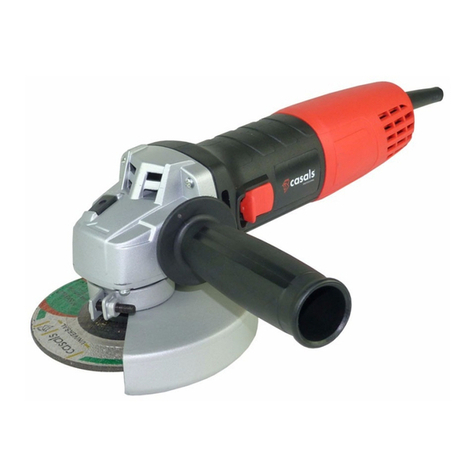
- Do not operate the angle grinder without the auxiliary handle.
- Always check the workpiece before operation and remove
any obstructions such as nails, staples, screws, string, rags,
cloths and other debris.
- Check the position of power cables before commencing work
ensuring they are well away from the work area.
- When using the angle grinder make sure that the workpiece
is securely clamped to a work bench or vice.
- Before cutting ensure there is a suitable gap below the work-
piece to prevent the disc from touching any obstacles.
- Allow the angle grinder to reach it’s optimum speed before
commencing work
- Not recommended for use in conjunction with a cut-off stand.
- Keep hands and other body parts well away from the work
area whist the tool is in use.
- Keep hands and other body parts well away from the discs
while the angle grinder is in use. Do not attempt to remove cut
material whilst the angle grinder is in operation or reach under-
neath for any reason.
- Do not touch the grinding disc after operation. The bit will be
HOT and will burn!
Service
- Have your power tool serviced by a qualied repair per-
son using only identical replacement parts. This will en-
sure that the safety of the power tool is maintained
Any misuse or failure to follow the instructions for use renders
the guarantee and the manufacturer’s liability null and void.
Safety Warnings for Angle Grinder
Safety Warnings Common for Grinding, Sanding, Wire
Brushing, or Abrasive
Cutting-Off Operations
- This power tool is intended to function as a grinder,
sander, wire brush or cut-off tool. Read all safety warn-
ings, instructions, illustrations and specications provid-
lose control of the power tool, the cord may be cut or snagged
and your hand or arm may be pulled into the spinning acces-
sory.
- Never lay the power tool down until the accessory has
come to a complete stop. The spinning accessory may grab
the surface and pull the power tool out of your control.
- Do not run the power tool while carrying it at your side.
Accidental contact with the spinning accessory could snag
your clothing, pulling the accessory into your body.
- Regularly clean the power tool’s air vents. The motor’s
fan will draw the dust inside the housing and excessive ac-
cumulation
of powdered metal may cause electrical hazards.
- Do not operate the power tool near ammable materials.
Sparks could ignite these materials.
- Do not use accessories that require liquid coolants. Us-
ing water or other liquid coolants may result in electrocution
or shock.
Kickback and related warnings
- Kickback is a sudden reaction to a pinched or snagged
rotating wheel, backing pad, brush or any other accessory.
Pinching or snagging causes rapid stalling of the rotating ac-
cessory which in turn causes the uncontrolled power tool to
be forced in the direction opposite of the accessory’s rota-
tion at the point of the binding. For example, if an abrasive
wheel is snagged or pinched by the workpiece, the edge of
the wheel that is entering into the pinch point can dig into
the surface of the material causing the wheel to climb out or
kick out. The wheel may either jump toward or away from the
operator, depending on direction of the wheel’s movement at
the point of pinching. Abrasive wheels may also break under
these conditions.
- Kickback is the result of power tool misuse and/or incor-
rect operating procedures or conditions and can be avoid-
ed by taking proper precautions as given below.
- Maintain a rm grip on the power tool and position
your body and arm to allow you to resist kickback
forces. Always use auxiliary handle, if provided, for
maximum control over kickback or torque reaction
during start-up. The operator can control torque reac-
tions or kickback forces, if proper precautions are taken.
- Never place your hand near the rotating accessory.
Accessory may kickback over your hand.
- Do not position your body in the area where power
tool will move if kickback occurs. Kickback will propel
the tool in direction opposite to the wheel’s movement at
the point of snagging.
- Use special care when working corners, sharp edges,
etc. Avoid bouncing and snagging the accessory. Cor-
ners, sharp edges or bouncing have a tendency to snag
the rotating accessory and cause loss of control or kick-
back.